

Summarize the article with:


Buying a diamond in Canada can be a significant purchase, whether you are choosing an engagement ring, wedding jewelry, or a diamond for everyday wear. With natural and lab-grown diamonds available in a wide range of sizes, shapes, qualities, and prices, understanding what you are actually paying for is essential.
The diamond market also involves technical terminology that can make comparison difficult. Carat weight, cut, colour, clarity, grading reports, diamond origin, and retail pricing all play different roles. A diamond’s appearance alone does not tell you everything about its quality or value.
For Canadian buyers, there are also practical considerations such as applicable sales taxes, retailer policies, warranties, resizing, and the documentation provided with the diamond. Canada’s Competition Bureau regulates certain precious-metal marking and advertising practices, while independent gemological laboratories provide grading and identification information for diamonds.
At Ryan Jeweller, we make it easier to explore diamond jewelry while understanding the details behind your purchase. Whether you are comparing natural or lab-grown diamonds, explore our collection and use this guide to make a more informed decision.
What to Know Before Buying a Diamond in Canada
Before comparing prices, start by understanding the characteristics that determine what you are actually buying.
Understand the 4Cs
The 4Cs are the standard framework used to describe diamond quality:
- Cut
- Colour
- Clarity
- Carat weight
GIA explains that cut can influence brilliance, fire, and scintillation, while colour and clarity describe specific characteristics of the diamond and carat weight measures its weight. gia
These characteristics should be considered together rather than individually.
Carat Does Not Mean Physical Size
Carat measures weight, not the exact visible dimensions of a diamond.
One metric carat equals 0.20 grams. Two diamonds with the same carat weight can have different measurements and may appear different in size depending on their shape and proportions. gia
When comparing diamonds, look at:
- Carat weight
- Length and width
- Depth
- Shape
- Cut proportions
This can give you a better understanding of how large the diamond will appear when set in jewelry.
Consider Diamond Shape
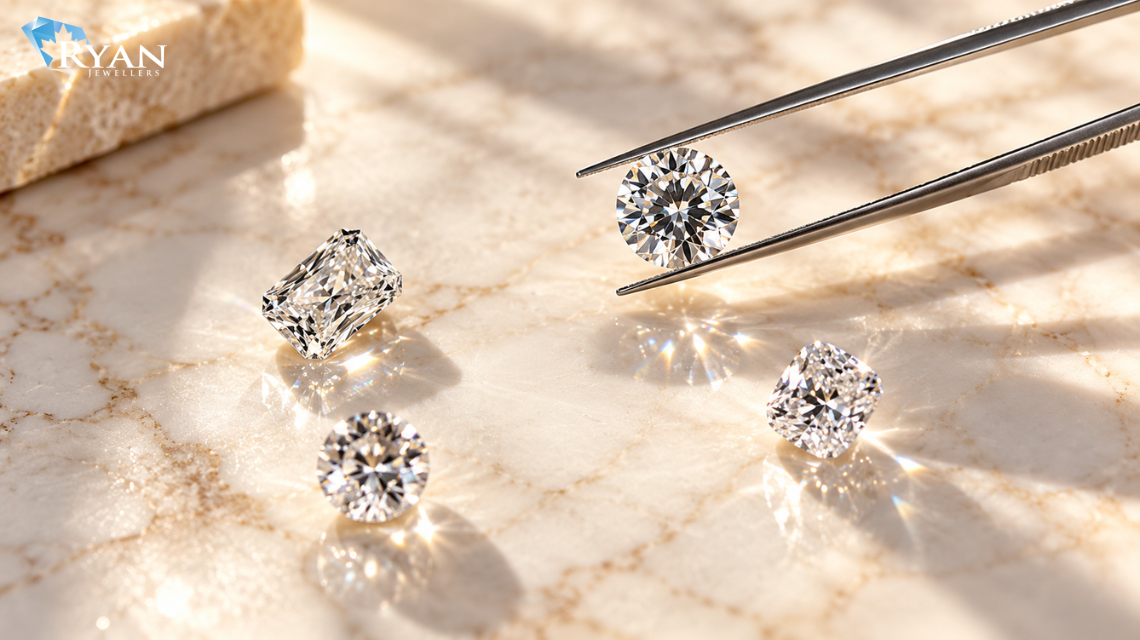
Diamond shape can have a major effect on appearance.
Common options include:
- Round
- Oval
- Pear
- Marquise
- Cushion
- Emerald
- Princess
For example, elongated shapes such as oval and marquise can create substantial face-up coverage relative to their carat weight.
Think About How You Will Wear the Diamond
A diamond intended for everyday wear should be evaluated differently from one purchased primarily for special occasions.
Consider:
- Ring setting
- Protection of the stone
- Prong construction
- Metal type
- Lifestyle
- Maintenance requirements
For an engagement ring, the setting is particularly important because it determines how securely the diamond is held.
If you’re considering whether fine jewelry is worth the investment, explore our Is Buying Fine Jewelry Worth It? guide to learn more about quality, value, craftsmanship, and long-term considerations before making a purchase.
Understanding Diamond Quality and Certification
Documentation is an important part of buying a diamond, particularly for higher-value purchases.
What Is a Diamond Grading Report?
A diamond grading report provides technical information about the characteristics of a diamond.
For example, a GIA Diamond Grading Report includes a full assessment of the 4Cs for eligible natural diamonds, along with measurements and identifying information.
A grading report should not be confused with an appraisal.
GIA specifically explains that its reports provide technical information but do not state an appraisal value. gia
Why a Grading Report Matters
Diamond characteristics can be difficult to evaluate accurately simply by looking at a stone.
A report allows buyers to compare documented characteristics rather than relying entirely on visual impressions or sales descriptions.
When purchasing a diamond, check that:
- The report number matches the documentation
- The diamond’s characteristics match the report
- The grading organization is clearly identified
- The report is current and verifiable
GIA also provides a report-checking service that allows users to verify report information against its database. gia
Natural Diamond Reports
For natural diamonds, grading reports can document:
- Carat weight
- Colour
- Clarity
- Cut
- Measurements
- Shape
- Other identifying characteristics
GIA currently offers several natural diamond report formats depending on the stone’s characteristics and weight.
Lab-Grown Diamond Documentation
Lab-grown diamonds can also be analyzed and identified by gemological laboratories.
GIA has graded laboratory-grown diamonds since 2007 and uses specialized testing to distinguish laboratory-grown diamonds from natural diamonds.
When purchasing a lab-grown diamond, look for clear disclosure of its origin and supporting documentation where provided.
Natural vs Lab-Grown Diamonds in Canada
Canadian buyers can choose between natural and laboratory-grown diamonds depending on their preferences, priorities, and budget.
What Is a Natural Diamond?
Natural diamonds form through geological processes deep within the Earth over extremely long periods.
They are recovered through mining and then cut and polished for use in jewelry.
Canada is also an important diamond-producing country. Natural Resources Canada reported approximately $1.52 billion in Canadian domestic exports of diamonds and diamond products in 2024.
What Is a Lab-Grown Diamond?
Laboratory-grown diamonds are produced using technological processes that replicate the conditions needed for diamond growth.
Two major production methods are:
- HPHT — High Pressure High Temperature
- CVD — Chemical Vapor Deposition
GIA notes that laboratory-grown diamonds can be identified through advanced testing and that its laboratory-grown diamond documentation can identify the growth process and disclose certain treatments.
Are Lab-Grown Diamonds Real Diamonds?
Laboratory-grown diamonds have the same basic crystal structure and chemical composition as natural diamonds. However, their origins are different.
The distinction is therefore about origin, not simply whether the material is diamond.
Canadian consumer guidance also emphasizes clear terminology and disclosure so buyers understand whether they are purchasing natural or laboratory-grown material.
Comparing Natural and Lab-Grown Diamonds
| Factor | Natural Diamond | Lab-Grown Diamond |
|---|---|---|
| Origin | Formed naturally in the Earth | Produced in a controlled laboratory environment |
| Material | Diamond | Diamond |
| Growth process | Geological | HPHT or CVD |
| 4Cs | Used to describe quality | Quality characteristics can also be evaluated |
| Identification | Gemological testing available | Advanced testing can identify laboratory-grown origin |
| Pricing | Determined by market and characteristics | Determined by market, characteristics, production, and retailer |
| Availability | Dependent on natural supply | Production can provide additional supply |
Neither category should be evaluated solely by appearance. Compare origin, quality, documentation, design, and price together.
If you’re considering whether gold jewelry is worth buying, explore our Is Gold Jewelry Worth Buying? guide to learn about gold purity, quality, value, and the factors to consider before making a purchase.
How Diamond Prices Work in the Canadian Market
Diamond pricing is not based on carat weight alone.
A diamond’s price can be influenced by:
- Carat weight
- Cut
- Colour
- Clarity
- Shape
- Natural or laboratory-grown origin
- Market conditions
- Certification
- Retailer
- Setting
- Metal
- Design and craftsmanship
Why Larger Diamonds Cost More
Larger diamonds are generally less common than smaller diamonds with comparable characteristics.
GIA notes that prices per carat can increase around commonly targeted weight thresholds such as 1.00, 1.50, and 2.00 carats. A diamond slightly below one of these thresholds may have a similar visual appearance while being priced differently.
Therefore, comparing a 0.95-carat diamond with a 1.00-carat diamond can sometimes reveal meaningful differences in price relative to visible size.
Cut Can Influence Value
Two diamonds with identical carat weight can have different prices because their cut, colour, clarity, and other characteristics differ.
GIA notes that cut affects a diamond’s brilliance, fire, and scintillation.
This means it can be useful to consider visual performance rather than simply selecting the highest carat weight within a budget.
Natural and Lab-Grown Pricing
Natural and lab-grown diamonds have different supply structures and market dynamics, so their prices should not be assumed to follow exactly the same pattern.
If your priority is maximizing diamond size within a specific jewelry budget, comparing both categories may give you more options.
Remember Canadian Sales Taxes
The final amount paid by a Canadian customer can depend on the applicable tax rules and place of supply.
The Canada Revenue Agency currently lists different GST/HST rates depending on where a taxable supply is made. For example, the federal GST is 5% in non-participating provinces, while HST rates vary by participating province.
When comparing jewelry prices, therefore, consider the final purchase cost, not just the advertised product price.
If you want to avoid costly errors when shopping for a diamond, explore our Diamond Buying Mistakes Guide to learn about common pitfalls and how to make a more informed purchase.
Tips for Choosing a Trusted Diamond Retailer
The retailer you choose can affect everything from product information to after-sales service.
Look for Transparent Diamond Information
A reputable retailer should clearly identify relevant information about the diamond.
Depending on the product, this can include:
- Natural or lab-grown origin
- Carat weight
- Colour
- Clarity
- Cut
- Shape
- Measurements
- Grading documentation
Be cautious of product descriptions that emphasize marketing language without providing useful specifications.
Check the Retailer’s Policies
Before purchasing an expensive diamond or engagement ring, review:
- Return policy
- Exchange policy
- Resizing policy
- Warranty
- Repair services
- Shipping
- Insurance responsibilities
This is particularly important when purchasing online.
Ask About Certification
For a significant diamond purchase, ask whether the stone comes with an independent grading report.
You should also be able to verify the report information where the grading laboratory provides a verification service.
Understand Precious-Metal Markings
If the diamond is mounted in gold, platinum, or another precious metal, check the stated metal quality.
In Canada, precious-metal quality marks are not mandatory in every case. However, when a quality mark is used, it must accurately represent the metal quality and comply with applicable requirements.
For example, Canadian requirements recognize gold quality indicators including:
- 10K / .416
- 14K / .583
- 18K / .750
- 22K / .916
and silver can be marked .925 when the applicable requirements are met.
Consider After-Sale Support
Diamond jewelry is intended to be worn and maintained over time.
Ask whether the retailer provides services such as:
- Cleaning
- Inspection
- Repairs
- Resizing
- Stone-setting checks
- Warranty support
A retailer’s support after the transaction can be just as important as the initial purchase experience.
Compare the Complete Package
Rather than comparing only two advertised prices, compare what is actually included.
For example:
| Factor | What to Compare |
|---|---|
| Diamond | 4Cs, shape, dimensions |
| Origin | Natural or lab-grown |
| Documentation | Grading report and verification |
| Metal | Type and purity |
| Setting | Construction and craftsmanship |
| Size | Ring, bracelet, necklace, or earring measurements |
| Services | Resizing, warranty, repairs |
| Final cost | Product price plus applicable taxes and fees |
This gives you a more meaningful comparison between retailers.
If you’re looking for inspiration when shopping for men’s jewelry in Canada, explore our Best Men’s Jewelry in Canada Guide to discover popular styles and practical tips for choosing the right piece.
FAQ About Buying Diamonds in Canada
What should I look for when buying a diamond in Canada?
Start with the diamond’s 4Cs, shape, dimensions, origin, grading documentation, and price. Also consider the setting, metal, retailer policies, and after-sales services.
Are lab-grown diamonds available in Canada?
Yes. Canadian consumers can purchase laboratory-grown diamonds through jewelry retailers. When shopping, look for clear disclosure that the diamond is laboratory-grown and review any available grading or identification documentation.
Are lab-grown diamonds real diamonds?
Laboratory-grown diamonds are diamonds, but they have a different origin from natural diamonds. Advanced gemological testing can distinguish laboratory-grown diamonds from natural diamonds. gia
Do I need a diamond grading report?
A grading report can be particularly useful for a significant purchase because it provides independent technical information about a diamond’s characteristics.
Is a diamond grading report the same as an appraisal?
No. A grading report documents characteristics such as the 4Cs, while an appraisal is an assessment of value for a specific purpose. GIA does not provide appraisal values on its grading reports.
What is the most important of the 4Cs?
There is no single characteristic that is universally most important. Cut can have a major influence on brilliance and visual performance, while carat, colour, and clarity also affect appearance and price. The appropriate balance depends on your priorities and budget.
Should I buy a natural or lab-grown diamond?
Consider origin, quality, documentation, design, and price. Natural and laboratory-grown diamonds are different categories with different origins and market characteristics, so your choice depends on what matters most to you.
Are diamond prices the same across Canada?
No. Retail prices can vary between sellers based on diamond characteristics, retailer pricing, design, services, and other factors. Applicable sales taxes can also vary by province or territory.
How can I compare two diamonds fairly?
Compare the same characteristics: origin, carat, cut, colour, clarity, shape, dimensions, grading documentation, and setting. Comparing only carat weight or total price can produce a misleading comparison.
Should I buy a diamond online in Canada?
Online purchasing can be convenient, but review the retailer’s product information, grading documentation, return policy, resizing terms, warranty, shipping, and customer support before completing the purchase.
Final Thoughts
Buying diamonds in Canada becomes much easier when you understand what is behind the price. Instead of focusing only on carat weight or the appearance of a stone, consider the 4Cs, diamond origin, dimensions, grading documentation, setting, metal, retailer policies, and total purchase cost.
For natural and lab-grown diamonds alike, transparent information is essential. A grading report can help document diamond characteristics, while Canadian regulations provide requirements around accurate precious-metal markings and consumer information.
Take time to compare your options, ask questions, and consider how the diamond will fit your lifestyle and jewelry design.
At Ryan Jeweller, we help Canadian customers explore diamond jewelry with a focus on quality, craftsmanship, and informed purchasing.
This is a useful guide for anyone considering buying a diamond in Canada. I especially liked the reminder to look beyond carat weight and compare factors such as cut, clarity, colour, certification, and overall value.
I found the practical buying considerations particularly helpful. Having a clear understanding of diamond certification and the different quality characteristics can make it easier to compare stones from different jewellers.
The Canada-specific information makes this a helpful reference when researching diamonds locally. I appreciate the emphasis on checking documentation, comparing quality factors, and considering the overall purchase rather than focusing on price alone.