

Summarize the article with:


Understanding diamond anatomy is an important step in becoming a confident diamond buyer. While many people focus on the 4Cs—cut, color, clarity, and carat—knowing how a diamond is physically structured helps explain why some diamonds appear brighter, more brilliant, and more valuable than others.
For Canadian buyers, learning the different parts of a diamond makes it easier to evaluate quality, compare options, and choose a piece that matches both personal preferences and budget.
At Ryan Jewellers, we provide high-quality diamond jewelry and expert guidance to help you understand every detail behind your purchase.
Understanding Diamond Anatomy Basics
Diamond anatomy refers to the different sections and features that make up a polished diamond. Each part plays a role in how light enters, reflects, and exits the stone, directly affecting its sparkle and overall appearance.
A well-cut diamond is carefully shaped and polished to maximize light performance. Even diamonds with excellent color and clarity may appear less brilliant if the proportions and angles are not properly balanced.
The main parts of a diamond include:
- Table: The largest flat surface on the top of the diamond
- Crown: The upper section between the table and girdle
- Girdle: The narrow edge separating the crown and pavilion
- Pavilion: The lower section that reflects light back through the top
- Culet: The small point or facet at the bottom of the diamond
Each component works together to influence brilliance, fire, and overall beauty.
👉 Discover our curated selection of lab-created diamond rings here: Lab-Created Diamond Rings
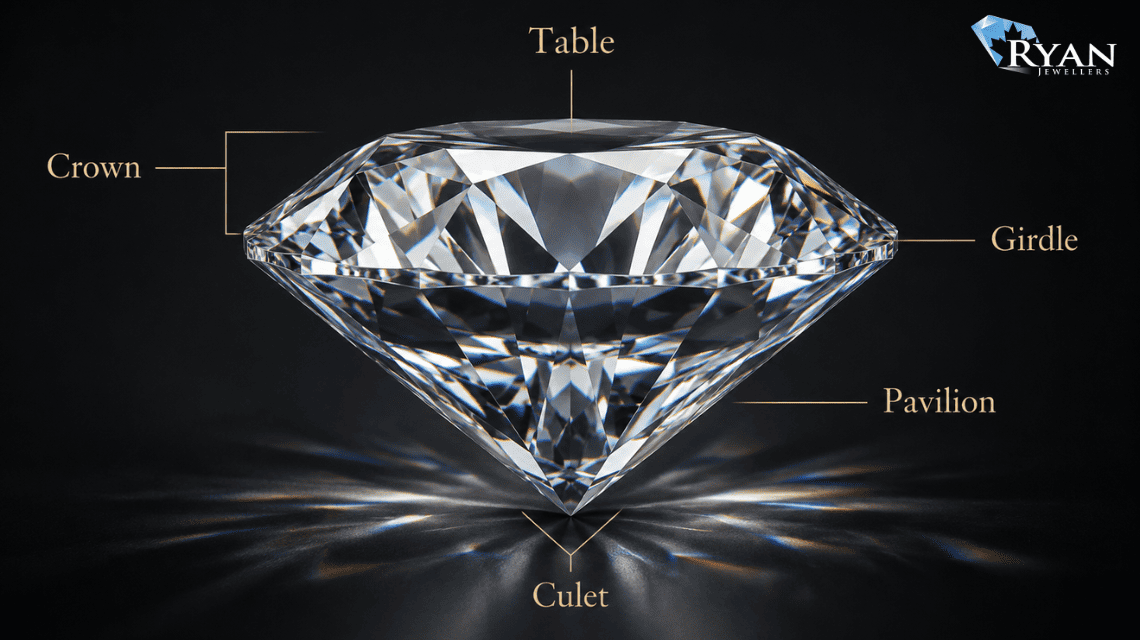
Table, Crown, Pavilion, and Girdle Explained
Table
The table is the largest flat facet on the top of a diamond. It allows light to enter the stone and plays a major role in how much brilliance the diamond displays.
A properly proportioned table helps balance light reflection and creates a bright appearance. If the table is too large or too small, it can affect the diamond’s ability to reflect light effectively.
Crown
The crown is the upper portion of the diamond between the table and the girdle. It contains several angled facets that help separate white light into flashes of color, known as fire.
A well-designed crown contributes to:
- Brightness
- Color flashes
- Visual depth
The crown angle and facet arrangement are important factors when evaluating diamond cut quality.
Pavilion
The pavilion is the lower portion of the diamond beneath the girdle. Its angled facets are responsible for reflecting light back toward the viewer.
A properly cut pavilion allows light to travel through the diamond and return through the top. If pavilion angles are too shallow or too deep, light may escape through the bottom, reducing brilliance.
Girdle
The girdle is the narrow area that separates the crown from the pavilion. It helps protect the diamond from damage and provides a surface for setting the stone into jewelry.
Girdles can be:
- Thin
- Medium
- Slightly thick
- Thick
A well-balanced girdle provides durability while maintaining the diamond’s appearance.
The Importance of Cut and Angles
Diamond cut is one of the most important factors affecting beauty and sparkle. It refers not only to the diamond’s shape but also to how precisely it has been cut and polished.
The relationship between different angles determines how efficiently the diamond handles light.
A well-cut diamond:
- Reflects more light
- Appears brighter
- Creates stronger sparkle
- Shows better visual balance
A poorly cut diamond may appear dull even if it has excellent color and clarity grades.
For buyers comparing diamonds, understanding anatomy helps explain why two diamonds with similar specifications can look noticeably different.

How Anatomy Impacts Sparkle
A diamond’s sparkle comes from three main visual effects:
Brilliance
The amount of white light reflected from the diamond. Proper proportions between the table, crown, and pavilion maximize brightness.
Fire
The flashes of rainbow colors created when light passes through the diamond’s facets.
Scintillation
The flashes of light seen when the diamond moves or when the viewer changes position.
Diamond anatomy directly influences all three effects. The precision of the cut determines whether light is reflected back beautifully or lost through the sides and bottom of the stone.
Choosing Diamonds Based on Anatomy
When selecting a diamond, anatomy should be considered alongside the traditional 4Cs.
Helpful tips include:
- Prioritize Cut Quality: A well-cut diamond often provides more visual impact than a larger diamond with weaker proportions.
- Review Certification: Certified diamonds provide important information about cut quality and characteristics.
- Consider Diamond Shape: Different shapes have unique facet patterns and anatomy, affecting sparkle and appearance.
- Balance Beauty and Budget: Understanding anatomy helps you choose a diamond that looks impressive without overspending.
For Canadian buyers, education and careful comparison are key to finding a diamond that offers both beauty and value.
👉 Explore our stunning collection of diamond earrings here: Diamond Earrings
👉 Learn more about diamond quality, grading, and buying tips in our complete guide: Diamond Education: The Ultimate Guide to Understanding Diamonds
FAQ – Diamond Anatomy Explained
Why is diamond anatomy important?
Diamond anatomy explains how different parts of the stone affect light reflection, sparkle, and overall appearance.
Does diamond anatomy affect price?
Yes. Well-cut diamonds with optimized proportions often command higher value because of their superior brilliance.
What part of a diamond creates the most sparkle?
The interaction between the table, crown, pavilion, and overall cut quality determines how much sparkle a diamond produces.
Is diamond cut the same as diamond shape?
No. Shape refers to the outline of the diamond, while cut refers to the quality of its proportions, angles, and polish.
Should I consider anatomy when buying a lab-grown diamond?
Yes. Lab-grown diamonds have the same physical properties as natural diamonds, so cut quality and anatomy remain important factors.
Final Thoughts
Understanding diamond anatomy allows buyers to look beyond appearance and make more informed decisions. Every part of a diamond—from the table and crown to the pavilion and girdle—plays a role in creating brilliance, durability, and long-term beauty.
At Ryan Jewellers, we help Canadian buyers explore high-quality diamond jewelry with confidence by providing carefully selected pieces and valuable diamond education.
Really enjoyed this article because it breaks down diamond anatomy into simple, easy-to-understand terms. I especially liked the explanation of the table, crown, pavilion, and girdle, and how each part contributes to a diamond’s brilliance. It’s a fantastic resource for anyone wanting to understand what they’re paying for before buying diamond jewelry.
Fantastic guide with clear illustrations and practical explanations. The point that a diamond’s proportions work together to influence sparkle really stood out to me because many people focus only on carat weight or clarity. Do you think more first-time buyers in Canada are starting to pay closer attention to cut quality and diamond anatomy before making a purchase?
This was a very informative read. I completely agree that understanding a diamond’s anatomy helps shoppers appreciate why two diamonds with similar specifications can look so different. I’d love to see a future article explaining how each part of a diamond affects light performance, including brilliance, fire, and scintillation, with real comparison examples.