
Summarize the article with:


Choosing the right watch size is about more than case diameter. Wrist circumference, lug-to-lug length, case thickness, bracelet or strap width, and overall proportions all affect how a watch looks and feels. For Canadian buyers, understanding these measurements before purchasing can make it easier to find a watch that is comfortable, balanced, and appropriate for everyday wear.
If you are comparing different watches, Ryan Jeweller offers a convenient starting point for exploring styles, proportions, and luxury timepieces.
What Watch Size Is Right for Your Wrist?
There is no universal watch size that works perfectly for every wrist. Personal preference matters, but proportion is usually more useful than following a strict size chart.
As a general reference:
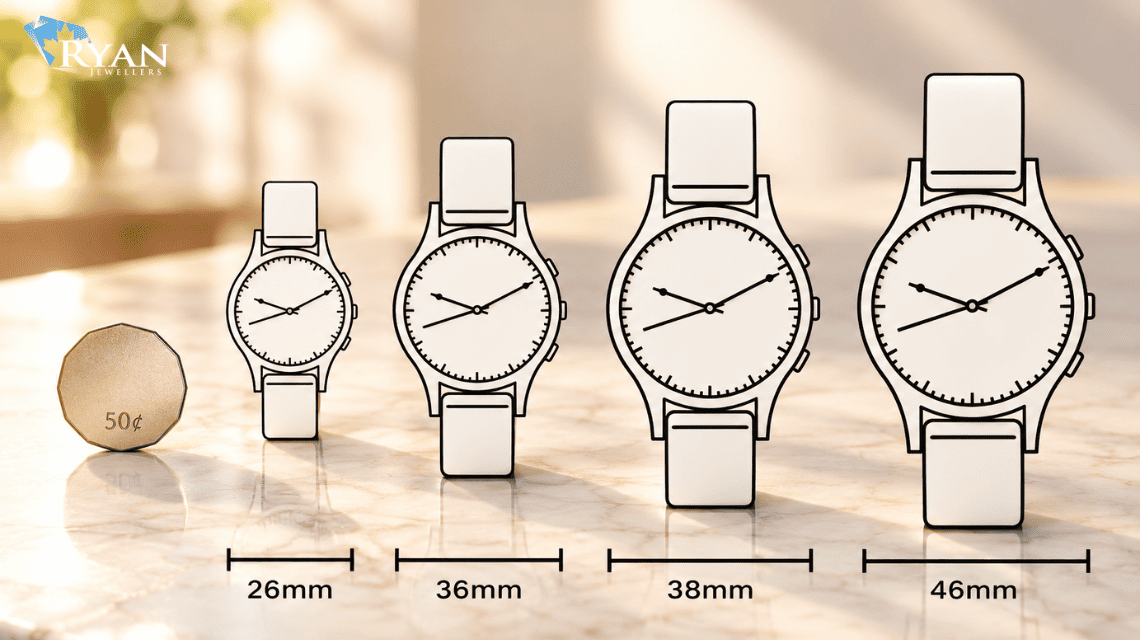
- Small watches: often under 36 mm
- Medium watches: approximately 36–40 mm
- Large watches: approximately 41–44 mm
- Oversized watches: generally 45 mm and above
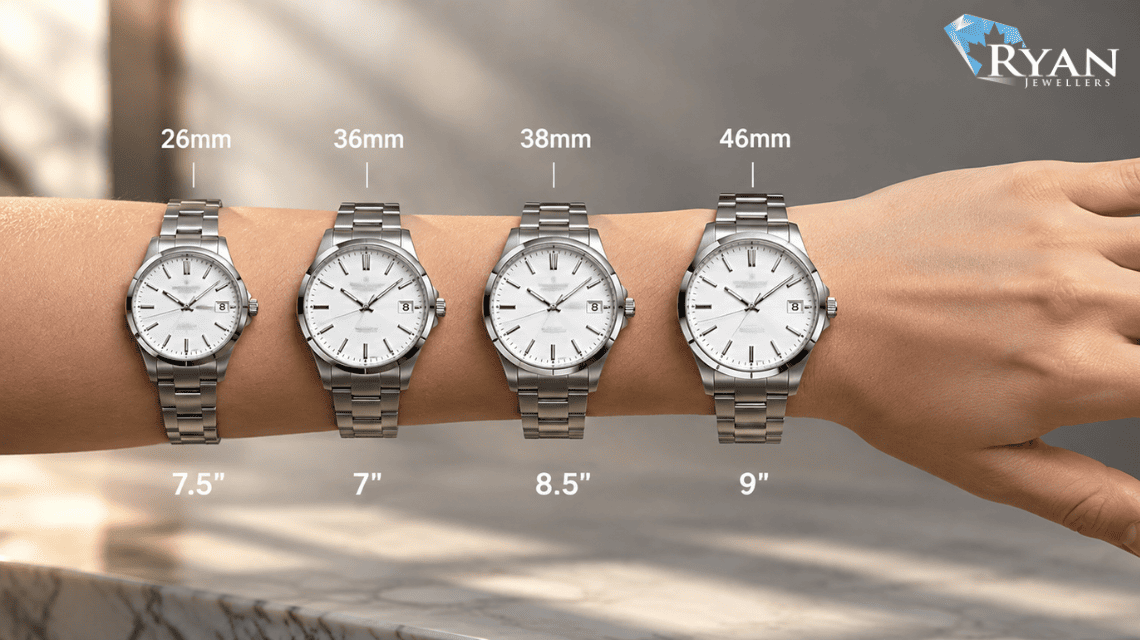
These categories are only guidelines. A 40 mm watch with short lugs can wear smaller than a 38 mm watch with long lugs, while a thick case can make a watch feel substantially larger.
Small Watches
Smaller watches can create a refined and understated appearance. They are often comfortable for people with smaller wrists, but they can also work well for anyone who prefers classic proportions.
Vintage-inspired watches frequently use smaller case diameters than many contemporary sports watches.
Medium Watches
Medium-sized watches provide a versatile middle ground.
A watch around 36–40 mm can work well for:
- Business clothing
- Casual outfits
- Everyday wear
- Formal occasions
This range is popular because it can provide sufficient dial visibility without overwhelming the wrist.
Large Watches
Larger watches create more wrist presence and are common among sports, diving, and modern luxury models.
They can be particularly suitable if you prefer:
- Large dials
- Strong visual presence
- Sport-oriented designs
- Larger complications
However, diameter should always be evaluated together with lug-to-lug length and thickness.
Oversized Watches
Cases above approximately 45 mm are generally considered oversized.
These watches can make a strong statement, but they may be less comfortable on smaller wrists. Long lugs can also cause the watch to extend beyond the edges of the wrist.
The best approach is to try the watch on rather than relying exclusively on the number printed in the specifications.
How Do Case Diameter, Thickness, and Lug-to-Lug Length Affect Fit?
Three measurements are particularly useful when evaluating watch size: case diameter, case thickness, and lug-to-lug length.
Case Diameter
Case diameter measures the width of the watch case, usually excluding the crown.
It is the measurement most commonly used to describe watch size.
However, diameter alone does not tell you exactly how a watch will wear.
For example, two 40 mm watches can have very different wrist presence if one has:
- Shorter lugs
- A thinner case
- A narrower bezel
while the other has:
- Long lugs
- A thick case
- A wide bracelet
Case Thickness
Case thickness measures how deep the watch is from the crystal to the case back.
Thickness affects:
- Comfort
- Visual weight
- How easily the watch fits under a cuff
- How high the watch sits on the wrist
Dress watches often use thinner cases, while diving and sports watches can be substantially thicker because of their construction and functions.
Lug-to-Lug Length
Lug-to-lug length is the distance between the outermost points of the watch’s lugs.
This measurement is particularly important for determining whether a watch visually fits across your wrist.
A watch can have a relatively modest case diameter but still wear large if the lugs extend significantly outward.
Ideally, the lugs should sit comfortably within the width of your wrist rather than visibly overhang it.
Bezel Width
The bezel also affects perceived size.
A wider bezel can make the dial appear smaller even when the overall case diameter is relatively large.
A thin bezel can create the impression of a larger dial and greater visual presence.
Dial Size
The visible dial area affects how large a watch appears.
Two watches with identical case diameters can look very different if one has a wide bezel and the other has a narrow bezel.
This is another reason why case diameter should not be used as the only measurement.
Crown Size
The crown can also influence comfort.
A large crown may increase the overall visual presence of the watch and can potentially press against the wrist depending on the case design and how the watch sits.
How Do You Measure Your Wrist for a Watch?
Measuring your wrist is straightforward and can give you a useful starting point before shopping.
Step 1: Use a Flexible Measuring Tape
Wrap a flexible measuring tape around the part of your wrist where you normally wear a watch.
Keep the tape comfortably snug without pulling it tightly.
Record the circumference in millimetres or centimetres.
Step 2: Use String if You Do Not Have a Tape
If you do not have a flexible measuring tape, use a piece of string.
Wrap it around your wrist, mark where the ends meet, and then measure the string against a ruler.
Step 3: Measure Your Wrist Width
For a more detailed assessment, measure the width of your wrist across the top.
This can help you understand how the watch case will visually sit across your wrist.
Step 4: Compare the Watch’s Measurements
Do not compare your wrist circumference directly with case diameter.
Instead, look at:
- Case diameter
- Lug-to-lug length
- Case thickness
- Bracelet or strap width
These measurements together provide a much better indication of how the watch will wear.
Wrist Measurement Is Only a Starting Point
Two people with the same wrist circumference can wear the same watch differently.
Wrist shape, personal preference, case design, and bracelet construction all influence comfort.
Therefore, use measurements to narrow your options rather than treating them as absolute rules.
What Is the Difference Between Small, Medium, and Large Watches?
Watch-size categories are not officially standardized across the entire industry. Different brands and retailers may classify sizes differently.
Still, the following framework can be useful:
| Watch Size | Approximate Case Diameter | General Characteristics |
|---|---|---|
| Small | Under 36 mm | Understated, classic, compact |
| Medium | 36–40 mm | Versatile, balanced, everyday |
| Large | 41–44 mm | Stronger wrist presence |
| Oversized | 45 mm+ | Bold, substantial appearance |
These measurements should not be treated as strict rules.
Small vs. Medium
A small watch can feel elegant and discreet.
A medium watch generally offers more dial visibility and can work across a broader range of clothing.
Medium vs. Large
The difference can be surprisingly noticeable.
A few millimetres can change the visual balance of the watch, particularly when combined with a thicker case or wider bracelet.
Large vs. Oversized
Oversized watches tend to dominate the wrist.
They can be appropriate for bold sports-oriented styles but may be less versatile for formal clothing.
Vintage vs. Modern Proportions
Historical watches were often smaller than many contemporary models.
As a result, a 34–36 mm vintage-inspired watch can look completely intentional rather than undersized.
Modern sports watches, meanwhile, often use larger cases because of their functional design.
How Should a Watch Bracelet or Strap Fit?
Case size is only one part of comfort. The bracelet or strap also needs to fit correctly.
Bracelet Fit
A metal bracelet should sit securely around the wrist without being excessively tight.
You should generally be able to move your wrist naturally without the bracelet digging into your skin.
A bracelet that is too loose can allow the watch to slide around excessively.
Strap Fit
Leather, rubber, fabric, and synthetic straps should provide secure contact without restricting circulation.
The correct fit depends partly on the material because different straps flex and wear differently.
Leave Room for Movement
Your wrist can change slightly in size throughout the day because of temperature, activity, and other factors.
A watch should therefore not be fitted so tightly that normal wrist movement becomes uncomfortable.
Bracelet Links
Metal bracelets can often be adjusted by removing or adding links.
Some watches also provide micro-adjustment positions within the clasp.
These small adjustments can make a significant difference to comfort.
Strap Width
The strap should generally look proportionate to the case.
A very narrow strap can make a large watch appear top-heavy, while an excessively wide strap can overwhelm a smaller case.
Lug Design
The shape and angle of the lugs determine how the strap or bracelet follows your wrist.
Curved or downward-facing lugs can help a relatively large case sit more comfortably on a smaller wrist.
How Should Watch Size Match Your Personal Style?
The correct size is not purely a measurement question. Your preferred aesthetic also matters.
Classic and Dress Watches
A smaller or medium-sized watch can complement formal clothing.
Slim cases and restrained dials tend to work well with:
- Suits
- Dress shirts
- Business attire
- Formal occasions
Sports Watches
Sports watches often use larger cases.
The additional size can accommodate:
- Rotating bezels
- Chronograph functions
- Increased water resistance
- Larger crowns
- Greater dial legibility
Luxury Watches
Luxury watches are available in a wide range of sizes.
Instead of choosing a larger case simply because the watch is expensive, consider whether the proportions suit your wrist and wardrobe.
Everyday Watches
For an everyday watch, versatility is often more important than maximum size.
A moderate case with a neutral dial and comfortable bracelet can work across different settings.
Statement Watches
If you want the watch to be a major part of your outfit, a larger case can provide stronger visual impact.
However, make sure the dimensions remain comfortable.
How Does Watch Size Affect Comfort?
A watch’s dimensions can influence how it feels throughout the day.
Weight
Materials such as gold and platinum are relatively dense, so watches made from them can feel heavier than comparable watches made from stainless steel or titanium.
Thickness
A thick watch may feel more noticeable on the wrist and can interact with clothing cuffs.
Lug Shape
Lugs that curve toward the wrist can improve the fit of larger cases.
Straight, extended lugs may make a watch feel larger.
Bracelet Flexibility
A bracelet with flexible links can follow the wrist more naturally than a rigid construction.
Centre of Gravity
A heavy case combined with a lightweight strap can cause the watch to rotate or move.
A balanced bracelet or strap can help keep the watch positioned comfortably.
Watch Size Guide by Wrist Circumference
Wrist circumference can provide a useful starting point, although there is no official universal sizing formula.
A general framework might look like this:
| Wrist Circumference | Starting Case Range |
|---|---|
| Under 15 cm | 32–38 mm |
| 15–17 cm | 34–40 mm |
| 17–19 cm | 36–42 mm |
| 19–21 cm | 38–44 mm |
| Over 21 cm | 40 mm+ |
These are starting ranges rather than rules.
For example, someone with a 16 cm wrist may comfortably wear a 42 mm sports watch if it has short, curved lugs. Another person with the same wrist circumference may prefer a 36 mm watch.
Lug-to-lug length can therefore be more useful than diameter when determining whether a watch will physically fit across the wrist.
If you want a more detailed overview before making a purchase, read our Watch Buying Guide for practical advice on movements, sizing, materials, features, and budget.
FAQ About Watch Sizes
What is the best watch size for a small wrist?
Smaller or medium-sized watches can often provide balanced proportions, but case diameter should be evaluated together with lug-to-lug length and thickness.
Is a 40 mm watch too large for a small wrist?
Not necessarily. A 40 mm watch with short lugs and a curved case can wear comfortably on a smaller wrist.
Is a 36 mm watch too small for a large wrist?
Not necessarily. Smaller watches can create a classic and understated appearance on larger wrists.
What is the most versatile watch size?
There is no universal answer, but watches around the mid-30s to low-40s millimetre range can offer considerable versatility depending on case proportions and personal style.
Should the lugs extend beyond my wrist?
Ideally, the lugs should not visibly overhang the edges of your wrist. However, wrist shape and personal preference also matter.
Is case diameter or lug-to-lug length more important?
Both matter, but lug-to-lug length can be particularly useful for determining whether the watch physically fits across your wrist.
How do I measure my wrist for a watch?
Wrap a flexible measuring tape or piece of string around your wrist where you normally wear your watch. Record the circumference and then compare it with the watch’s case and lug dimensions.
Does watch thickness matter?
Yes. Thickness affects how high the watch sits on the wrist, how it feels during movement, and how easily it fits beneath clothing.
Should a watch be tight on the wrist?
No. It should be secure without being uncomfortably tight. Your wrist naturally changes slightly throughout the day.
How loose should a watch bracelet be?
A bracelet should allow comfortable movement without allowing the watch to slide excessively around the wrist.
Is a metal bracelet better than a leather strap?
Neither is universally better. Metal bracelets can be durable and versatile, while leather straps can provide a traditional or dressier appearance.
Can a large watch be comfortable on a small wrist?
Yes, depending on the case shape, lug-to-lug length, thickness, weight, and bracelet or strap.
Does a wider strap make a watch look smaller?
A wider strap can create a more balanced appearance on a larger case, while a narrow strap can emphasize the size of the watch.
Are vintage watches usually smaller?
Many vintage watches use smaller case diameters than contemporary sports and luxury watches, although sizes vary significantly by era, brand, and model.
Does watch size affect value?
Case size itself does not determine the value of a watch. Brand, model, movement, materials, condition, rarity, provenance, and market demand can all influence value.
Should I choose a watch based only on my wrist size?
No. Wrist size is only one consideration. Your lifestyle, clothing, comfort preferences, watch style, movement, and intended use should also influence the decision.
How can I tell if a watch looks too big?
If the lugs visibly extend beyond your wrist, the case feels uncomfortable, or the watch overwhelms your overall proportions, you may want to consider a smaller or differently shaped case.
Can I wear different watch sizes?
Absolutely. You may prefer a smaller dress watch for formal occasions and a larger sports watch for casual or outdoor use.
Final Thoughts
Finding the right watch size is ultimately about proportion, comfort, and personal preference rather than following one universal measurement.
Start by measuring your wrist, then examine the watch’s case diameter, lug-to-lug length, thickness, strap or bracelet width, and overall case shape. These measurements provide a much more accurate picture of how a watch will actually wear.
If you are unsure between two sizes, trying both on can be the most useful comparison. Pay attention to whether the lugs sit comfortably within your wrist, whether the case feels balanced, and whether the bracelet or strap allows natural movement.
Remember that a smaller watch is not automatically more appropriate for a smaller wrist, and a larger wrist does not require an oversized watch. Your personal style and the design of the timepiece are equally important.
For Canadian buyers, material choice can also affect the overall wearing experience. Stainless steel, titanium, gold, platinum, and ceramic all have different characteristics relating to weight, durability, appearance, and maintenance.
The ideal watch is ultimately the one that feels comfortable, looks proportionate, and fits naturally into your lifestyle.
If you’re ready to compare different watch styles and find a timepiece that fits your wrist and personal aesthetic, explore Ryan Jeweller for more fine jewelry and watch options.