
Summarize the article with:


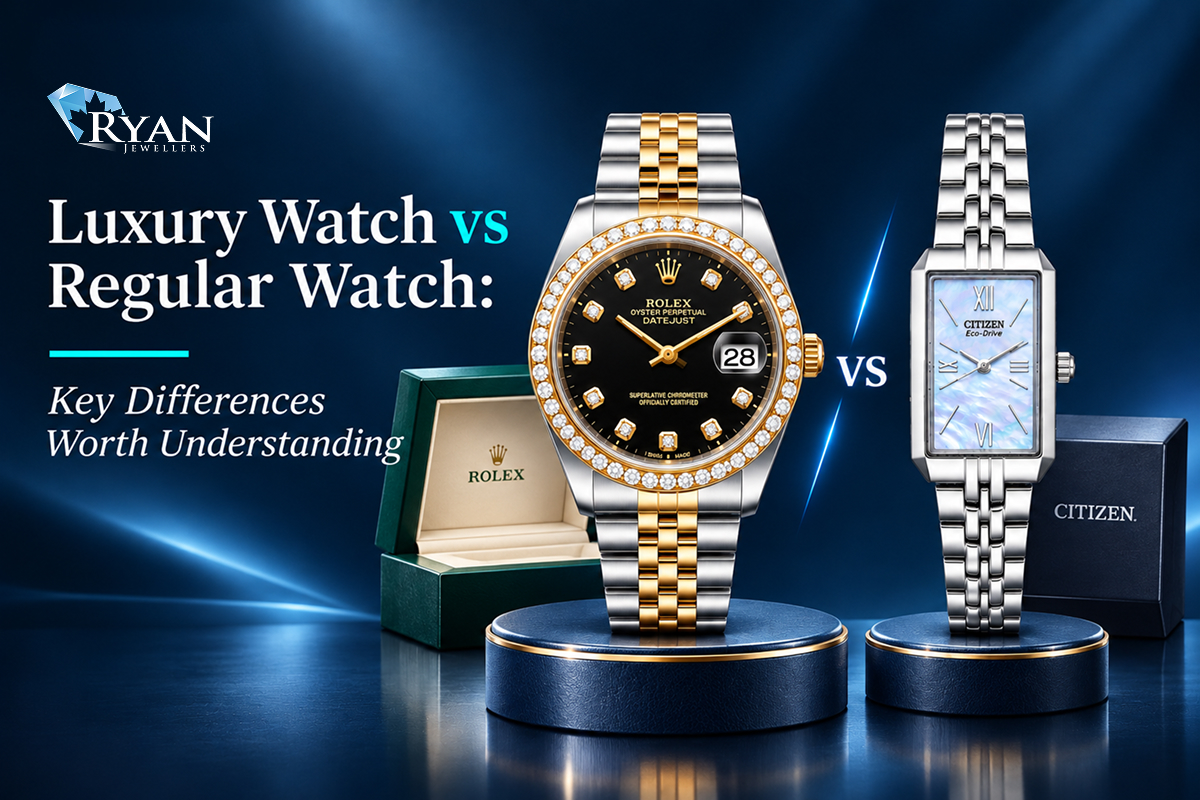
A watch can serve many purposes, from displaying the time and complementing an outfit to celebrating personal achievements and expressing an appreciation for craftsmanship. While regular watches focus primarily on practicality and affordability, luxury watches often combine sophisticated engineering, premium materials, distinctive design, and established watchmaking heritage.
However, does a higher price necessarily mean better quality, greater accuracy, or longer durability?
Understanding the luxury watch vs regular watch comparison requires looking beyond brand names and price tags. Movement technology, manufacturing standards, material selection, maintenance requirements, and long-term ownership all contribute to the overall value of a timepiece.
For Canadian buyers, the decision can be particularly important when choosing between an affordable everyday watch and a premium mechanical timepiece costing several thousand dollars.
At Ryan Jeweller, we believe that choosing the right watch begins with understanding what makes each timepiece unique.
What Defines a Luxury Watch Compared to a Regular Watch?
There is no universally accepted price threshold or technical standard that automatically defines a watch as luxurious. Instead, luxury watches generally distinguish themselves through a combination of craftsmanship, materials, engineering, brand heritage, and ownership experience.
What Is a Luxury Watch?
A luxury watch is typically a premium timepiece designed to offer more than basic timekeeping functionality. These watches often reflect considerable investment in movement development, manufacturing precision, design, finishing, and quality control.
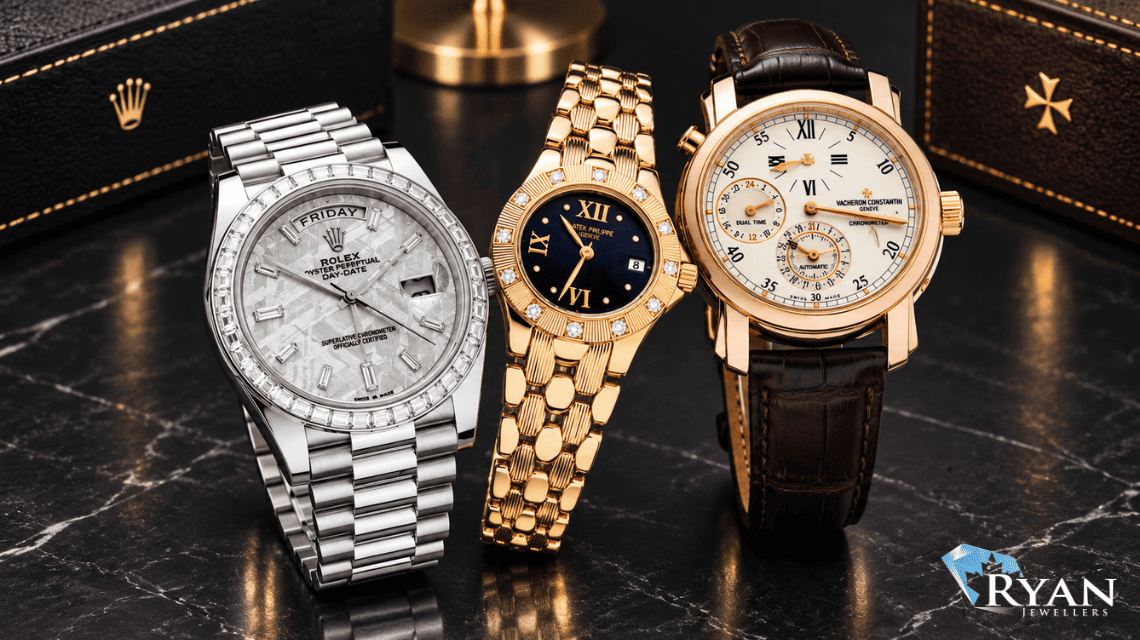
Established luxury watch manufacturers such as Rolex, Omega, Tudor, Cartier, Breitling, and Grand Seiko have developed distinctive identities through decades of watchmaking innovation and craftsmanship.
Common characteristics of luxury watches include:
- High-quality mechanical or premium quartz movements.
- Carefully finished cases, dials, and bracelets.
- Premium materials such as sapphire crystal, titanium, ceramic, or precious metals.
- Extensive quality-control procedures.
- Established brand heritage.
- Specialized complications on selected models.
- Dedicated servicing and after-sales support.
- Potential long-term collectability.
However, not every luxury watch includes all these characteristics. Some focus on artistic craftsmanship, while others prioritize technical innovation, jewellery design, or historical significance.
What Is a Regular Watch?
A regular watch, sometimes described as an everyday or mainstream watch, primarily focuses on accessible pricing, reliable timekeeping, and practical functionality.
Brands such as Casio, Timex, Citizen, and Seiko offer numerous affordable and mid-range models suitable for everyday use, although some of these manufacturers also produce premium and luxury timepieces.
Regular watches commonly offer:
- Affordable purchase prices.
- Reliable quartz, solar-powered, or mechanical movements.
- Practical and straightforward designs.
- Lower routine maintenance requirements on many quartz models.
- Accessible replacement straps and components.
- Functional features for everyday activities.
Importantly, being classified as a regular watch does not necessarily indicate poor quality. Many affordable watches offer exceptional durability, accuracy, and functionality relative to their prices.
Luxury Watch vs Regular Watch: Quick Comparison
| Feature | Luxury Watch | Regular Watch |
|---|---|---|
| Primary focus | Craftsmanship, design, engineering, and heritage | Practicality, affordability, and functionality |
| Movement | Mechanical or premium quartz | Quartz, solar, or mechanical |
| Materials | Often premium metals, sapphire, and ceramic | Steel, resin, mineral glass, and other materials |
| Manufacturing | Often more extensive finishing and quality control | Generally optimized for efficient production |
| Accuracy | Depends on movement and certification | Quartz models can be highly accurate |
| Maintenance | Often more specialized and expensive | Generally more affordable |
| Brand heritage | Often a major part of its appeal | Varies by manufacturer |
| Resale potential | Model-dependent | Usually limited, with exceptions |
| Collectability | Can be significant | Depends on the reference |
| Purchase price | Generally higher | Generally more accessible |
The distinction between luxury and regular watches is not always clear-cut. Buyers should evaluate individual models rather than relying exclusively on brand reputation or price.
How Do Movement Quality and Craftsmanship Compare?
The movement is the mechanism responsible for powering a watch and regulating its timekeeping. It represents one of the most significant areas of comparison between luxury and regular watches.
Quartz Movements in Regular Watches
Quartz watches use an electronic circuit and a vibrating quartz crystal to regulate timekeeping. Conventional quartz models are powered by batteries, while solar-powered quartz watches convert light into electrical energy.
Quartz technology offers several practical advantages:
- Excellent timekeeping accuracy.
- Relatively low maintenance requirements.
- Affordable manufacturing costs.
- Reliable everyday performance.
- No manual winding requirement.
Many standard quartz watches achieve accuracy within approximately 15–30 seconds per month, although actual specifications vary by movement.
Higher-end quartz movements can provide significantly greater precision. Consequently, quartz technology should not automatically be associated with inexpensive or low-quality watches.
Mechanical Movements in Luxury Watches
Many luxury watches feature mechanical movements consisting of carefully engineered gears, springs, wheels, and regulating components.
Mechanical watches operate without a conventional battery. Instead, energy is stored in a mainspring and gradually released through the movement.
There are two primary types of mechanical movements:
- Manual-winding movements: Require the wearer to wind the mainspring through the crown.
- Automatic movements: Use a rotating weight that winds the mainspring through wrist movement.
Luxury mechanical movements may incorporate advanced escapements, silicon components, extended power reserves, and sophisticated regulating systems.
Depending on the calibre, modern mechanical watches may offer power reserves ranging from approximately 38 hours to several days.
For many enthusiasts, the appeal of a mechanical watch lies not only in its functionality but also in the engineering and craftsmanship behind its construction.
Are Luxury Watches More Accurate?
One of the most common misconceptions in the luxury watch vs regular watch debate is that expensive watches are always more accurate.
In reality, a standard quartz watch can outperform many luxury mechanical watches in pure timekeeping accuracy.
| Movement Type | Representative Accuracy |
|---|---|
| Standard quartz | Approximately ±15–30 seconds per month |
| High-accuracy quartz | Selected movements achieve approximately ±5–10 seconds per year |
| Standard mechanical | Varies considerably by calibre and regulation |
| COSC-certified mechanical | Generally -4/+6 seconds per day during standardized movement testing |
| Rolex Superlative Chronometer | -2/+2 seconds per day after casing |
| Selected METAS Master Chronometer watches | 0/+5 seconds per day under the applicable certification standard |
Accuracy figures represent different testing conditions and movement specifications. Actual performance may vary.
Luxury mechanical watches justify their appeal through engineering complexity, traditional craftsmanship, finishing, and mechanical innovation rather than accuracy alone.
Movement Decoration and Finishing
Luxury watches may incorporate decorative finishing techniques that are less common in affordable mass-produced movements.
These techniques can include:
- Geneva stripes.
- Circular graining, also known as perlage.
- Polished screw heads.
- Bevelled movement edges.
- Engraved bridges and rotors.
- Decorative skeletonized components.
Some high-end manufacturers perform selected finishing processes by hand, while others use sophisticated industrial manufacturing techniques.
Although decorative finishing does not necessarily improve timekeeping accuracy, it contributes to the artistic and collectible appeal of a timepiece.
A transparent sapphire caseback allows owners to observe these mechanical components and appreciate the craftsmanship involved.
Manufacturing Standards and Quality Control
Luxury watch manufacturers often dedicate substantial resources to movement development, assembly, regulation, and performance testing.
Selected watches undergo third-party or manufacturer-specific certification procedures that evaluate characteristics such as precision, magnetic resistance, power reserve, and water resistance.
However, not every luxury watch is chronometer-certified, and many affordable watches meet excellent manufacturing standards.
Ultimately, movement quality should be assessed through its specifications, reliability, serviceability, and intended functionality rather than price alone.
How Do Materials, Durability, and Features Differ?
Material selection plays an important role in determining a watch’s appearance, comfort, durability, and manufacturing cost.
Although luxury watches frequently incorporate premium materials, many regular watches offer similar practical features at significantly lower prices.
Case and Bracelet Materials
Luxury watches may use a variety of metals and advanced materials to achieve specific aesthetic or functional characteristics.
| Material | Key Characteristics |
|---|---|
| Stainless steel | Durable, corrosion-resistant, and versatile |
| 904L stainless steel | Excellent corrosion resistance and polishing potential |
| Titanium | Lightweight and corrosion-resistant |
| Solid gold | Precious-metal value and distinctive luxury appeal |
| Platinum | Dense, corrosion-resistant precious metal |
| Ceramic | Highly scratch-resistant and colour-stable |
| Resin | Lightweight, affordable, and practical |
| Gold-plated metal | Gold appearance at a lower purchase price |
Stainless steel is widely used across both luxury and regular watches. However, luxury manufacturers may invest more heavily in machining precision, surface finishing, bracelet construction, and clasp engineering.
The use of precious metals can increase material costs considerably, particularly in watches featuring solid gold or platinum cases and bracelets.
Nevertheless, expensive materials do not automatically guarantee greater durability. Gold, for example, is generally softer than stainless steel, while ceramic may chip or fracture under strong impact despite its excellent scratch resistance.
Watch Crystal Quality
The watch crystal protects the dial and hands from external damage.
Three common crystal materials are used throughout the watch industry.
Acrylic Crystal
Acrylic is lightweight and relatively resistant to shattering. However, it scratches more easily than mineral glass or sapphire. Minor scratches can often be polished out.
Mineral Crystal
Mineral glass offers a practical balance between affordability and scratch resistance. It is widely used in accessible everyday watches.
Sapphire Crystal
Synthetic sapphire provides excellent scratch resistance and is commonly used in luxury watches. It maintains clarity well under regular use but can still chip or break under severe impact.
Importantly, sapphire crystal is no longer exclusive to luxury watches. Numerous affordable and mid-range models also incorporate sapphire, making it essential to compare individual specifications.
Water Resistance and Environmental Durability
Luxury watches are not necessarily more water-resistant than regular watches.
Water resistance depends on case construction, crown design, seals, and testing standards rather than the manufacturer’s price positioning.
| Water Resistance | Typical Intended Use |
|---|---|
| 30 metres | Incidental splashes |
| 50 metres | Limited water exposure; suitability for swimming depends on manufacturer guidance |
| 100 metres | Swimming and surface water activities when approved by the manufacturer |
| 200 metres | Water sports and recreational diving when the watch is designed for those activities |
| 300 metres and above | Specialized dive-watch applications, depending on model specifications |
Water resistance ratings are established under controlled testing conditions. They do not guarantee permanent protection, as seals and gaskets can deteriorate over time.
A relatively inexpensive Casio G-Shock may offer greater shock resistance and water resistance than an expensive luxury dress watch.
Similarly, a luxury watch designed primarily for formal occasions may prioritize slim construction and aesthetic refinement rather than outdoor durability.
Complications and Additional Features
A watch complication is a function beyond the basic display of hours, minutes, and seconds.
Luxury mechanical watches may offer complications such as:
- Chronographs.
- GMT and dual-time displays.
- Moonphase indicators.
- Annual and perpetual calendars.
- Power reserve indicators.
- World-time displays.
Some highly specialized luxury watches also incorporate tourbillons and minute repeaters, which demonstrate advanced mechanical watchmaking.
Regular digital and electronic watches can offer similarly useful features through electronic technology, including alarms, timers, multiple time zones, solar charging, and radio-controlled timekeeping.
The difference frequently lies in how these functions are achieved rather than whether they are available.
Mechanical complications require intricate physical mechanisms, whereas electronic watches can provide numerous functions through compact digital circuitry at a much lower cost.
How Do Maintenance Costs and Long-Term Ownership Compare?
The initial purchase price is only one part of owning a watch. Maintenance, servicing, replacement components, and insurance can influence its total ownership cost.
These considerations are particularly important for Canadian consumers purchasing premium mechanical watches.
Luxury Watch vs Regular Watch Price in Canada
Watch prices vary significantly depending on the manufacturer, movement, materials, and reference.
The following table provides broad indicative price ranges for different watch market segments in Canada.
| Watch Category | Typical Price Range (CAD) |
|---|---|
| Basic everyday watches | $30–$250 |
| Mid-range quartz and solar watches | $250–$1,000 |
| Accessible mechanical watches | $300–$1,500 |
| Premium watches | $1,000–$3,000 |
| Entry-level luxury watches | $2,000–$5,000 |
| Established luxury watch collections | $5,000–$20,000+ |
| High-end and complicated luxury watches | $20,000–$100,000+ |
These ranges are illustrative market segments rather than official industry classifications. Categories overlap, and actual Canadian retail prices vary by model and applicable taxes.
For example, Citizen Canada lists selected Eco-Drive watches at regular retail prices of approximately $295–$650 CAD, while Seiko Presage offers selected automatic mechanical watches starting around $625 CAD.
These examples demonstrate that reliable technology and mechanical craftsmanship are available well below traditional luxury-watch price points.
Routine Maintenance Requirements
Traditional battery-powered quartz watches typically require battery replacement every few years, depending on the movement and its functions.
Solar-powered watches generally eliminate routine disposable battery replacement, although their rechargeable energy-storage components may eventually require professional attention.
Mechanical watches require more specialized maintenance because their numerous moving components depend on lubrication, precise adjustment, and mechanical integrity.
A complete mechanical service may involve:
- Disassembling the movement.
- Cleaning individual components.
- Inspecting worn or damaged parts.
- Replacing components when necessary.
- Applying specialized lubricants.
- Reassembling and regulating the movement.
- Testing accuracy and water resistance.
Recommended servicing intervals vary by manufacturer, movement, age, and wearing conditions. Owners should follow the guidance provided for their specific watch.
Watch Maintenance Costs in Canada
Watch servicing costs can differ considerably between independent repair workshops and manufacturer-authorized service centres.
| Maintenance or Service | Indicative Cost (CAD) |
|---|---|
| Basic battery replacement | $20–$25 |
| Standard strap replacement | $25–$90 |
| Mineral crystal replacement | $40–$80 |
| Sapphire crystal replacement | $80–$120 |
| Basic mechanical movement service | $120–$250+ |
| Selected modern Rolex Datejust and Explorer complete service | $840 |
| Selected modern Rolex Submariner and GMT-Master II complete service | $980 |
| Selected modern Rolex Daytona complete service | $1,190 |
Basic repair prices represent indicative Canadian workshop pricing. Rolex examples reflect published Canadian complete-service prices for specified modern model categories. Additional repairs, replacement components, and optional refinishing may increase the final cost.
Luxury watches often require specialized equipment, manufacturer-specific components, and experienced watchmakers, contributing to higher servicing expenses.
For more detailed information about local servicing expenses, explore our guide to Watch Repair Costs in Canada.
Long-Term Durability and Repairability
One potential advantage of a well-made luxury mechanical watch is its ability to remain functional for decades when properly maintained.
Certain manufacturers provide established servicing networks and replacement components that support long-term ownership.
However, luxury pricing does not guarantee indefinite repairability. Discontinued components, vintage movements, proprietary parts, and manufacturer policies may affect future servicing.
Affordable mechanical watches can also remain functional for many years, while quartz and solar watches often provide excellent reliability with relatively limited maintenance.
The longevity of any watch ultimately depends on its construction, component availability, usage conditions, and care.
Resale Value and Depreciation
Resale potential is another important consideration in the luxury watch vs regular watch comparison.
Certain luxury watches, particularly highly sought-after references from established manufacturers, may retain a significant percentage of their original purchase price.
Factors influencing resale value include brand recognition, production availability, condition, original documentation, service history, and collector demand.
However, many luxury watches depreciate after purchase, sometimes substantially. Historical resale performance does not guarantee future financial returns.
Regular watches generally have more limited resale potential because of their lower initial prices and wider availability. Nevertheless, certain discontinued, limited-edition, or collectible affordable watches can develop strong secondary-market demand.
For most buyers, personal enjoyment and practical utility should remain the primary reasons for purchasing a watch.
Is a Luxury Watch Worth the Additional Cost?
Whether a luxury watch is worth its higher price depends on what the buyer expects from the ownership experience.
For some individuals, a luxury timepiece represents decades of mechanical innovation, artistic expression, and personal significance. For others, a reliable and affordable watch provides everything they need.
When a Luxury Watch May Be Worth Buying
A luxury watch may justify its additional cost if you appreciate traditional watchmaking, premium finishing, distinctive design, or the long-term enjoyment of owning a carefully crafted mechanical timepiece.
Luxury watches are often purchased to commemorate meaningful milestones, including graduations, weddings, anniversaries, professional achievements, and retirement.
Beyond their practical functionality, these watches can carry emotional significance and become valued personal possessions.
A luxury watch may be particularly appealing if you value:
- Mechanical watchmaking and engineering.
- Premium case and bracelet finishing.
- Established watchmaking heritage.
- Distinctive design and material quality.
- Long-term ownership and collectability.
- Specialized mechanical complications.
- Personal and sentimental significance.
For these buyers, the value of a luxury watch extends beyond its ability to display the time.
When a Regular Watch May Be the Better Choice
A regular watch can be the smarter purchase for buyers who prioritize functionality, affordability, and convenience.
Many modern quartz and solar watches offer excellent precision, impressive durability, and practical features without the servicing costs associated with luxury mechanical timepieces.
A regular watch may be more suitable if you value:
- Affordable purchase prices.
- Highly accurate everyday timekeeping.
- Low routine maintenance requirements.
- Practical features for work and sports.
- Easy replacement when damaged.
- Minimal financial concern during daily wear.
For individuals who work in demanding environments or regularly participate in outdoor activities, a durable and affordable watch may offer greater practical value than a delicate luxury timepiece.
Comparing Value Based on Your Priorities
| Buying Priority | Recommended Watch Category |
|---|---|
| Affordable everyday timekeeping | Regular quartz watch |
| High accuracy at a reasonable price | Quartz or solar watch |
| Mechanical craftsmanship | Mechanical luxury or premium watch |
| Low maintenance | Quartz or solar watch |
| Premium materials and finishing | Luxury watch |
| Outdoor durability | Purpose-built sports watch at any price |
| Mechanical complications | Luxury mechanical watch |
| Potential collectability | Selected luxury and limited-edition watches |
| Celebrating personal milestones | Luxury or premium watch |
| Maximum functionality for the price | Regular or mid-range watch |
Finding the Right Balance Between Quality and Price
Buyers do not necessarily need to choose between an inexpensive everyday watch and an exceptionally expensive luxury model.
The Canadian watch market offers numerous intermediate options that combine reliable movements, attractive designs, sapphire crystals, quality materials, and accessible pricing.
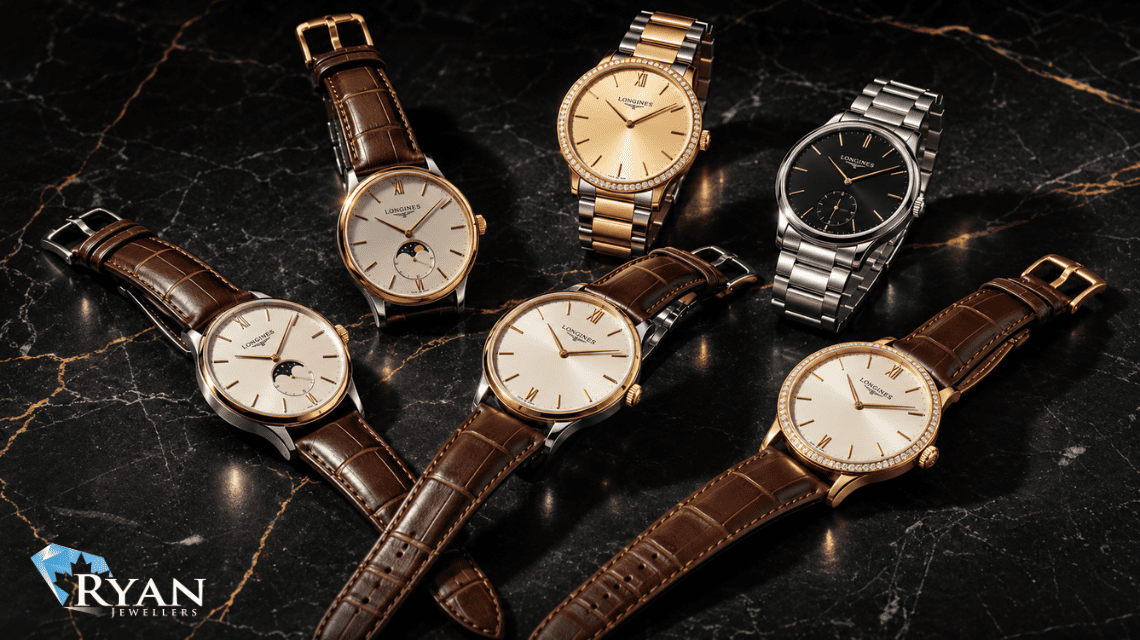
Brands such as Seiko, Citizen, Tissot, Hamilton, and Longines offer different combinations of affordability, craftsmanship, and technical performance across their respective market segments.
For first-time buyers, exploring these options can provide valuable insight into personal preferences before committing to a higher-priced luxury timepiece.
Ultimately, the best watch is not necessarily the most expensive one. It is the timepiece that offers the right combination of functionality, design, comfort, craftsmanship, and ownership costs for your lifestyle.
FAQ About Luxury Watches vs Regular Watches
What is the main difference between a luxury watch and a regular watch?
The main difference is the overall emphasis on craftsmanship, materials, engineering, brand heritage, and ownership experience. Luxury watches often incorporate premium finishing and sophisticated movements, while regular watches generally prioritize affordability and practical functionality.
Are luxury watches more accurate than regular watches?
Not necessarily. Affordable quartz watches can provide greater timekeeping accuracy than many luxury mechanical watches. Luxury mechanical watches are often valued for their intricate engineering, craftsmanship, design, and traditional watchmaking techniques rather than accuracy alone.
How much does a luxury watch cost in Canada?
Entry-level luxury watches may cost approximately $2,000–$5,000 CAD, while established luxury collections frequently range from $5,000 to $20,000 CAD or considerably more. However, there is no universally recognized price threshold defining a luxury watch, and prices vary by brand, materials, and movement.
Do luxury watches last longer than regular watches?
A well-maintained luxury mechanical watch can remain functional for decades, particularly when replacement components and professional servicing are available. However, many affordable quartz, solar, and mechanical watches also offer excellent longevity. Durability depends on construction, maintenance, and usage rather than price alone.
Do luxury watches hold their value better?
Selected luxury watches may retain more of their original purchase price because of brand recognition, limited availability, or collector demand. However, many luxury watches depreciate, and resale performance varies considerably between references. A luxury watch should not be considered a guaranteed financial investment.
Is a luxury watch worth buying as a first watch?
A luxury watch may be worth purchasing as a first watch if you appreciate its craftsmanship, design, and long-term ownership experience and can comfortably afford its maintenance costs. Buyers seeking practical everyday functionality may find better value in a well-made quartz, solar, or accessible mechanical watch.
Final Thoughts
The luxury watch vs regular watch comparison demonstrates that the true value of a timepiece extends beyond its retail price.
Luxury watches offer an appealing combination of sophisticated engineering, premium materials, carefully executed finishing, brand heritage, and personal significance. For watch enthusiasts, these characteristics can make ownership a rewarding experience that continues for decades.
Regular watches, meanwhile, provide accessible pricing, practical functionality, reliable timekeeping, and often lower maintenance costs. Many affordable models deliver exceptional performance and durability, making them excellent choices for everyday use.
For Canadian buyers, choosing the right watch involves balancing purchase price, servicing requirements, movement preferences, design, comfort, and long-term expectations.
Whether you are celebrating a meaningful milestone, beginning a watch collection, or simply searching for a dependable everyday accessory, the best timepiece is one that genuinely complements your lifestyle.
Ready to discover your next timepiece? Visit Ryan Jeweller in Maple Ridge, British Columbia, or explore our Watch Comparison page for detailed insights into luxury watch brands, movement technologies, and different watch collections. Discover the craftsmanship, functionality, and timeless designs that make every watch unique.