
Summarize the article with:


A luxury watch is built for long-term use, but proper daily care can help preserve its appearance, performance, and water resistance. Learning how to care for a watch does not require complicated equipment or frequent professional intervention. Simple habits such as gentle cleaning, careful storage, and protecting the watch from moisture and chemicals can make a meaningful difference over time.
For Canadian watch owners, everyday conditions can vary considerably throughout the year. Cold temperatures, snow, rain, humidity, and indoor heating can all influence how a watch is worn and stored. Manufacturers such as OMEGA recommend avoiding extreme temperatures and sudden temperature changes, while also protecting watches from chemicals and strong magnetic fields.
If you’re looking for a luxury timepiece designed for long-term ownership, explore the collection at Ryan Jeweller and find a watch that suits your lifestyle.
What Does Everyday Watch Care Involve?
Everyday watch care is primarily about preventing avoidable damage.
A simple routine includes:
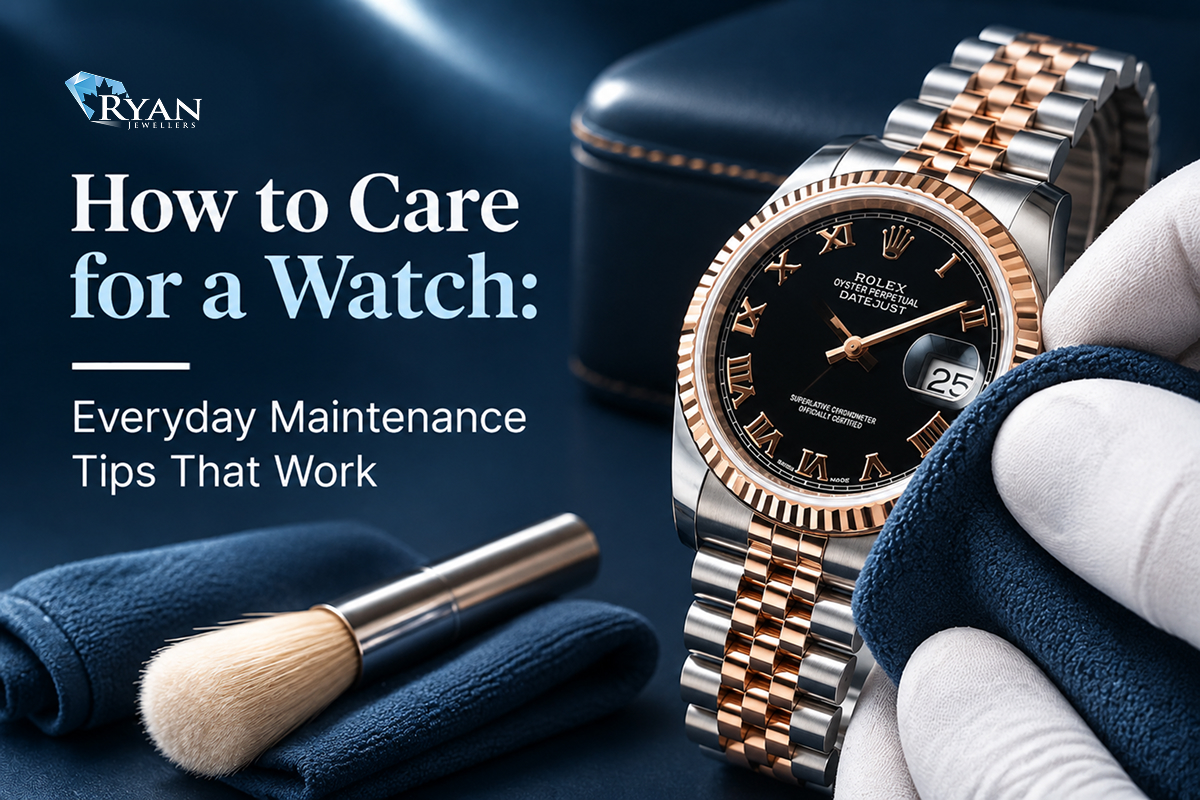
- Wiping the watch regularly with a soft microfiber cloth
- Keeping the case and bracelet free from accumulated dirt
- Avoiding unnecessary contact with chemicals and cosmetics
- Protecting the watch from strong impacts
- Keeping leather straps away from excessive moisture
- Storing the watch safely when it is not being worn
- Checking that the crown is properly secured before water exposure
Rolex recommends occasionally cleaning suitable cases and bracelets with a microfiber cloth, while TUDOR similarly recommends gentle cleaning with a microfiber cloth or soft brush and soapy water for appropriate watches.
Pay Attention to the Crown
The crown is an important part of a watch’s sealing system.
If your watch has a screw-down crown, it should be properly secured according to the manufacturer’s instructions before exposure to water. Rolex notes that its crown must be screwed down correctly to maintain waterproofness.
Never force a crown that feels unusually stiff or difficult to operate. A problem with the crown can affect both the watch’s operation and its water resistance.
Understand Your Watch’s Water Resistance
Water resistance varies significantly between models.
A watch rated for everyday water exposure is not necessarily suitable for swimming or diving. Even water-resistant watches can lose their protection over time as seals age or after an impact.
OMEGA recommends having water resistance tested regularly by an authorized service centre because gaskets can age and accidental shocks can affect the crown.
How Should You Clean a Watch Case, Crystal, and Bracelet?
The correct cleaning method depends on the watch’s materials and construction. Always follow the manufacturer’s instructions for the specific model.
Cleaning the Case and Crystal
For routine maintenance, begin with a clean microfiber cloth.
Gently wipe:
- The crystal
- Case surfaces
- Bezel
- Lugs
- Caseback
Avoid abrasive materials or aggressive rubbing.
Sapphire crystal is highly scratch resistant, but it is not completely immune to damage. A soft cloth is usually sufficient for removing fingerprints, dust, and light surface residue.
Cleaning a Metal Bracelet
Metal bracelets can accumulate sweat, skin oils, dust, and debris between their links.
For suitable water-resistant watches, manufacturers including Rolex and TUDOR recommend gentle cleaning with soapy water and a soft brush.
A simple method is:
- Confirm that the crown is properly secured.
- Use mild soapy water where the manufacturer permits it.
- Gently clean the bracelet with a soft brush.
- Rinse with fresh water when appropriate.
- Dry thoroughly with a soft microfiber cloth.
Do not use abrasive brushes or household metal polish.
Cleaning Rubber Straps
Rubber straps are generally easier to clean than leather.
OMEGA recommends soapy water and a toothbrush for cleaning suitable rubber straps and waterproof cases, followed by drying with a soft cloth.
Even with rubber, avoid unnecessary exposure to harsh chemicals, solvents, and cosmetics.
Caring for a Leather Strap
Leather requires more caution around water.
TUDOR specifically recommends protecting leather straps from water and moisture.
Instead of washing a leather strap under running water:
- Wipe it gently with a suitable dry or slightly damp cloth.
- Avoid soaking it.
- Keep it away from prolonged sweat and moisture.
- Allow it to dry naturally if it becomes damp.
- Follow the strap manufacturer’s care instructions.
Leather is also a material that naturally changes with age, so some patina and signs of use are normal.
Cleaning After Salt-Water Exposure
Salt and sand can accumulate around the case and bracelet.
For suitable water-resistant watches, Rolex and TUDOR recommend rinsing with fresh water after exposure to seawater.
However, rinsing a watch afterward does not mean every watch is suitable for swimming. Always check the specific model’s water-resistance rating first.
How Can You Protect Your Watch From Moisture and Chemicals?
Moisture and chemicals are among the most common avoidable threats to a watch.
Avoid Direct Contact With Chemicals
Perfume, cosmetics, detergents, solvents, and other chemicals can affect cases, bracelets, straps, and gaskets.
OMEGA specifically advises avoiding direct contact with solvents, detergents, perfumes, cosmetics, and mosquito repellents because these substances may damage the bracelet, case, or gaskets.
A practical habit is to apply perfume, moisturizer, or other cosmetics first and allow them to dry before putting on your watch.
Be Careful Around Water
Before exposing a watch to water, check:
- Water-resistance rating
- Crown position
- Condition of the case
- Manufacturer’s recommendations
- Age and service history
Do not operate the crown or pushers underwater unless the manufacturer specifically states that the function is designed for underwater operation.
OMEGA specifically states that the crown should not be manipulated in water.
Watch for Condensation
Condensation beneath the crystal should not be ignored.
If you notice fogging or moisture inside the watch:
- Stop wearing it.
- Avoid operating the crown or pushers unnecessarily.
- Seek professional inspection.
Moisture inside the case can potentially affect the movement and other components.
Protect Against Temperature Extremes
Canadian winters can expose watches to conditions that differ considerably from indoor environments.
OMEGA recommends avoiding temperatures above 60°C or below 0°C and avoiding extreme temperature variations.
Rather than leaving a watch next to a heater, radiator, or in an extremely cold location, store it in a stable indoor environment.
Avoid Strong Magnetic Fields
Magnetic fields can affect certain mechanical watches.
OMEGA recommends keeping watches away from strong magnetic sources such as speakers, refrigerators, laptops, and some tablet accessories.
If a mechanical watch suddenly begins gaining or losing time after exposure to a strong magnetic source, professional inspection may be appropriate.
How Should You Handle and Store Your Watch?
Good handling habits can prevent scratches, impacts, and unnecessary wear.
Remove Your Watch for High-Risk Activities
Even a robust luxury watch should not be exposed unnecessarily to situations where it could suffer a hard impact.
Consider removing your watch when:
- Performing heavy manual work
- Working with machinery
- Handling abrasive materials
- Participating in activities involving significant impacts
OMEGA advises owners to avoid mechanical, thermal, and other forms of shock.
Store the Watch Separately
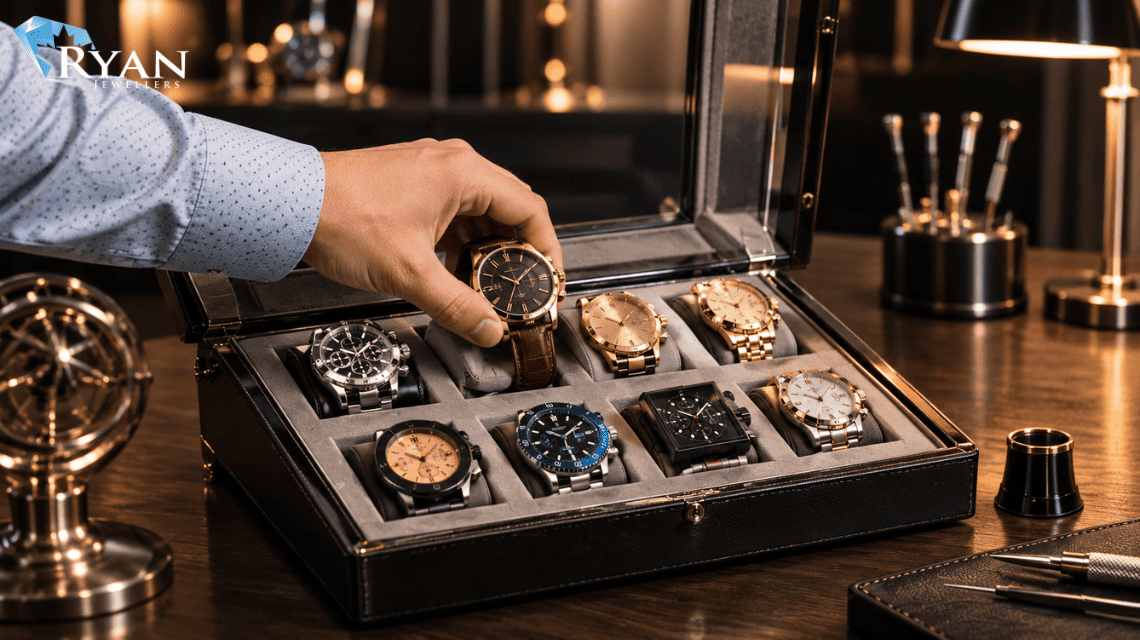
When you are not wearing your watch, place it somewhere clean and protected.
A suitable watch box or padded watch roll can help prevent:
- Scratches
- Dust accumulation
- Accidental impacts
- Contact with other watches or jewelry
If storing multiple watches together, make sure their cases and bracelets cannot rub against one another.
Keep the Original Box and Documentation
For luxury watches, retaining the original box, warranty card, manuals, and service documentation can be useful.
These records can help establish the watch’s history and may become particularly valuable if you later sell or insure the timepiece.
Avoid Unnecessary Polishing
Small scratches are a normal part of owning a watch.
Do not attempt to remove them with household polishing products.
Professional refinishing removes material from the case or bracelet and can affect the original shape if performed incorrectly. Rolex recommends that professional polishing be carried out through an Official Rolex Service Centre.
For collectible or vintage watches, preserving the original case profile can be especially important.
When Should You Have Your Watch Professionally Inspected?
Knowing when to seek professional help is an important part of understanding how to care for a watch.
The Watch Suddenly Gains or Loses Time
Mechanical watches have some natural variation in timekeeping. However, a sudden change can indicate an issue.
Potential causes include:
- Magnetization
- Impact
- Movement wear
- Lubrication problems
- Internal contamination
If the change is unusual or persistent, have the watch inspected rather than attempting to adjust the movement yourself.
The Crown Feels Unusual
Seek professional assistance if the crown becomes:
- Loose
- Difficult to turn
- Unusually stiff
- Difficult to screw down
- Unable to remain secured
The crown plays an important role in protecting the movement from moisture.
The Watch Has Experienced an Impact
A significant impact can affect a movement even when there is no obvious external damage.
If the watch has been dropped or struck hard and subsequently behaves differently, professional inspection is advisable.
Water Resistance Is Uncertain
Water resistance can change over time because seals and gaskets age.
OMEGA recommends regular water-resistance testing, while Rolex recommends periodic professional servicing to maintain accuracy and waterproofness.
This is particularly important if you frequently expose your watch to water.
The Watch Is Due for Service
Service intervals vary by brand, model, movement, climate, and usage.
Rolex currently recommends servicing approximately every 10 years, depending on the model and real-life usage.
OMEGA gives a general guideline of approximately 5–8 years, while noting that service frequency depends on the model, climate, and how the watch is cared for.
These different recommendations demonstrate why there is no single service interval that applies to every luxury watch.
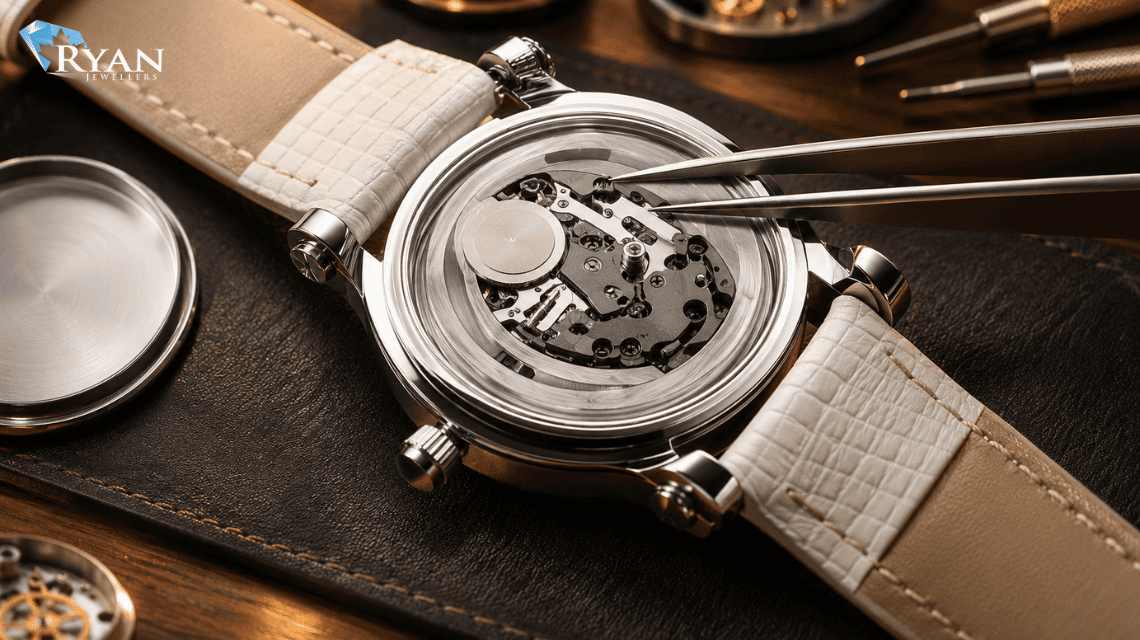
What Happens During a Professional Service?
A complete service is considerably more involved than exterior cleaning.
Depending on the brand and service level, it can involve:
- Movement disassembly
- Cleaning
- Inspection
- Lubrication
- Replacement of worn components
- Gasket replacement
- Accuracy testing
- Water-resistance testing
- Power-reserve testing
- Case and bracelet refinishing where appropriate
For example, Rolex states that its complete service includes dismantling and cleaning the movement, inspecting components, lubrication, electronic accuracy testing, waterproofness testing, and final technical checks.
TUDOR similarly states that its service process includes a complete movement overhaul, replacement of seals, accuracy checks, and waterproofness testing.
How Much Can Servicing Cost in Canada?
Service pricing depends heavily on the brand, model, age, movement, and condition.
For example, Rolex’s current Canadian pricing lists complete service from CAD $840 for many modern six-digit references, with higher starting prices for professional models and more complicated watches.
Additional repairs or parts may cost extra.
For a valuable luxury watch, it is sensible to request an assessment and estimate before authorizing major work.
A Simple Watch Care Routine
If you want a practical routine for everyday ownership, keep it simple.
Daily
- Wipe away fingerprints and surface oils with a microfiber cloth.
- Avoid unnecessary contact with chemicals.
- Check that the crown is properly secured before water exposure.
- Remove the watch for activities involving significant impact.
Weekly or As Needed
- Inspect the bracelet or strap for accumulated dirt.
- Clean suitable metal or rubber components according to the manufacturer’s instructions.
- Check for unusual scratches, loose components, or changes in timekeeping.
After Water or Beach Exposure
- Confirm the watch is suitable for the activity.
- Rinse appropriate water-resistant watches with fresh water after seawater exposure.
- Dry the watch thoroughly.
- Watch for condensation or unusual behaviour.
Periodically
- Check water resistance when appropriate.
- Review the manufacturer’s recommended service interval.
- Keep service records and documentation.
- Have unusual timekeeping or mechanical issues professionally inspected.
Learn more about proper watch maintenance with our Watch Care Guide and discover practical tips to keep your timepiece in excellent condition.
FAQ About Caring for a Watch
How often should I clean my watch?
There is no universal cleaning schedule. For everyday wear, wiping the watch with a microfiber cloth regularly can help remove surface oils and dust. Deeper cleaning should follow the manufacturer’s instructions and the materials used on the watch.
Can I wash my watch with soap and water?
Some water-resistant watches with metal bracelets or suitable rubber straps can be cleaned with mild soapy water and a soft brush. However, leather straps require different care, and the crown must be properly secured before cleaning a water-resistant watch.
Can I wear my watch in the shower?
It depends on the specific watch and its water-resistance rating. Water resistance can also deteriorate as seals age. Always check the manufacturer’s instructions rather than assuming that a watch is suitable for showering.
How should I store a luxury watch?
Keep it in a clean, dry, stable environment away from strong magnetic fields, extreme temperatures, and unnecessary moisture. A padded watch box or watch roll can help prevent scratches and impacts.
How often should a luxury watch be serviced?
The recommended interval varies by brand and model. Rolex currently recommends approximately every 10 years depending on model and usage, while OMEGA gives a general guideline of 5–8 years depending on conditions.
What should I do if my watch gets wet inside?
Stop wearing it and have it professionally inspected as soon as possible. Do not open the case yourself or attempt to dry the movement with household equipment, as further damage can occur.
Final Thoughts
Knowing how to care for a watch is ultimately about consistency rather than complicated maintenance. Keep the watch clean, protect it from unnecessary impacts and chemicals, store it correctly, and pay attention to changes in water resistance or timekeeping.
For Canadian owners, seasonal temperature changes make stable storage particularly important. At the same time, watches exposed regularly to water, snow, sweat, or outdoor conditions may require closer attention to seals and overall condition.
Most importantly, follow the manufacturer’s recommendations for your specific model. Service intervals, water-resistance limits, cleaning methods, and materials can vary considerably between watches.
A luxury watch is designed to be enjoyed for years. With sensible daily care and professional servicing when needed, you can help preserve both its performance and appearance.
Ready to find a luxury timepiece worth caring for? Explore the collection at Ryan Jeweller and discover a watch that fits your style, lifestyle, and long-term collection.