
Summarize the article with:


A custom bracelet gives you the freedom to create jewelry around your personal style, meaningful details, and everyday preferences. Rather than choosing a finished design, you can decide on the metal, diamonds, gemstones, chain or links, proportions, clasp, and other details that make the final piece feel personal.
Custom design can work for many occasions. You might create a diamond bracelet for an anniversary, a personalized gold bracelet as a meaningful gift, or a simple everyday piece designed to complement jewelry you already own.
For Canadian buyers, however, appearance is only one part of the decision. The bracelet should also suit how it will be worn. Metal purity, gemstone durability, bracelet size, clasp security, maintenance, and budget can all affect the long-term experience.
A custom bracelet does not need to be elaborate to be distinctive. Sometimes, a particular gemstone, engraving, metal combination, or carefully chosen proportion is enough to make a piece feel truly one of a kind.
If you are exploring ideas, visit Ryan Jeweller to discover jewelry inspiration before beginning your custom design.
What Are Custom Bracelets?
Custom bracelets are bracelets designed or significantly modified according to an individual’s preferences.
The exact level of customization depends on the jeweller. Some projects involve modifying an existing bracelet, while others begin with an original concept.
Depending on the design, you may be able to customize:
- Bracelet style
- Metal type
- Gold karat
- Diamond selection
- Gemstone selection
- Stone shape
- Stone arrangement
- Bracelet length
- Link size
- Chain thickness
- Clasp style
- Engraving
- Surface finish
Fully Custom Bracelet Designs
A fully custom bracelet starts with an idea rather than a completed product.
For example, you might want a yellow-gold bracelet featuring several small diamonds arranged around a specific motif. The jeweller can develop the structure around that concept.
You can also bring reference images instead of a finished design. Several examples can help communicate the shapes, proportions, and overall aesthetic you prefer.
Modified Bracelet Designs
Customization does not always require designing something from scratch.
An existing bracelet may be modified by changing:
- Metal colour
- Gold karat
- Gemstones
- Diamond arrangement
- Bracelet length
- Clasp
- Engraving
This approach can be useful if you already like the basic design but want to make it more personal.
Why Choose a Custom Bracelet?
Customization gives you more control over the final result.
You can prioritize what matters most, whether that is:
- A particular gemstone
- A specific metal
- A minimalist appearance
- A larger centre stone
- A meaningful engraving
- Everyday comfort
- A distinctive design
The goal is to create a bracelet that balances appearance, comfort, durability, craftsmanship, and personal meaning.
Popular Custom Bracelet Styles
Custom design can be applied to many different bracelet styles. Your choice should depend on how you plan to wear the piece and the look you want to achieve.
Custom Diamond Bracelets
Diamond bracelets can range from subtle everyday pieces to more elaborate designs.
Possible styles include:
- Diamond line bracelets
- Diamond station bracelets
- Diamond link bracelets
- Cluster designs
- Geometric diamond bracelets
- Personalized diamond bracelets
You can customize the diamond shape, size, arrangement, metal, and overall proportions.
Tennis-Style Diamond Bracelets
A tennis-style bracelet typically features a continuous or closely arranged line of diamonds.
The design can be customized through:
- Diamond size
- Diamond shape
- Metal
- Bracelet length
- Setting
- Clasp
Because many stones are involved, the quality and security of the setting are important considerations for a bracelet intended for regular wear.
Custom Chain Bracelets
Chain bracelets are highly adaptable.
You can customize:
- Chain style
- Link size
- Thickness
- Length
- Metal
- Clasp
- Pendant or charm
Possible chain structures include cable, box, curb, rope, and wheat-style chains.
A delicate chain can create a minimalist appearance, while larger links can produce a stronger visual presence.
Custom Cuff Bracelets
Cuff bracelets have an open structure and typically wrap around the wrist without a traditional clasp.
They can be designed with:
- Smooth metal
- Diamonds
- Gemstones
- Engraving
- Textured surfaces
A cuff can provide a particularly clean foundation for a modern custom design.
Custom Bangle Bracelets
Bangles are generally rigid bracelets that maintain their shape.
They can be:
- Plain
- Engraved
- Diamond-set
- Gemstone-set
- Textured
- Mixed-metal
Because bangles move differently from flexible chain bracelets, sizing is particularly important.
Charm Bracelets
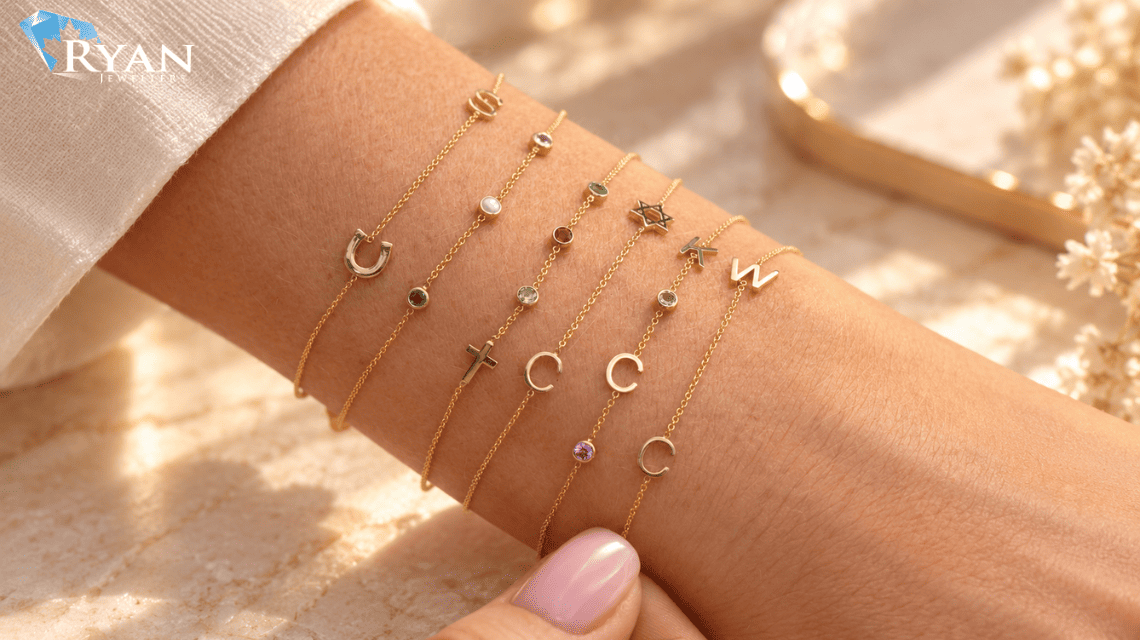
A custom charm bracelet can represent personal experiences, family members, interests, or milestones.
You might incorporate:
- Initials
- Birthstones
- Dates
- Symbols
- Small diamonds
- Meaningful charms
The design can evolve over time as additional charms are added.
Personalized Engraved Bracelets
Engraving provides a simple way to add meaning.
Possible details include:
- Names
- Initials
- Dates
- Short messages
- Symbols
The available space depends on the bracelet’s construction, so confirm the engraving area before finalizing the design.
Minimalist Custom Bracelets
Minimalist bracelets focus on simple proportions and restrained details.
Examples include:
- Fine gold chain + small diamond
- Slim bangle + engraving
- Small gemstone + delicate chain
- Simple diamond station bracelet
This style can be particularly versatile for everyday wear.
Choosing Metals, Diamonds, and Gemstones
Material selection affects the bracelet’s appearance, durability, maintenance, and price. Therefore, it should be considered alongside the design rather than as a separate decision.
Choosing Gold
Common gold qualities include:
- 10K
- 14K
- 18K
- 22K
- 24K
The karat indicates the proportion of pure gold in the alloy.
| Gold Type | Approximate Gold Content |
|---|---|
| 10K | 41.7% |
| 14K | 58.3% |
| 18K | 75% |
| 22K | 91.6% |
| 24K | 99.9% |
Canadian Competition Bureau guidance allows gold quality marks from 9K through 24K when the applicable requirements are met. It also specifies accepted quality designations such as .417 for 10K, .583 for 14K, .750 for 18K, and .916 for 22K.
If a precious-metal quality mark is used, it must truthfully represent the metal’s quality. Canadian requirements also call for appropriate marking practices and, in applicable cases, a Canadian trademark.
Yellow Gold
Yellow gold provides a warm and traditional appearance.
It can work particularly well with:
- White diamonds
- Warm-coloured gemstones
- Classic bracelets
- Vintage-inspired designs
White Gold
White gold offers a cooler, contemporary appearance.
Many white gold pieces use rhodium plating to create a bright white surface. Because plating can wear through everyday use, future maintenance may include professional replating.
Rose Gold
Rose gold has a warm pink tone created by its alloy composition.
It can add a softer or more distinctive appearance to a custom bracelet.
Platinum
Platinum is naturally white and has a high density.
It is often selected for fine jewelry and gemstone settings. However, platinum is not scratch-proof and can develop a natural patina through everyday wear.
Choosing Diamonds
If your bracelet includes diamonds, the traditional 4Cs provide a useful framework:
- Cut
- Colour
- Clarity
- Carat weight
These characteristics should be considered together.
Carat weight measures a diamond’s weight rather than directly measuring its visible size. Therefore, two diamonds with the same carat weight can have different dimensions and appearances.
Diamond Shapes
Popular diamond shapes include:
- Round
- Oval
- Emerald
- Pear
- Marquise
- Cushion
- Radiant
- Princess
The right shape depends on the bracelet design and your preferred aesthetic.
Round diamonds offer a classic appearance, while shapes such as oval, emerald, and pear can create a more distinctive visual effect.
Choosing Gemstones
Custom bracelets can also incorporate coloured gemstones such as:
- Sapphire
- Ruby
- Emerald
- Aquamarine
- Tourmaline
- Amethyst
However, gemstones differ in hardness, toughness, and sensitivity.
If a bracelet will be worn frequently, discuss the gemstone’s durability and care requirements with your jeweller before selecting it.
Consider the Bracelet’s Movement
Bracelets experience frequent movement against clothing, surfaces, and other jewelry.
Therefore, gemstone selection should take everyday use into account.
A delicate gemstone may be beautiful but require more careful handling than a more durable option.
Custom Bracelet Design Ideas
Once you have chosen the basic bracelet structure, personalization can make the design more distinctive.
Diamond Station Bracelet
Small diamonds can be positioned at intervals along a chain.
This creates a refined look while keeping the overall bracelet relatively lightweight.
You can customize:
- Number of diamonds
- Spacing
- Diamond shape
- Metal
- Chain style
Birthstone and Diamond Bracelet
A birthstone can be paired with one or more diamonds.
For example:
Birthstone + diamond + gold chain
This can create a meaningful gift for a birthday, anniversary, or family milestone.
Because gemstones differ in durability, the intended frequency of wear should be considered.
Initial Bracelet
A custom bracelet can incorporate one or more initials.
You might create:
- One initial
- Two initials
- Family initials
- Initial + diamond
- Initial + birthstone
The lettering can be subtle or become the main visual feature.
Family Bracelet
A bracelet can represent family members through individual gemstones, initials, or charms.
For example, each family member could be represented by:
- A birthstone
- An initial
- A small diamond
- A symbolic charm
This allows the bracelet to develop meaning without relying on elaborate decoration.
Anniversary Bracelet
A custom bracelet can commemorate an important anniversary.
Possible details include:
- Anniversary date
- Number of years
- Birthstones
- Diamond accents
- Engraving
The design can remain simple while still carrying significant sentimental value.
Mixed-Metal Bracelet
Combining metal colours can create contrast.
Examples include:
- Yellow gold + white gold
- Rose gold + white gold
- Yellow gold + platinum
The combination should be intentional so that the different metals feel like part of the same design.
Custom Diamond Cuff
A cuff can provide a strong foundation for diamonds or gemstones.
A simple gold cuff can be personalized with:
- Small diamonds
- Engraving
- Geometric details
- Textured metal
- Hidden gemstones
This approach works particularly well for modern jewelry styles.
Layering Bracelet Collection
Instead of creating one bracelet to stand alone, you can design several pieces that work together.
For example:
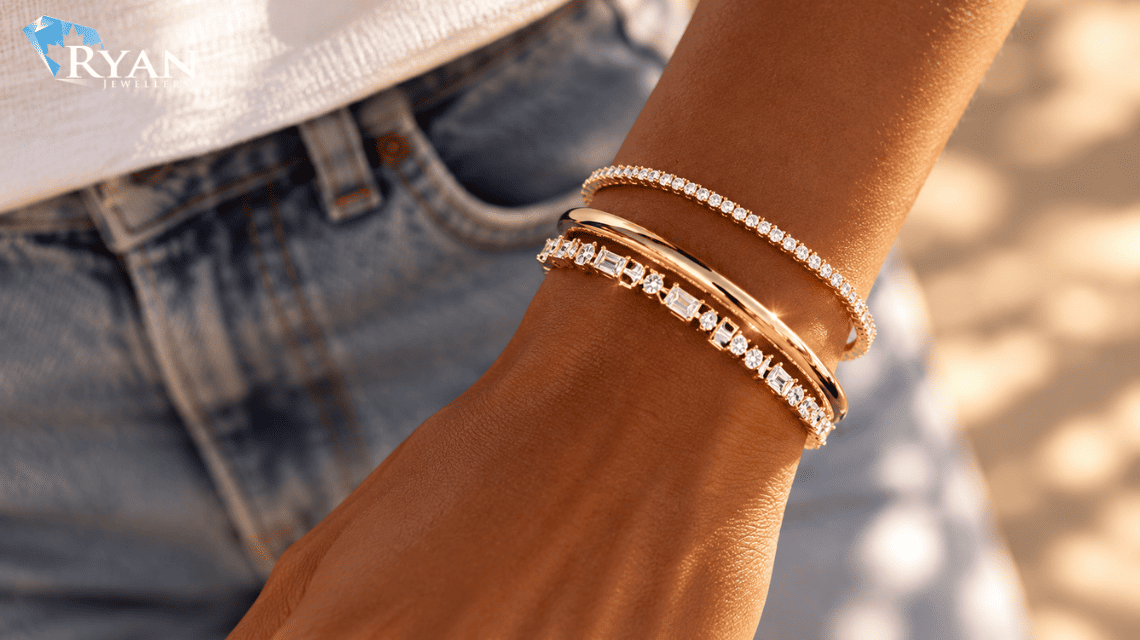
Fine chain + diamond station bracelet + simple bangle
The bracelets can share a metal or gemstone while maintaining different shapes and proportions.
This creates flexibility because each piece can also be worn independently.
How the Custom Bracelet Design Process Works
Although each Canadian jeweller has its own workflow, custom bracelet projects generally move through several stages.
1. Initial Consultation
Start by discussing:
- Purpose of the bracelet
- Budget
- Preferred style
- Metal
- Diamonds
- Gemstones
- Bracelet size
- Desired completion date
Reference images can help communicate your preferences.
2. Define the Design
Establish the key characteristics of the bracelet.
For example:
Style: minimalist
Metal: 14K yellow gold
Gemstones: small diamonds
Structure: delicate chain
Use: everyday wear
This gives the jeweller a clear starting point.
3. Select Materials
Choose:
- Metal
- Gold karat
- Diamonds
- Gemstones
- Chain
- Clasp
For significant diamond purchases, review the stone’s characteristics and any available grading documentation.
4. Develop the Design
The jeweller may provide sketches, technical drawings, or CAD images.
Review the bracelet from multiple perspectives.
Pay attention to:
- Width
- Thickness
- Stone placement
- Clasp
- Link construction
- Overall proportions
5. Confirm the Size
Bracelet sizing is particularly important.
A bracelet that is too tight can be uncomfortable, while one that is too loose may move excessively or increase the risk of catching on objects.
For bangles and cuffs, sizing can work differently from flexible bracelets, so discuss the intended fit with your jeweller.
6. Approve the Final Specifications
Before production begins, confirm:
- Metal
- Gold karat
- Diamond specifications
- Gemstone specifications
- Bracelet dimensions
- Length
- Clasp
- Engraving
- Total price
- Production timeline
- Revision policy
This helps reduce misunderstandings once manufacturing starts.
7. Manufacturing and Setting
The bracelet is produced according to the approved design.
Depending on the project, this may involve:
- Metal fabrication
- Casting
- Link construction
- Stone setting
- Engraving
- Polishing
- Finishing
8. Final Inspection
Before accepting the finished bracelet, check:
- Stone security
- Clasp function
- Link movement
- Metal finish
- Engraving
- Bracelet size
- Overall construction
If the bracelet contains diamonds or gemstones, make sure the final piece corresponds with the approved specifications.
How to Design a Bracelet for Everyday Wear
A bracelet designed for daily use needs different considerations from one intended for occasional events.
Prioritize Comfort
Consider:
- Weight
- Width
- Thickness
- Link movement
- Clasp
- Fit
A bracelet can look beautiful but become inconvenient if it is too heavy or restrictive.
Consider Your Daily Activities
Think about whether you:
- Work with your hands
- Exercise regularly
- Wear a watch
- Type frequently
- Handle equipment
- Wear several bracelets together
These habits can influence the ideal design.
Choose a Secure Clasp
The clasp is one of the most important functional components of a bracelet.
Depending on the design, options may include:
- Lobster clasp
- Box clasp
- Toggle
- Magnetic clasp
- Hook closure
For valuable diamond bracelets, discuss security with your jeweller before choosing a closure.
Avoid Excessively Delicate Construction
A very fine bracelet may provide an elegant appearance, but delicate chains and links can require more careful handling.
If you want an everyday piece, balance delicacy with appropriate construction.
Consider Your Watch
If you regularly wear a watch, think about how the bracelet will interact with it.
A delicate bracelet may layer comfortably beside a watch, while a large cuff or rigid bangle may create more visual and physical competition.
Plan for Maintenance
Depending on the materials and construction, future maintenance may include:
- Professional cleaning
- Stone inspection
- Clasp inspection
- Link repair
- Polishing
- Rhodium replating for applicable white gold pieces
Ask your jeweller about recommended maintenance before finalizing the design.
How to Make a Custom Bracelet Timeless
Trends can provide inspiration, but a timeless bracelet usually starts with a design that reflects your personal preferences.
Choose a Versatile Foundation
Simple designs can adapt to different occasions.
For example:
- Fine gold chain
- Diamond station bracelet
- Simple bangle
- Small gemstone bracelet
You can then add one distinctive detail to make the piece personal.
Use Meaningful Details
Consider incorporating:
- Birthstones
- Initials
- Important dates
- Family symbols
- Hidden diamonds
- Engraving
The detail does not need to be obvious to everyone.
Think About Your Existing Jewelry
Consider how the bracelet will work with:
- Rings
- Earrings
- Necklaces
- Watches
- Other bracelets
The pieces do not need to match exactly. Repeating one element, such as the metal or gemstone, can create visual consistency.
Design for Future Wear
A bracelet created for a single event may spend most of its time stored away afterward.
If you want long-term value from the piece, consider whether it can work with both casual and formal clothing.
If you’re looking for more inspiration and practical guidance before starting your own design, read our Custom Jewelry Guide to explore custom design options, styles, and what to consider when creating a one-of-a-kind piece.
FAQ About Custom Bracelets
What are custom bracelets?
Custom bracelets are bracelets designed or significantly modified according to an individual’s preferences. Customization may involve the metal, diamonds, gemstones, chain, links, clasp, dimensions, and engraving.
Are custom bracelets more expensive than ready-made bracelets?
Not necessarily. Cost depends on the materials, diamonds or gemstones, design complexity, craftsmanship, bracelet construction, and production requirements.
Can I use diamonds in a custom bracelet?
Yes. Diamonds can be used in station bracelets, line bracelets, cuffs, bangles, chain bracelets, and other custom designs.
Can I use lab-grown diamonds in a custom bracelet?
Yes. Lab-grown diamonds can be incorporated into custom bracelets and other fine jewelry. The choice between natural and lab-grown diamonds should consider the individual stone’s characteristics, documentation, origin, and your personal preferences.
What metal is best for a custom bracelet?
There is no universal best metal. Yellow gold, white gold, rose gold, and platinum have different characteristics relating to appearance, purity, durability, maintenance, and price.
What gold karat should I choose?
10K, 14K, and 18K are common choices for frequently worn jewelry. Higher-karat gold contains more pure gold but is generally softer. The appropriate choice depends on the bracelet design and intended use.
Can I add a birthstone to a custom bracelet?
Yes. Birthstones can be incorporated into bracelets alongside diamonds or used as the main gemstone. However, gemstone durability varies, so consider how often the bracelet will be worn.
Can I engrave a custom bracelet?
Yes, provided the bracelet has enough suitable space. Initials, dates, names, and short messages are common choices.
How should a custom bracelet fit?
The appropriate fit depends on the bracelet style and personal preference. Flexible bracelets should allow comfortable movement without being excessively loose, while cuffs and bangles require different sizing considerations.
What bracelet style is best for everyday wear?
There is no single best style. Delicate chain bracelets, diamond station bracelets, simple bangles, and minimalist designs can all work well when their construction, weight, clasp, and size suit the wearer.
Are diamond bracelets difficult to maintain?
They require regular care like other fine jewelry. Settings, clasps, and links should be inspected periodically, particularly when the bracelet is worn frequently.
Final Thoughts
Custom bracelets give you the flexibility to create jewelry around your personal style, meaningful experiences, and everyday needs. From diamond station bracelets and classic bangles to personalized gemstone designs and modern cuffs, customization allows you to control the details that make a piece unique.
The strongest designs do not necessarily use the most diamonds or the most elaborate construction. Instead, they balance proportion, material quality, comfort, durability, craftsmanship, and personal meaning.
For Canadian buyers, understanding precious-metal quality is also important. The Competition Bureau states that when a precious-metal quality mark is used, it must accurately represent the quality of the material. Canadian requirements also establish specific quality designations for gold and other precious metals.
Before production begins, confirm the metal and karat, diamond or gemstone specifications, bracelet dimensions, clasp, total price, production timeline, and after-sales policies. These details can help ensure that the finished bracelet matches your expectations.
Most importantly, think about how you will actually wear the piece. A bracelet that looks beautiful, feels comfortable, and works naturally with your existing jewelry is more likely to become a long-term favourite.
Ready to explore your options? Visit Ryan Jeweller to discover inspiration for creating a custom bracelet designed specifically for you.