
Summarize the article with:


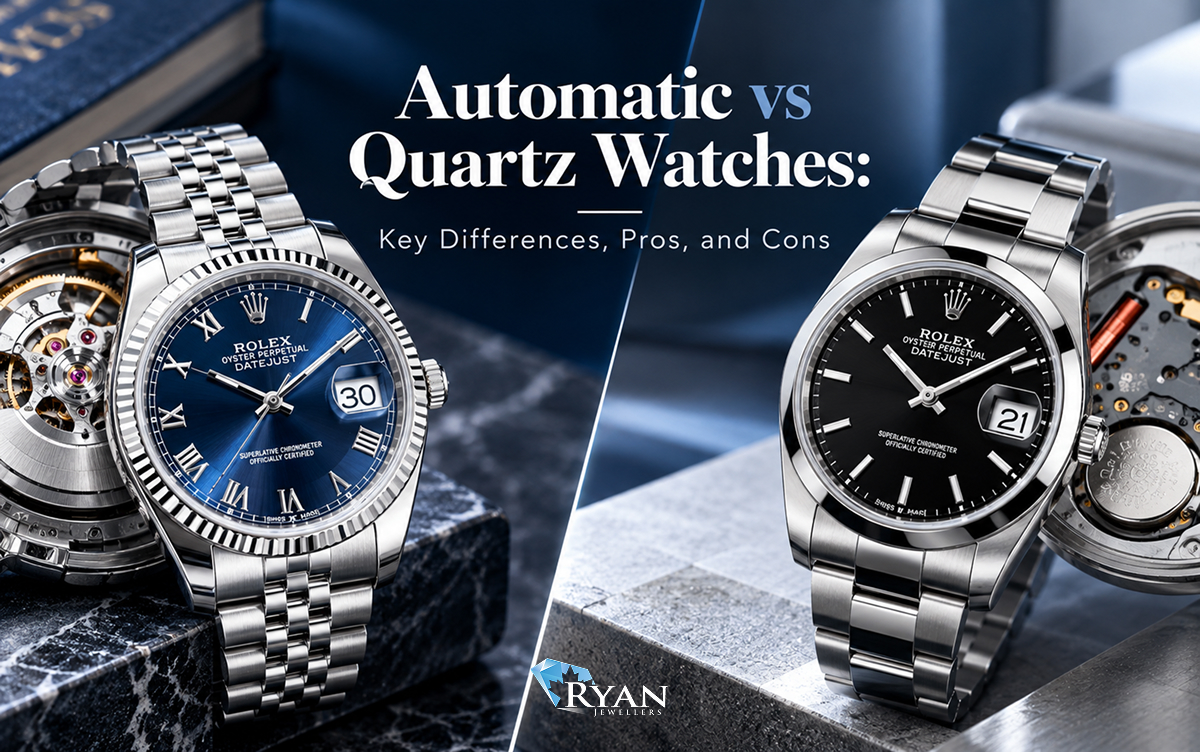
When choosing a watch, one of the most important decisions is the movement. Automatic vs quartz watches represent two fundamentally different approaches to timekeeping. Automatic watches use mechanical components and a mainspring, while quartz watches rely on an electronic oscillator regulated by a quartz crystal.
Neither movement is universally better. Quartz watches are generally known for accuracy, convenience, and relatively low maintenance, while automatic watches appeal to buyers who appreciate mechanical craftsmanship and traditional watchmaking.
For Canadian buyers, the choice can also depend on how often the watch will be worn, the desired budget, maintenance expectations, and whether the watch is primarily intended for everyday use, formal occasions, or collecting.
If you’re comparing different watch styles and movements, explore Ryan Jeweller to discover timepieces suited to different preferences and occasions.
What Is an Automatic Watch?
An automatic watch is a type of mechanical watch that uses a mainspring as its source of energy.
Unlike a manually wound mechanical watch, an automatic movement incorporates a rotor that can rotate as the wearer moves their wrist. This motion helps wind the mainspring and replenish the movement’s stored energy.
How an Automatic Movement Works
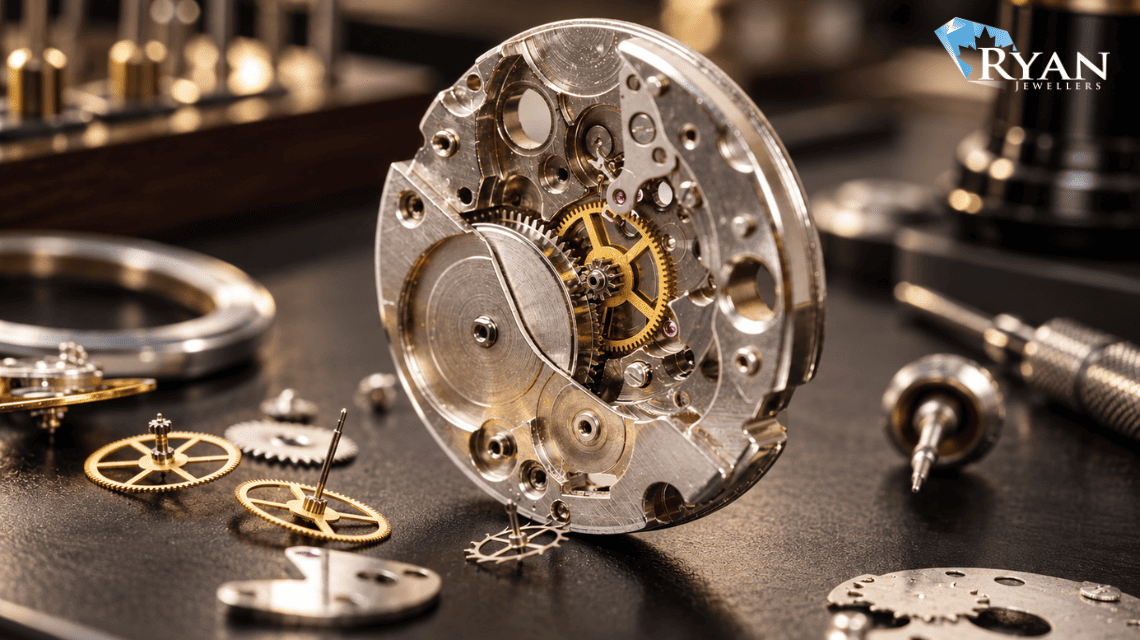
Although automatic movements vary in construction, the basic process involves several key components:
- The rotor moves as the watch moves.
- The rotor transfers energy through the winding mechanism.
- The mainspring stores that energy.
- The gear train transfers the energy through the movement.
- The escapement regulates the release of energy.
- The balance wheel oscillates to regulate timekeeping.
- The hands display the time.
This mechanical system operates without a conventional battery.
What Happens When an Automatic Watch Is Not Worn?
An automatic watch does not generate unlimited power.
It stores energy in its mainspring, which gives the watch a specific power reserve.
If the watch is left unworn for long enough, the stored energy will eventually run out and the watch will stop.
Depending on the movement, it may then need to be wound or worn again before it resumes operation.
Advantages of Automatic Watches
Automatic watches can appeal to people who appreciate:
- Mechanical craftsmanship
- Traditional watchmaking
- Movement finishing
- Mechanical complexity
- Collectability
- The experience of wearing a mechanical timepiece
For many enthusiasts, the movement itself is part of the attraction.
Disadvantages of Automatic Watches
Automatic watches also have practical considerations.
They can:
- Be less accurate than quartz watches
- Require periodic mechanical servicing
- Stop if left unworn for too long
- Be more sensitive to shocks and magnetic fields depending on the movement
- Cost more to manufacture and service
These factors do not make automatic watches inferior. They simply reflect the characteristics of mechanical timekeeping.
What Is a Quartz Watch and How Does It Work?
A quartz watch uses an electronic system regulated by a quartz crystal.
Quartz technology became widely adopted because it offered a highly practical way to achieve accurate timekeeping.
How Quartz Timekeeping Works
The basic process is different from a mechanical movement.
A battery or other power source supplies electricity to the electronic circuit.
The quartz crystal oscillates at a precise frequency when an electrical current is applied.
The electronic circuit uses these oscillations as a reference for measuring time.
Depending on the design, the electronic signal is then used to drive a stepper motor that moves the hands.
Digital quartz watches can instead use the electronic signal to control a digital display.
Advantages of Quartz Watches
Quartz watches are generally valued for:
- High accuracy
- Convenience
- Low routine maintenance
- Easy everyday use
- Wide availability
- Often lower purchase prices
A quartz watch does not need to be wound every day.
Battery Life
Many traditional quartz watches use replaceable batteries.
Battery life varies depending on:
- Movement
- Battery type
- Functions
- Chronograph use
- Power requirements
Some watches use alternative electronic power systems, including solar-powered technology.
Therefore, not every quartz watch requires the same type of battery maintenance.
Disadvantages of Quartz Watches
Quartz watches can be less appealing to buyers who specifically value traditional mechanical watchmaking.
Potential disadvantages include:
- Less mechanical craftsmanship
- Electronic components may require replacement
- Battery replacement for applicable models
- Less mechanical interaction for enthusiasts
However, these are primarily matters of preference rather than fundamental quality.
What Are the Main Differences Between Automatic and Quartz Watches?
The fundamental difference is the way each movement generates and regulates time.
| Feature | Automatic | Quartz |
|---|---|---|
| Movement type | Mechanical | Electronic |
| Primary energy source | Mainspring | Battery or other electronic power source |
| Winding | Automatic through rotor | Not normally required |
| Regulation | Mechanical oscillator | Quartz crystal |
| Typical accuracy | Varies by movement | Generally very high |
| Routine maintenance | Periodic mechanical servicing | Generally lower |
| Can stop when unused? | Yes | Depends on power source |
| Mechanical craftsmanship | High | Limited compared with mechanical |
| Typical ownership experience | Traditional and mechanical | Convenient and practical |
Automatic Watches Are Mechanical
The defining characteristic of an automatic watch is that it uses a mechanical movement.
There are no electronic quartz oscillators regulating the time.
Instead, mechanical components work together to control the release of energy.
Quartz Watches Are Electronic
Quartz watches use electronic regulation.
The quartz crystal provides a stable frequency reference, allowing the circuit to measure time very accurately.
This difference explains much of the contrast between the two technologies.
Automatic Watches Offer a Mechanical Experience
For enthusiasts, an automatic watch can be more than a timekeeping instrument.
The movement can become part of the appeal.
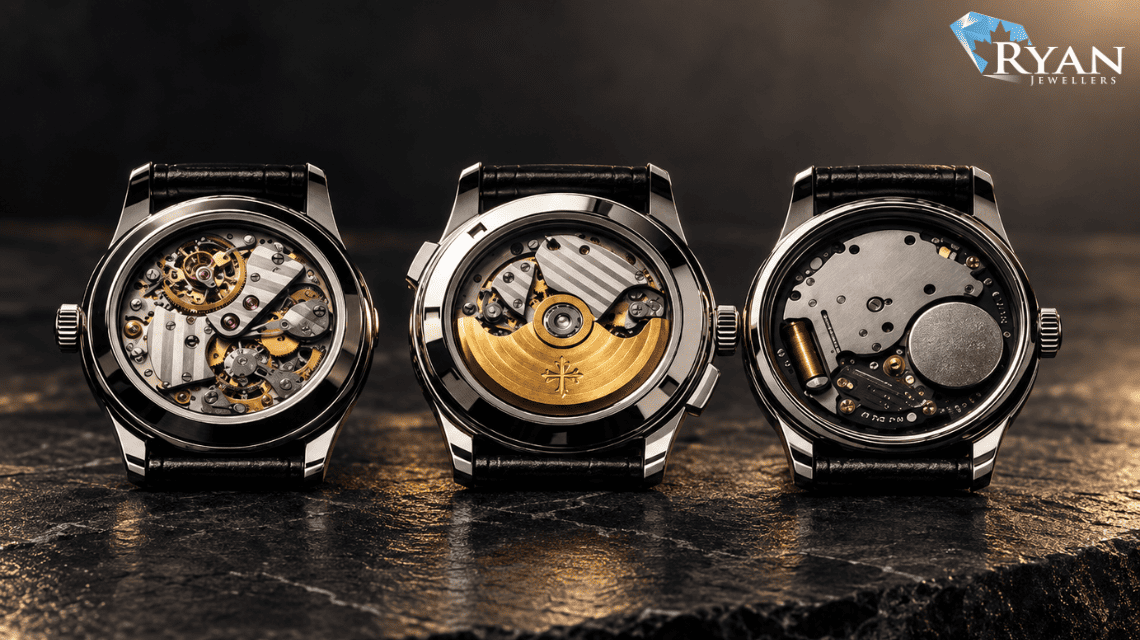
Some luxury automatic watches feature visible casebacks, allowing the wearer to see:
- Rotor
- Bridges
- Balance wheel
- Gears
- Finishing
- Engraving
This is one reason mechanical watches remain popular despite the practical advantages of quartz technology.
Quartz Prioritizes Practicality
If the main goal is reliable and accurate everyday timekeeping, quartz offers considerable advantages.
A quartz watch can remain ready to wear without needing regular winding.
For someone who owns several watches and rotates between them, this can be especially convenient.
Which Type of Watch Is More Accurate and Easier to Maintain?
For most consumers, quartz is the clear winner for accuracy and convenience.
That does not mean automatic watches are inaccurate. Quality mechanical watches can maintain impressive performance, and some are manufactured and adjusted to strict accuracy standards.
However, quartz technology generally provides greater precision in everyday timekeeping.
Why Quartz Is Generally More Accurate
Quartz crystals oscillate at a highly stable frequency.
The electronic circuit uses that frequency as a precise reference for measuring time.
Mechanical watches, by comparison, depend on physical components whose performance can be affected by factors such as:
- Position
- Temperature
- Shock
- Magnetism
- Wear
- Movement condition
Modern mechanical movements incorporate technologies designed to reduce these effects, but mechanical timekeeping remains inherently more complex.
What About Automatic Watch Accuracy?
Automatic watches can vary considerably in accuracy.
Factors include:
- Movement design
- Regulation
- Construction
- Position
- Temperature
- Wear
- Magnetic exposure
A well-regulated mechanical watch can perform very well, but it should not be expected to behave exactly like a quartz watch.
Which Requires Less Maintenance?
Quartz generally requires less mechanical maintenance.
Depending on the movement, maintenance may involve:
- Battery replacement
- Inspection
- Seal replacement
- Occasional servicing
Automatic watches contain many mechanical components that move continuously when the watch is running.
Over time, lubricants can degrade and components can wear, making periodic servicing part of responsible ownership.
Water Resistance Still Matters
Neither movement type automatically makes a watch suitable for water exposure.
Water resistance depends on the watch’s overall construction, including:
- Case
- Crown
- Crystal
- Caseback
- Seals
- Pushers
Always follow the manufacturer’s instructions for swimming, showering, and diving.
Which Is Better for Everyday Wear?
If convenience is the priority, quartz is often the more practical choice.
If you enjoy mechanical craftsmanship and do not mind periodic servicing, an automatic watch can provide a more engaging ownership experience.
How Do Automatic and Quartz Watches Compare in Cost?
Price varies enormously within both categories.
It is therefore inaccurate to assume that every automatic watch is expensive or every quartz watch is inexpensive.
Quartz Watch Pricing
Quartz watches are available across a very broad price range.
At accessible price points, quartz can provide excellent value because the technology is relatively efficient to manufacture.
Luxury manufacturers also produce quartz watches using premium materials, refined finishing, and sophisticated designs.
Therefore, quartz does not automatically mean inexpensive.
Automatic Watch Pricing
Automatic watches can also range from relatively accessible models to extremely expensive luxury timepieces.
The price may reflect:
- Movement complexity
- Movement finishing
- Case materials
- Bracelet quality
- Complications
- Hand craftsmanship
- Brand heritage
- Limited production
An automatic watch with a simple movement can therefore cost much less than a highly complicated luxury automatic watch.
Why Automatic Watches Can Cost More
Mechanical movements require numerous precisely manufactured components.
Depending on the watch, these may include:
- Gears
- Springs
- Jewels
- Bridges
- Balance assembly
- Escapement
- Rotor
- Winding system
Assembly and adjustment can also require considerable skilled labour.
Luxury mechanical watches may receive additional finishing and decoration, further increasing manufacturing costs.
Quartz Can Offer Better Practical Value
If your definition of value is:
Accuracy + convenience + low maintenance
then quartz can be extremely difficult to beat.
A relatively affordable quartz watch may outperform a much more expensive mechanical watch in basic timekeeping accuracy.
Automatic Can Offer Different Value
If your definition of value includes:
Craftsmanship + mechanical engineering + finishing + horological tradition
then an automatic watch may provide greater personal value.
This is why comparing automatic and quartz watches purely by price can be misleading.
Consider Long-Term Ownership
When comparing prices in Canada, consider more than the purchase price.
Potential ownership expenses include:
- Servicing
- Battery replacement
- Strap replacement
- Bracelet adjustment
- Repairs
- Insurance
- Applicable taxes
For mechanical watches, servicing can represent a more significant long-term expense.
Automatic vs Quartz Watches: Which Should You Choose?
The best choice depends on what you want from your watch.
Choose Automatic If You Value:
Mechanical craftsmanship
You enjoy the engineering behind a traditional mechanical movement.
Horological tradition
You appreciate the history of mechanical watchmaking.
Movement finishing
You enjoy seeing and examining the components inside the watch.
Collectability
You are interested in building a collection around movements, brands, complications, or design.
The ownership experience
You enjoy winding, wearing, and interacting with a mechanical timepiece.
Choose Quartz If You Value:
Accuracy
You want highly precise everyday timekeeping.
Convenience
You want a watch that can sit unused without requiring daily winding.
Low maintenance
You prefer fewer mechanical servicing requirements.
Practicality
You want a reliable everyday timepiece without unnecessary complexity.
Budget efficiency
You want strong everyday performance without necessarily paying for mechanical craftsmanship.
Automatic vs Quartz Watches for Different Lifestyles
Your lifestyle can make the decision easier.
For Office and Business Wear
Both can work well.
Choose automatic if you appreciate mechanical sophistication.
Choose quartz if you want a dependable, low-maintenance watch for daily business use.
For Frequent Travel
Quartz can be particularly convenient because it generally requires less attention when switching between watches.
However, an automatic GMT watch can provide a useful combination of mechanical craftsmanship and multiple-time-zone functionality.
For Outdoor Activities
Quartz can be practical because of its accuracy and convenience.
Depending on the model, rugged quartz watches can also offer excellent durability and useful features.
For Formal Events
Both movements can be appropriate.
The movement is often less important than:
- Case proportions
- Materials
- Dial design
- Strap
- Overall styling
For Watch Collectors
Automatic and manual mechanical watches are often particularly attractive to collectors because the movement itself can be an important part of the watch’s identity.
For Everyday Practicality
Quartz generally has the advantage.
If you want a watch that is simply ready to wear and highly accurate, quartz is difficult to beat.
What About Luxury Automatic and Quartz Watches?
The assumption that luxury watches must be mechanical is not entirely accurate.
Luxury manufacturers have produced quartz watches that use:
- Precious metals
- High-quality finishing
- Sophisticated electronic movements
- Refined cases
- Premium bracelets
- Distinctive designs
The key difference is that luxury and mechanical are not synonymous.
A luxury watch can be defined by many factors, including:
- Craftsmanship
- Materials
- Design
- Finishing
- Brand heritage
- Exclusivity
- Technical innovation
Mechanical movements are particularly valued in traditional haute horlogerie, but quartz technology can still play a role in premium watchmaking.
How Should You Compare an Automatic and Quartz Watch?
If you are choosing between two specific watches, use a practical checklist.
1. Compare the Movement
Determine whether each watch uses:
- Automatic
- Manual mechanical
- Quartz
- Solar quartz
- Another technology
2. Compare Accuracy
If precise everyday timekeeping is your highest priority, quartz generally has the advantage.
3. Compare Maintenance
Ask:
- How often does it require servicing?
- Does it require a battery?
- Are replacement components readily available?
- What does servicing typically involve?
4. Compare Materials
Look at:
- Case material
- Crystal
- Bracelet
- Strap
- Bezel
5. Compare Comfort
Check:
- Case diameter
- Lug-to-lug length
- Thickness
- Weight
- Bracelet or strap
6. Compare Your Actual Use
Ask yourself whether the watch will be:
- Worn every day
- Rotated with other watches
- Used for formal occasions
- Used during travel
- Part of a collection
The answer can make the movement choice much clearer.
If you want a more detailed overview before making a purchase, read our Watch Buying Guide for practical advice on movements, sizing, materials, features, and budget.
FAQ About Automatic vs Quartz Watches
Are automatic watches better than quartz watches?
Not universally. Automatic watches offer mechanical craftsmanship and a traditional ownership experience, while quartz watches generally provide greater accuracy, convenience, and lower maintenance.
Which is more accurate, automatic or quartz?
Quartz watches are generally more accurate than mechanical automatic watches because their timekeeping is regulated electronically using a quartz crystal.
Do automatic watches need batteries?
No. Traditional automatic watches use a mainspring and mechanical movement rather than a conventional battery. The mainspring is wound through the movement of the rotor and can also typically be wound manually through the crown.
Are quartz watches cheaper than automatic watches?
Quartz watches are often less expensive, but this is not always the case. Luxury quartz watches can be very expensive, while some automatic watches are relatively affordable. Price depends on materials, movement, craftsmanship, brand, and other factors.
Which watch is easier to maintain?
Quartz watches generally require less routine maintenance. Automatic watches contain more moving mechanical components and typically require periodic servicing.
Which should I buy for everyday use?
If you prioritize accuracy, convenience, and low maintenance, quartz is often the practical choice. If you enjoy mechanical craftsmanship and traditional watchmaking, an automatic watch may be more rewarding.
Final Thoughts
When comparing automatic vs quartz watches, there is no universally better choice. The right movement depends on what you value most in a watch.
Quartz watches are generally the practical choice for buyers who prioritize accuracy, convenience, and lower maintenance. Automatic watches, on the other hand, offer the appeal of mechanical craftsmanship, traditional watchmaking, and the intricate movement that operates beneath the dial.
Your decision should also consider how you plan to wear the watch, your budget, preferred design, case size, materials, and long-term ownership requirements. If you want a reliable everyday timepiece that requires minimal attention, quartz may be the better fit. If you appreciate the engineering and craftsmanship of mechanical watchmaking, an automatic watch may provide a more rewarding experience.
Ultimately, the best watch is the one that matches your lifestyle, priorities, and personal style rather than simply the one with the more expensive or complicated movement.
Ready to explore different watch styles and movements? Visit Ryan Jeweller to discover a selection of watches and fine jewelry designed for different tastes and occasions.