
Summarize the article with:


When it comes to luxury dive watches, few names carry as much recognition as the Omega Seamaster and Rolex Submariner. Both collections have shaped the history of Swiss watchmaking through their precision, durability, water resistance, and distinctive designs. However, each offers a different combination of technology, craftsmanship, and ownership experience.
The Omega Seamaster vs Rolex Submariner comparison is particularly relevant for Canadian buyers looking to purchase a luxury timepiece. While Omega emphasizes modern movement technology and versatile styling, Rolex focuses on refined engineering, timeless aesthetics, and strong brand recognition.
Whether you are purchasing your first luxury watch or expanding an existing collection, understanding these differences can help you make a more informed decision.
At Ryan Jeweller, we believe that choosing a luxury timepiece begins with understanding its craftsmanship, functionality, and long-term value.
How Do the Omega Seamaster and Rolex Submariner Differ?
Although both watches have deep connections to professional diving, Omega and Rolex have developed distinct identities over several decades.
History and Brand Heritage
Omega introduced the Seamaster collection in 1948. Over time, the collection expanded to include several specialized dive watches. In 1993, Omega launched the Seamaster Diver 300M, which later gained international recognition through its association with the James Bond film franchise.
Rolex introduced the Submariner in 1953. Its functional design helped establish many of the characteristics that define modern dive watches, including a rotating timing bezel, luminous hour markers, and a highly legible dial.
While the Seamaster has evolved through different materials, colours, and technological innovations, the Submariner has maintained a remarkably consistent visual identity.
Design and Visual Identity
The Omega Seamaster Diver 300M typically features:
- A distinctive wave-patterned dial on many references.
- Skeletonized hands and luminous hour markers.
- A helium escape valve positioned at 10 o’clock.
- A sporty, contemporary case design.
- Multiple dial colours and bracelet configurations.
- A transparent sapphire caseback on many models.
In comparison, the Rolex Submariner features:
- A clean, highly recognizable dial.
- Mercedes-style hour hand.
- A streamlined Oyster case.
- A Cerachrom ceramic bezel.
- A traditional solid caseback.
- A classic Oyster bracelet.
Consequently, the Seamaster appeals to buyers who appreciate modern details, while the Submariner attracts those who prefer understated and timeless luxury.
Omega Seamaster vs Rolex Submariner: Quick Comparison
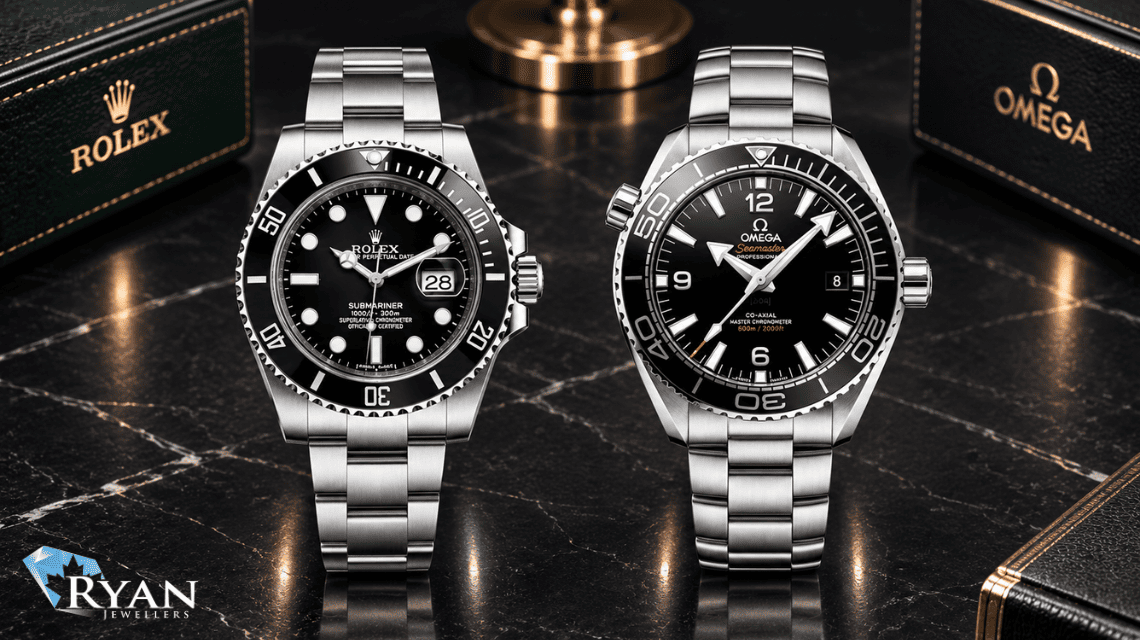
The following table compares the Omega Seamaster Diver 300M reference 210.30.42.20.01.001 with the Rolex Submariner reference 124060.
| Feature | Omega Seamaster Diver 300M | Rolex Submariner |
|---|---|---|
| Collection introduction | 1948 | 1953 |
| Case diameter | 42 mm | 41 mm |
| Case material | Stainless steel | Oystersteel |
| Movement | Omega Calibre 8800 | Rolex Calibre 3230 |
| Power reserve | 55 hours | 70 hours |
| Water resistance | 300 metres | 300 metres |
| Accuracy standard | 0/+5 seconds per day | -2/+2 seconds per day |
| Certification | Master Chronometer | Superlative Chronometer |
| Magnetic resistance | 15,000 gauss | No comparable published rating |
| Bezel material | Ceramic | Cerachrom ceramic |
| Helium escape valve | Yes | No |
| Date display | Yes | No |
| Caseback | Transparent sapphire | Solid |
| Manufacturer warranty | 5 years | 5 years |
Specifications may vary across different references within each collection.
How Do Their Movements and Performance Compare?
Movement technology is one of the most important factors in the Omega Seamaster vs Rolex Submariner comparison. Both brands develop sophisticated mechanical movements, but their engineering priorities differ.
Omega Co-Axial Master Chronometer Calibre 8800
The Omega Seamaster Diver 300M uses the Calibre 8800 in many standard date-equipped models. This automatic movement incorporates Omega’s Co-Axial escapement, which helps reduce friction between certain movement components.
Its key technical characteristics include:
- Approximately 55 hours of power reserve.
- Resistance to magnetic fields of 15,000 gauss.
- Master Chronometer certification.
- A silicon balance spring.
- An average daily precision standard of 0/+5 seconds.
Furthermore, Master Chronometer testing evaluates the finished watch under different conditions, including magnetic exposure, temperature variations, and movement positions.
This magnetic resistance is particularly useful in modern environments where people regularly encounter electronic devices and magnetic accessories.
Rolex Calibre 3230 and 3235
The Rolex Submariner without a date display uses Calibre 3230, while the Submariner Date features Calibre 3235.
Both automatic movements incorporate Rolex’s Chronergy escapement, which improves energy efficiency while maintaining mechanical reliability.
Their key characteristics include:
- Approximately 70 hours of power reserve.
- Superlative Chronometer certification.
- A precision tolerance of -2/+2 seconds per day after casing.
- A Parachrom hairspring.
- Paraflex shock absorbers.
In particular, the longer power reserve allows owners to remove their watches for an extended period without immediately needing to reset the time.
Which Movement Offers Better Performance?
Rolex offers a longer power reserve and a narrower stated daily precision tolerance. Meanwhile, Omega stands out for its independently certified magnetic resistance and Master Chronometer testing standards.
However, the two brands use different testing protocols. Therefore, comparing their accuracy figures alone does not provide a complete picture of real-world performance.
Both movements offer excellent reliability for everyday wear, making the final decision largely dependent on individual priorities.
How Do Their Case Materials, Sizes, and Water Resistance Compare?
The construction of a luxury dive watch directly influences its durability, comfort, appearance, and underwater performance.
Case Materials and Durability
Omega uses stainless steel for many standard Seamaster Diver 300M models. This material offers excellent corrosion resistance and durability, making it suitable for everyday wear and marine environments.
Rolex, on the other hand, uses Oystersteel, an alloy belonging to the 904L stainless-steel family. It provides excellent corrosion resistance and can achieve a distinctive polished finish.
Although the materials differ, both offer the durability expected from premium Swiss dive watches. Nevertheless, neither material is completely immune to scratches or everyday wear.
Case Size and Wrist Comfort
The standard Omega Seamaster Diver 300M measures 42 mm in diameter, while the current Rolex Submariner measures 41 mm.
Despite the relatively small difference, their case thickness, bracelet construction, and overall proportions influence how they feel on the wrist.
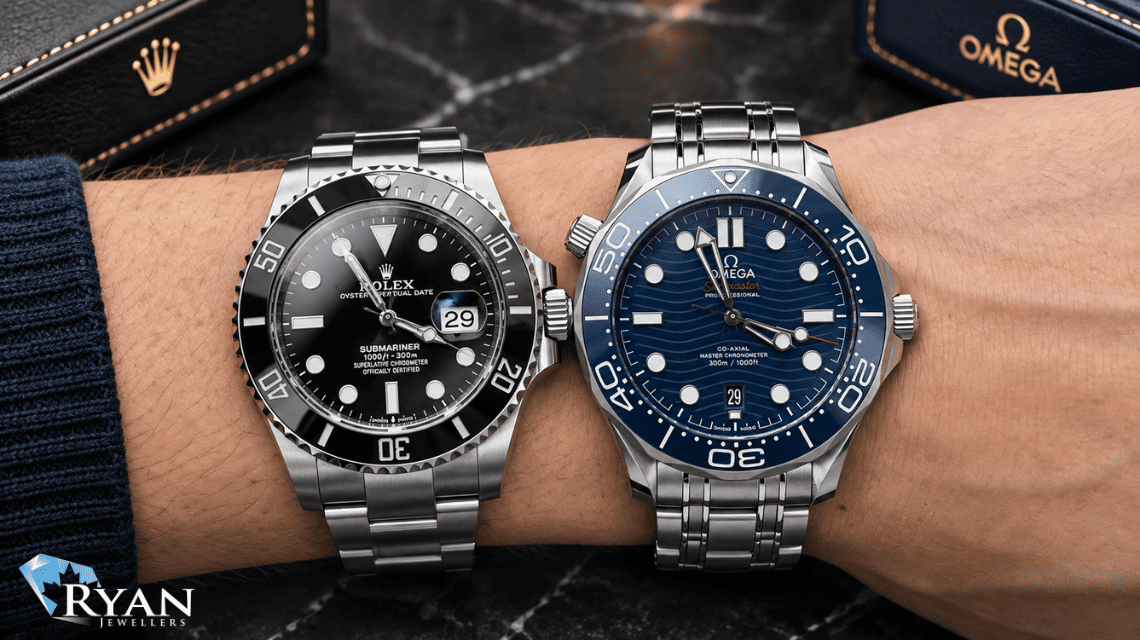
The Seamaster generally creates a sportier wrist presence. In contrast, the Submariner offers more restrained proportions that transition comfortably between casual and professional environments.
Additionally, Rolex’s Glidelock extension system allows wearers to adjust bracelet length without tools. The standard steel Seamaster also offers a bracelet clasp with comfort adjustment and a diver’s extension.
Water Resistance and Diving Features
Both watches offer water resistance of 300 metres, making them suitable for recreational scuba diving when properly maintained.
However, Omega includes a helium escape valve, which allows accumulated helium to escape during decompression in saturation diving environments.
The Rolex Submariner does not feature a helium escape valve. Instead, Rolex incorporates this technology into its specialized Sea-Dweller collection.
For most owners, this difference has little practical impact. Nevertheless, the helium escape valve remains an important part of the Seamaster’s technical and visual identity.
Dial, Bezel, and Crystal
Both watches feature scratch-resistant sapphire crystals and unidirectional rotating bezels that allow divers to monitor elapsed time.
Omega uses a black ceramic bezel with a white enamel diving scale on its standard black Seamaster Diver 300M. Meanwhile, Rolex incorporates a Cerachrom ceramic bezel insert with platinum-coated markings.
Furthermore, both watches provide excellent low-light visibility through their luminous hands and hour markers.
How Do Their Prices and Ownership Costs Differ?
For Canadian buyers, price is often a deciding factor when comparing the Omega Seamaster vs Rolex Submariner.
Although both belong to the Swiss luxury watch segment, they occupy different retail price positions.
Omega Seamaster vs Rolex Submariner Price in Canada
The following table provides indicative Canadian retail prices for popular stainless-steel models.
| Watch Model | Reference | Approximate Retail Price (CAD) |
|---|---|---|
| Omega Seamaster Diver 300M | 210.30.42.20.01.001 | $8,700 |
| Rolex Submariner | 124060 | $12,800 |
| Rolex Submariner Date | 126610LN | $14,350 |
| Rolex Submariner Date Green Bezel | 126610LV | $15,050 |
Prices are approximate estimates before applicable Canadian taxes. Actual retail prices and availability may vary.
The Omega Seamaster offers a considerably lower entry price. Moreover, it includes a date complication, advanced movement technology, and 300-metre water resistance at that price point.
On the other hand, the Rolex Submariner commands a higher retail price, reflecting its market positioning, brand recognition, and consumer demand.
Maintenance and Servicing Costs
Both watches require periodic maintenance to preserve movement performance and water resistance.
Omega generally recommends a complete service every five to eight years, depending on usage and operating conditions. Meanwhile, Rolex generally recommends servicing approximately every ten years, depending on the model and real-world use.
However, actual servicing costs depend on several factors:
- Watch age and condition.
- Movement complexity.
- Replacement components.
- Water resistance testing.
- Bracelet and case restoration requirements.
Therefore, buyers should consider long-term maintenance expenses alongside the initial purchase price.
Both manufacturers also offer a five-year international warranty on qualifying new watches, subject to their respective warranty conditions.
Resale Value and Market Demand
Rolex generally demonstrates stronger resale value retention, particularly for popular stainless-steel Submariner references.
Several factors contribute to this performance, including global demand, brand recognition, production availability, and collector interest.
Omega also maintains an established secondary market. However, standard Seamaster Diver 300M models often trade below their original retail prices.
As a result, purchasing a pre-owned Seamaster may provide excellent value for buyers who prioritize technical performance over resale potential.
Nevertheless, neither watch guarantees financial appreciation. Secondary market prices can fluctuate according to economic conditions, consumer preferences, and product availability.
Availability in Canada
Omega Seamaster models are generally easier to purchase through authorized retailers, with numerous dial colours and configurations available.
In contrast, popular Rolex Submariner references may have limited availability through authorized dealers. Buyers seeking immediate ownership sometimes turn to the secondary market, where prices can exceed official retail pricing.
Consequently, availability and purchasing flexibility may influence the overall ownership experience.
Which Luxury Dive Watch Should You Choose?
The right choice in the Omega Seamaster vs Rolex Submariner comparison ultimately depends on your lifestyle, budget, design preferences, and long-term expectations.
Choose the Omega Seamaster for Modern Technology and Value
The Omega Seamaster Diver 300M is an excellent choice for buyers who appreciate contemporary design and advanced watchmaking technology.
Its Master Chronometer movement, magnetic resistance, transparent caseback, and distinctive dial provide a compelling combination of performance and craftsmanship.
Additionally, its lower Canadian retail price makes it attractive to buyers who want a premium Swiss mechanical watch without reaching the Submariner’s price range.
The Seamaster is particularly suitable for individuals who prioritize technical innovation, design variety, and purchasing flexibility.
Choose the Rolex Submariner for Timeless Design and Recognition
The Rolex Submariner appeals to buyers who appreciate understated styling, heritage, and long-term ownership appeal.
Its recognizable silhouette, extended power reserve, Oystersteel construction, and refined bracelet make it highly versatile.
Furthermore, its strong presence in the secondary market may appeal to collectors who consider value retention an important purchasing factor.
The Submariner is particularly suitable for individuals who prefer classic luxury watches with enduring visual appeal.
Which Watch Is Better for Different Lifestyles?
| Buying Priority | Recommended Watch |
|---|---|
| Advanced magnetic resistance | Omega Seamaster |
| Longer power reserve | Rolex Submariner |
| Lower initial purchase price | Omega Seamaster |
| Greater design variety | Omega Seamaster |
| Classic and understated styling | Rolex Submariner |
| Stronger historical value retention | Rolex Submariner |
| Transparent movement display | Omega Seamaster |
| Everyday versatility | Both |
| Recreational scuba diving | Both |
Ultimately, trying on both watches is one of the most effective ways to determine which model suits your wrist and personal style.
Explore the Watch Comparison Guide at Ryan Jewellers to compare luxury watch brands, models, features, and prices before choosing your next timepiece.
FAQ About Omega Seamaster vs Rolex Submariner
Is the Omega Seamaster better than the Rolex Submariner?
Neither watch is universally better. Omega offers advanced magnetic resistance, Master Chronometer certification, and a lower purchase price. Meanwhile, Rolex provides a longer power reserve, iconic styling, and generally stronger resale value retention.
How much does an Omega Seamaster cost compared to a Rolex Submariner in Canada?
A standard stainless-steel Omega Seamaster Diver 300M costs approximately $8,700 CAD, while the Rolex Submariner starts at approximately $12,800 CAD. The stainless-steel black Submariner Date costs approximately $14,350 CAD before taxes. Prices may vary by retailer and reference.
Which is more accurate, the Omega Seamaster or Rolex Submariner?
Rolex specifies a precision tolerance of -2/+2 seconds per day, while Omega’s Master Chronometer standard for the compared model is 0/+5 seconds per day. However, both brands use different testing procedures, and actual performance may vary depending on wearing conditions.
Does the Rolex Submariner hold its value better than the Omega Seamaster?
Generally, stainless-steel Rolex Submariner models demonstrate stronger historical resale value retention. However, resale performance depends on the specific reference, condition, purchase price, and secondary market demand.
Which watch is better for diving?
Both watches offer 300-metre water resistance and essential diving features. However, the Omega Seamaster includes a helium escape valve designed for saturation diving environments. For recreational diving, both watches provide comparable stated water resistance.
Is the Omega Seamaster or Rolex Submariner better for everyday wear?
Both watches are suitable for everyday wear. The Seamaster offers sportier styling and modern technical features, while the Submariner offers a more understated appearance and excellent versatility across casual, business, and formal settings.
Final Thoughts
The Omega Seamaster vs Rolex Submariner comparison highlights two exceptional interpretations of the modern luxury dive watch. Both combine Swiss craftsmanship, reliable automatic movements, impressive durability, and distinctive design.
The Omega Seamaster Diver 300M stands out for its advanced Co-Axial movement, magnetic resistance, contemporary aesthetics, and competitive Canadian pricing. Meanwhile, the Rolex Submariner distinguishes itself through its timeless design, longer power reserve, strong brand recognition, and historical value retention.
Ultimately, the best luxury watch is one that complements your lifestyle, reflects your personality, and delivers lasting satisfaction beyond its initial purchase.
Still exploring your options? Visit the Watch Comparison page at Ryan Jeweller to discover more detailed luxury watch comparisons and find the timepiece that best suits your preferences.