
Summarize the article with:


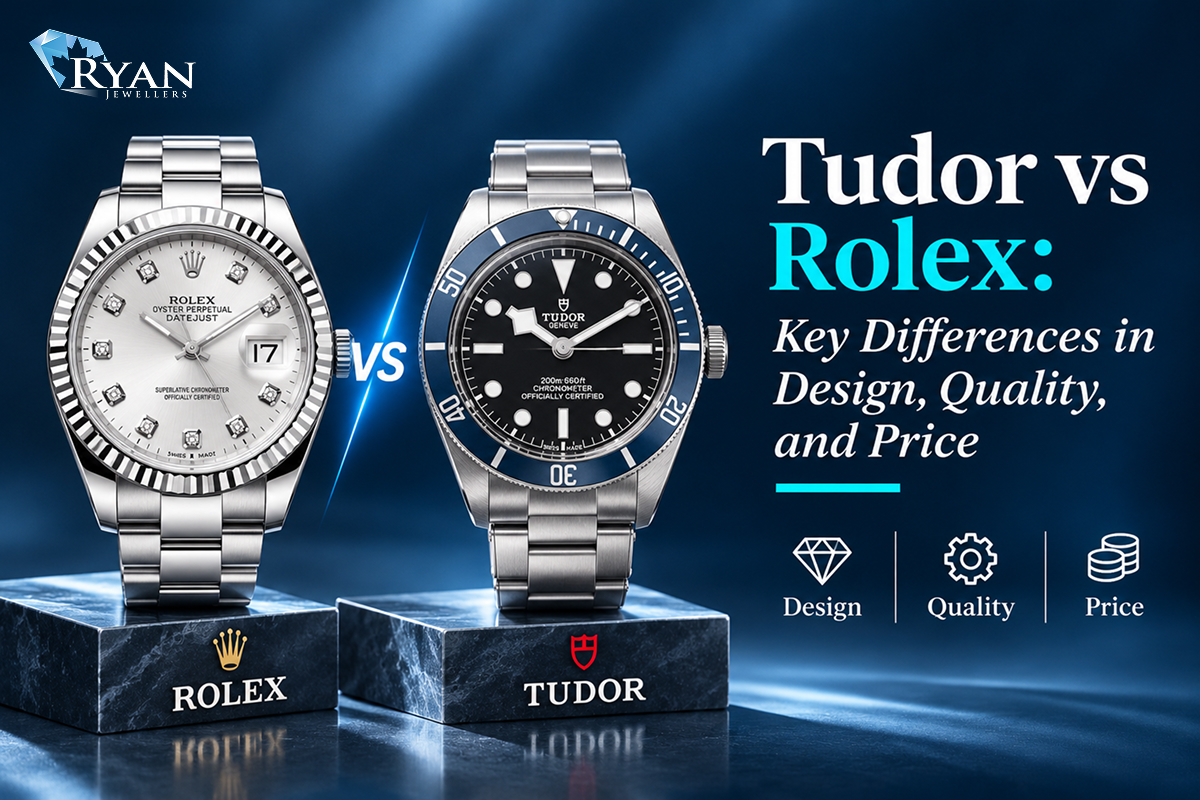
When comparing Tudor vs Rolex, the two brands are often mentioned together for good reason. TUDOR was created by Rolex founder Hans Wilsdorf as a separate brand intended to offer reliable watches at a more accessible price point. However, TUDOR has developed its own identity, collections, movements, and design language over the decades.
For Canadian buyers, the comparison goes beyond brand reputation. Case size, movement technology, materials, water resistance, warranty, availability, and Canadian retail pricing can all affect which watch is the better fit.
If you’re researching Tudor vs Rolex before buying, exploring both brands side by side can make it easier to understand what you’re paying for and which design suits your lifestyle. Ryan Jeweller offers a selection of luxury watches for Canadian buyers looking to compare established Swiss watch brands.
How Are Tudor and Rolex Connected?
The relationship between TUDOR and Rolex dates back to the vision of Hans Wilsdorf, the founder of Rolex.
TUDOR Was Created as a Separate Brand
The TUDOR trademark was registered for Hans Wilsdorf in 1926. In 1946, he created Montres TUDOR S.A. as a separate company. The original concept was to offer watches that maintained the dependability associated with Rolex while being positioned at a more accessible price.
This historical connection explains why early TUDOR watches sometimes shared design and technical characteristics with Rolex watches.
For example, early TUDOR models used Oyster-type cases and were closely associated with Rolex in their advertising and distribution. Rolex also supported TUDOR’s technical and after-sales operations during the brand’s early development.
TUDOR Is Not Simply a Lower-Priced Rolex
Although the brands share historical roots, modern TUDOR has its own product strategy and identity.
TUDOR’s collections include:
- Black Bay
- Black Bay 54
- Black Bay 58
- Pelagos
- Ranger
- 1926
- Royal
Rolex, meanwhile, offers collections such as:
- Oyster Perpetual
- Datejust
- Day-Date
- Submariner
- GMT-Master II
- Explorer
- Cosmograph Daytona
- Sea-Dweller
- Sky-Dweller
The two brands therefore overlap in some categories but are not interchangeable.
Shared Heritage, Different Positioning
TUDOR’s historical mission was to provide a more accessible alternative while maintaining strong standards of reliability. Today, it has developed increasingly sophisticated in-house movements and, on selected models, METAS Master Chronometer certification.
Rolex remains positioned at a higher luxury level, with extensive in-house manufacturing and its own Superlative Chronometer standards. Rolex describes itself as an integrated and independent Swiss watch manufacture that produces the majority of its components in-house.
Explore the Rolex Watches collection at Ryan Jewellers and discover iconic timepieces for your collection.
How Do Tudor and Rolex Watch Designs Compare?
Design is one of the clearest differences when comparing Tudor vs Rolex.
TUDOR: Heritage-Inspired and Sport-Focused
TUDOR has developed a particularly strong identity around vintage-inspired sports watches.
The Black Bay family is a good example.
The Black Bay 54 takes inspiration from TUDOR’s first diving watch and uses a 37 mm case with 200-metre water resistance. Its proportions deliberately reference the brand’s historical dive-watch designs.
The Black Bay 58 takes its name from 1958, the year associated with the introduction of TUDOR’s first 200-metre dive watch. Its 39 mm case provides a more compact profile than many contemporary sports watches.
The Pelagos takes a more technical approach, with models available in titanium and larger case sizes designed around professional diving.
Explore the TUDOR Watches collection at Ryan Jewellers and discover heritage-inspired timepieces for your collection.
Rolex: Iconic and Highly Consistent
Rolex has a broader design vocabulary, but many of its most recognizable models have remained visually consistent over generations.
Examples include:
- Submariner
- Datejust
- GMT-Master II
- Explorer
- Cosmograph Daytona
The Oyster case, distinctive bracelets, fluted bezels on selected models, and recognizable professional-watch designs contribute to Rolex’s strong visual identity.
Rolex’s current Canadian collection includes models ranging from the Oyster Perpetual to the Deepsea, Daytona, GMT-Master II, and Day-Date.
Case Sizes
TUDOR provides a broad range of contemporary sizes.
For example:
- Black Bay 54 — 37 mm
- Black Bay 58 — 39 mm
- Black Bay — 41 mm
- Pelagos — 39–43 mm depending on model
Rolex also offers numerous sizes across its collections, from smaller 28 mm models to large professional watches such as the 44 mm Deepsea and 50 mm Deepsea Challenge.
This means that neither brand is simply “larger” or “smaller.” The appropriate choice depends on the specific model.
Materials
Both brands use stainless steel and precious metals, while selected TUDOR models also use ceramic, bronze, titanium, and other materials.
TUDOR’s Pelagos collection, for example, includes titanium cases, while the Black Bay family includes steel, ceramic, bronze, silver, and gold configurations.
Rolex offers Oystersteel, gold alloys, platinum, and RLX titanium across its current collection.
How Do Their Movements and Technical Features Differ?
Movement technology is another important part of a Tudor vs Rolex comparison.
Both brands use mechanical movements extensively, but their approaches and certification systems differ.
Rolex Superlative Chronometer
Rolex applies its Superlative Chronometer certification to its watches after the movements have undergone official COSC certification.
The brand states that its fully assembled watches are tested for precision, power reserve, waterproofness, and self-winding performance.
Rolex’s stated precision tolerance for Superlative Chronometers is approximately −2/+2 seconds per day after casing.
This is an important distinction because the testing applies to the completed watch rather than only the uncased movement.
TUDOR Manufacture Calibres
TUDOR has progressively expanded its use of Manufacture Calibres.
Many modern TUDOR mechanical watches use movements developed specifically for the brand, with features such as:
- Variable-inertia balances
- Silicon balance springs on selected calibres
- Approximately 65–70 hours of power reserve depending on calibre
- COSC certification on many models
Selected newer TUDOR movements have also achieved METAS Master Chronometer certification.
For example, the Black Bay 58 GMT uses Manufacture Calibre MT5450-U, which is COSC and METAS certified and provides a certified 65-hour power reserve.
Anti-Magnetic Performance
Magnetic resistance has become an important technical feature in modern mechanical watches.
Selected TUDOR Master Chronometer movements are certified to resist magnetic fields up to 15,000 gauss.
Rolex also uses advanced materials and movement components designed to improve resistance to magnetic fields, but its certification system and technical approach are distinct from METAS Master Chronometer certification.
Water Resistance
Both brands offer watches designed for water-oriented use, but specifications vary by model.
Examples include:
TUDOR
- Black Bay 54 — 200 m
- Black Bay 58 — 200 m
- Pelagos — professional diving-oriented models with higher water-resistance specifications
Rolex
- Submariner — 300 m
- Sea-Dweller — 1,220 m
- Deepsea — 3,900 m
The exact specifications should always be checked for the individual reference rather than assumed from the brand name.
Bracelet and Clasp Technology
TUDOR has increasingly focused on practical bracelet adjustment systems.
The TUDOR T-fit clasp on selected models provides rapid adjustment without requiring tools.
Rolex also offers sophisticated bracelet adjustment systems, including Glidelock on selected professional watches.
For buyers who wear their watch throughout the day, these small details can have a significant impact on comfort.
How Do Tudor and Rolex Prices Compare?
Price is often the deciding factor when comparing Tudor vs Rolex, particularly for Canadian buyers.
The difference is significant, but it is important to compare equivalent categories rather than comparing entry-level models with precious-metal pieces.
TUDOR Pricing in Canada
Current TUDOR pricing shows that several mechanical sports models remain below typical Rolex pricing.
For example, current official TUDOR pricing includes:
- Black Bay 54 37 mm steel — CAD $4,725
- Black Bay 58 39 mm steel — approximately CAD $5,225–$5,350, depending on configuration
- Black Bay 58 GMT — approximately CAD $5,650
- Pelagos 39 — approximately CAD $5,625
- Pelagos Ultra — approximately CAD $6,900
- Black Bay Ceramic — approximately CAD $7,725
These are manufacturer-listed suggested retail prices and can vary by model and configuration.
Rolex Pricing in Canada
Rolex’s Canadian retail prices begin considerably higher for many comparable steel models.
Current examples include:
- Oyster Perpetual 28 — CAD $7,800
- Oyster Perpetual 36 — CAD $8,500
- Oyster Perpetual 41 — CAD $8,950
- Explorer 40 — CAD $10,600
- Submariner — CAD $12,800
- GMT-Master II — approximately CAD $15,000+, depending on configuration
At the upper end, Rolex’s precious-metal and gem-set watches can exceed CAD $100,000. For example, the current Canadian Rolex collection lists a platinum Cosmograph Daytona at CAD $107,100.
Why Is Rolex More Expensive?
The price difference cannot be attributed to one factor.
Rolex’s pricing reflects a combination of:
- Brand positioning
- Manufacturing infrastructure
- Materials
- Movement development
- Finishing
- Certification
- Production
- Distribution
- Demand
TUDOR, meanwhile, was historically developed around the concept of offering Rolex-associated reliability at a more accessible price and has maintained a distinct position within Swiss luxury watchmaking.
Is TUDOR Better Value?
For some buyers, yes.
A TUDOR can provide:
- Manufacture mechanical movement
- Strong water resistance
- Swiss chronometer certification on many models
- Heritage-inspired design
- Premium materials
- Long power reserves
- Five-year international guarantee on watches sold since 2020
TUDOR’s official guarantee covers watches sold since 2020 for five years internationally, subject to its conditions.
However, “better value” depends on what you value. Someone prioritizing Rolex’s brand identity, specific collections, or particular features may reasonably consider the higher price worthwhile.
Which Brand Should You Choose for Your Budget and Style?
The answer to Tudor vs Rolex becomes easier when you start with your intended use rather than the brand name.
Choose TUDOR If You Want Strong Value
TUDOR may be particularly appealing if you want a Swiss luxury mechanical watch without moving into Rolex’s typical price range.
The Black Bay 54 and Black Bay 58 are especially suitable for buyers who appreciate vintage-inspired proportions, while the Pelagos is better suited to those looking for a more technical diving watch.
Choose Rolex If Brand Recognition Matters
Rolex may be the stronger choice if you prioritize:
- Highly recognizable designs
- Broad international recognition
- Professional-watch heritage
- Classic collections
- Rolex’s Superlative Chronometer standards
- Specific models such as Submariner or GMT-Master II
The current Canadian collection demonstrates the breadth of Rolex’s offering, from relatively simple Oyster Perpetual models to complicated and precious-metal watches.
For a First Luxury Watch
For a buyer entering Swiss luxury watchmaking, the comparison can be especially interesting.
A TUDOR Black Bay 54 offers a compact 37 mm case, 200 m water resistance, and Manufacture Calibre MT5400.
A Rolex Oyster Perpetual 36 offers a 36 mm Oystersteel case and Rolex’s Calibre 3230 with Superlative Chronometer certification.
Both can function as versatile everyday watches, but their pricing and brand positioning are significantly different.
For Diving
Compare:
TUDOR Pelagos vs Rolex Submariner
The Pelagos family emphasizes professional diving, titanium construction on selected models, and practical technical features.
The Submariner is one of Rolex’s most recognizable professional watches and offers 300 m water resistance in its current standard configuration.
For Travel
Rolex has a particularly recognizable travel-watch option in the GMT-Master II.
TUDOR offers GMT functionality through models such as the Black Bay 58 GMT, which combines a 39 mm case with a GMT movement and, on the current model, COSC and METAS certification.
For Everyday Wear
Either brand can work well for everyday use.
Focus on:
- Case size
- Thickness
- Bracelet comfort
- Water resistance
- Power reserve
- Clasp adjustment
- Personal style
A watch that feels comfortable on your wrist will generally provide a better ownership experience than one chosen solely because of its prestige.
Tudor vs Rolex: Quick Comparison
| Category | TUDOR | Rolex |
|---|---|---|
| Brand origin | Registered in 1926; Montres TUDOR S.A. created in 1946 | Founded by Hans Wilsdorf |
| Historical connection | Created by Rolex founder Hans Wilsdorf | Parent heritage behind TUDOR’s creation |
| Positioning | Luxury with a comparatively accessible price point | Higher-positioned luxury |
| Key collections | Black Bay, Pelagos, Ranger, 1926, Royal | Datejust, Submariner, GMT-Master II, Explorer, Daytona |
| Movement approach | Manufacture calibres on many models | Extensive in-house manufacture |
| Certification | COSC on many models; METAS on selected models | Rolex Superlative Chronometer |
| Dive watches | Black Bay, Pelagos | Submariner, Sea-Dweller, Deepsea |
| GMT | Black Bay 58 GMT | GMT-Master II |
| Entry-level examples | Black Bay 54 from about CAD $4,475–$4,725 | Oyster Perpetual 28 from about CAD $7,800 |
| Warranty | Five-year international guarantee on watches sold since 2020, subject to conditions | Five-year international guarantee on qualifying new watches |
| Overall positioning | Sporty, heritage-focused, value-oriented | Premium, highly recognizable, broad luxury portfolio |
The prices shown are current manufacturer-listed examples and can change. TUDOR and Rolex also offer many configurations at substantially different prices.
Explore the Watch Comparison Guide at Ryan Jewellers to compare luxury watch brands, models, features, and prices before choosing your next timepiece.
FAQ About Tudor vs Rolex
Is TUDOR owned by Rolex?
TUDOR was created by Rolex founder Hans Wilsdorf as a separate company and brand. The two have a long historical connection, but TUDOR has developed its own identity and product portfolio.
Is TUDOR as good as Rolex?
TUDOR produces high-quality Swiss mechanical watches, including models with Manufacture Calibres and selected METAS Master Chronometer certification. Rolex occupies a different position in the luxury market, with its own manufacturing infrastructure and Superlative Chronometer standards. The better choice depends on the buyer’s priorities.
Is TUDOR cheaper than Rolex in Canada?
Generally, yes. Current official Canadian pricing includes TUDOR Black Bay 54 models from approximately CAD $4,475–$4,725, while the Rolex Oyster Perpetual 28 starts around CAD $7,800. Exact prices vary by model and configuration.
Which is better for diving, TUDOR or Rolex?
Both offer capable dive watches. TUDOR’s Pelagos and Black Bay families provide several diving-oriented options, while Rolex offers the Submariner, Sea-Dweller, and Deepsea. The right choice depends on the required depth rating, case size, materials, and budget.
Does TUDOR use Rolex movements?
Modern TUDOR has developed and uses its own Manufacture Calibres across many collections. The brand’s movements are distinct from Rolex movements, although TUDOR’s historical development was closely connected to Rolex.
Which brand should I buy, TUDOR or Rolex?
Choose TUDOR if you prioritize value, heritage-inspired sports designs, and a lower entry price. Rolex may be preferable if you prioritize brand recognition, iconic collections, Rolex’s specific technical standards, or particular models such as the Submariner or GMT-Master II.
Final Thoughts
The Tudor vs Rolex comparison is not simply a question of choosing between a cheaper and a more expensive watch.
Both brands share a remarkable historical connection through Hans Wilsdorf, but they have developed into distinct watchmakers with different market positions and design philosophies. TUDOR was originally created to offer dependable watches at a more accessible price, while Rolex developed its own integrated manufacturing approach and highly recognizable luxury-watch identity.
For Canadian buyers, the current price difference can be substantial. A TUDOR Black Bay 54 starts around CAD $4,475–$4,725 depending on configuration, while a Rolex Oyster Perpetual 28 starts around CAD $7,800. From there, both brands offer increasingly expensive models with precious metals, complications, and advanced technical features.
The best choice ultimately depends on what you value most. TUDOR can be compelling for buyers looking for strong specifications and heritage-inspired design at a comparatively accessible price. Rolex can make more sense for those who value its distinctive collections, extensive manufacturing capabilities, professional-watch heritage, and globally recognized identity.
If you’re comparing Tudor vs Rolex in Canada, explore the watch collections at Ryan Jeweller and compare the models, sizes, materials, and styles that best fit your budget and lifestyle.