
Summarize the article with:


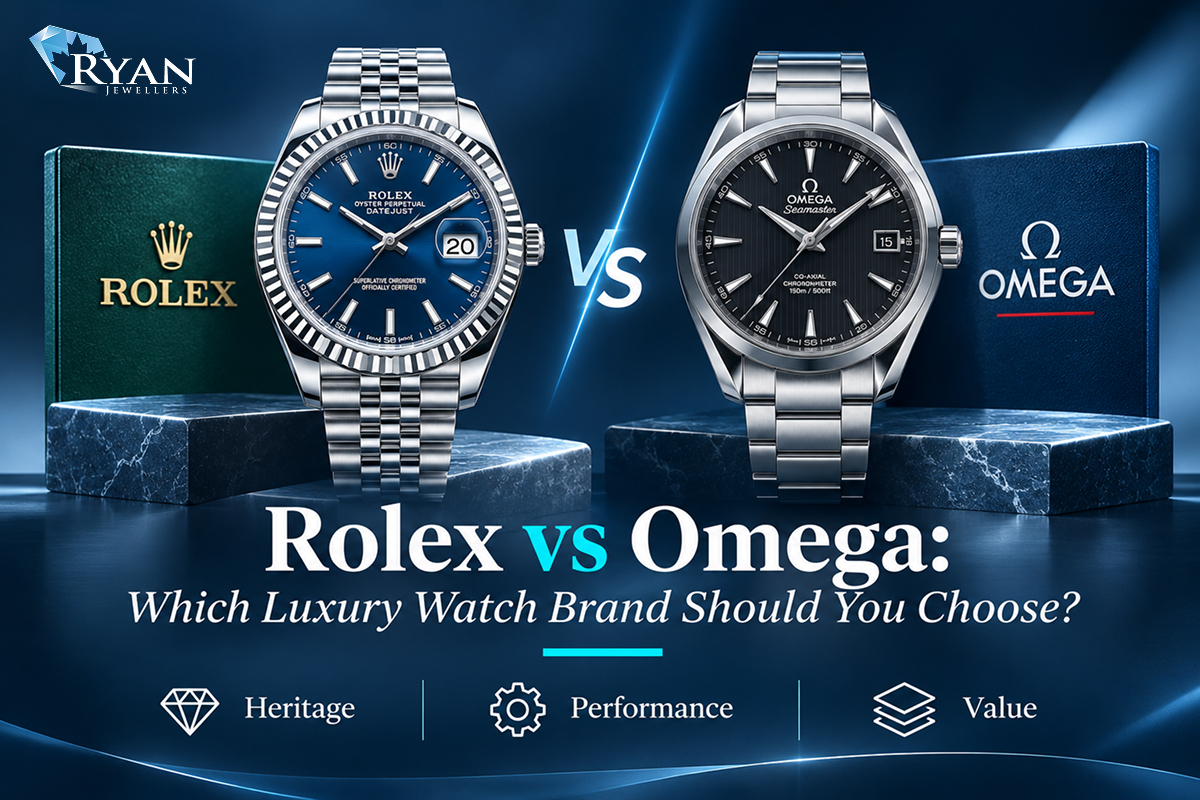
When comparing Rolex vs Omega, there is no simple answer to which brand is better. Both are highly respected Swiss watchmakers with extensive histories, strong technical capabilities, and collections designed for different types of buyers.
Rolex is particularly known for its recognizable designs, Oyster architecture, professional watches, and Superlative Chronometer certification. Omega has built a strong identity around precision, anti-magnetic technology, chronographs, diving watches, and collections such as the Speedmaster and Seamaster. Both brands offer a wide selection of case sizes, materials, complications, and price points.
For Canadian buyers, the decision should also take into account local pricing, warranty coverage, servicing, availability, and the type of watch you actually intend to wear.
If you’re researching Rolex vs Omega before making a purchase, explore the luxury watch selection at Ryan Jeweller to compare different brands, collections, and styles.
What Are the Main Differences Between Rolex and Omega?
The biggest differences between Rolex and Omega are found in their brand identity, design language, movement technology, collections, and approach to technical performance.
Rolex: Recognizable Design and Professional Heritage
Rolex has developed some of the most recognizable luxury-watch designs in the industry.
Its current collection includes models such as:
- Oyster Perpetual
- Datejust
- Day-Date
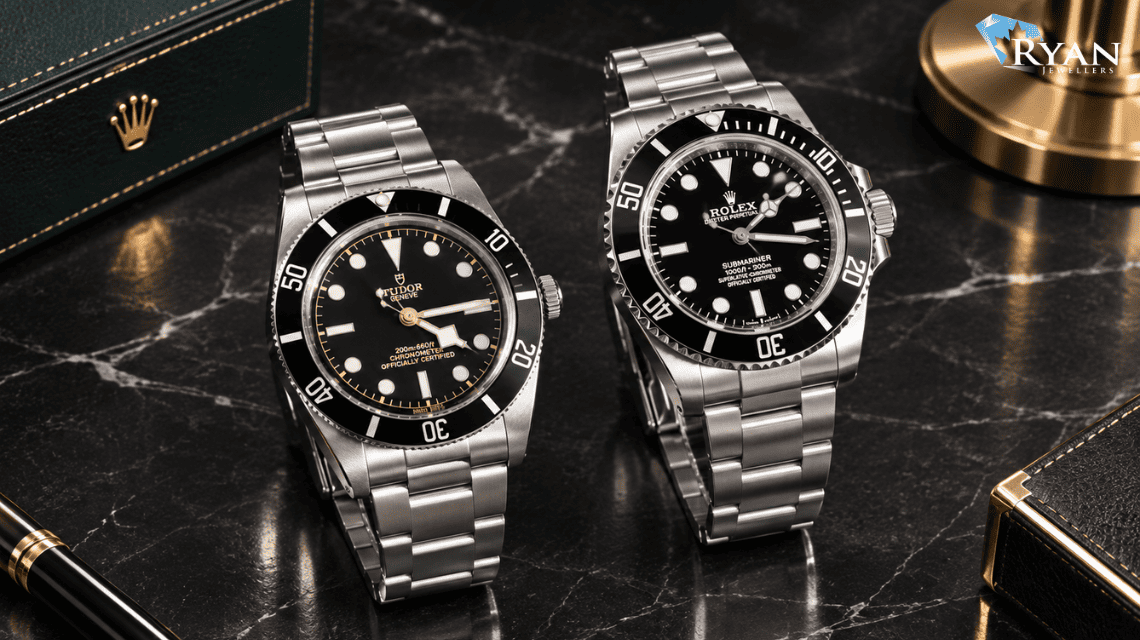
- Submariner
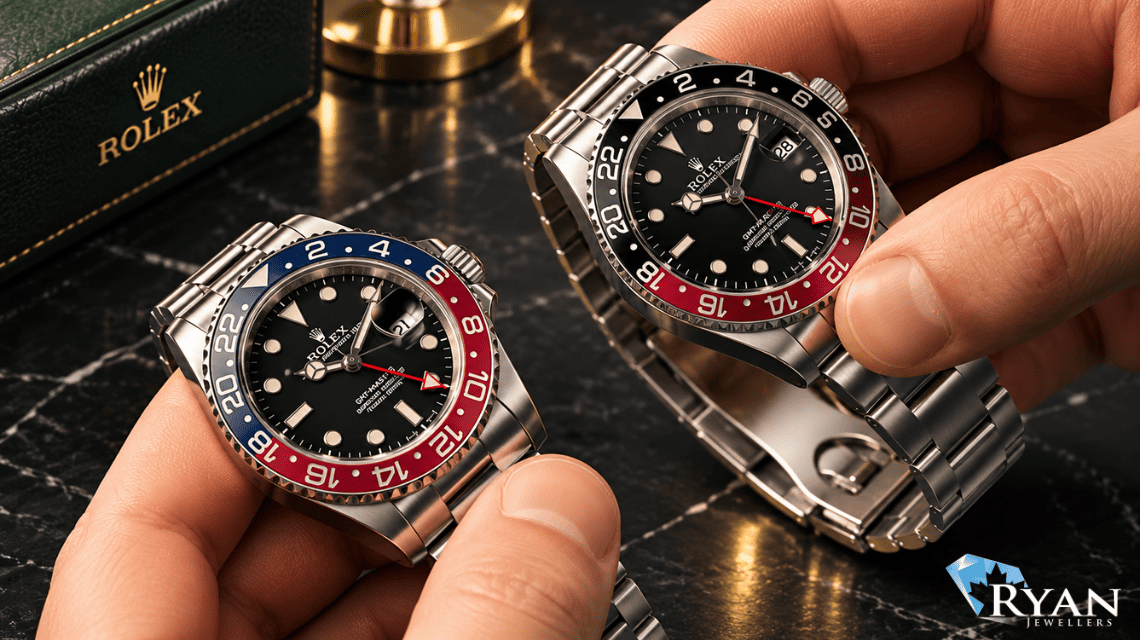
- GMT-Master II
- Explorer
- Explorer II
- Sea-Dweller
- Deepsea
- Cosmograph Daytona
- Sky-Dweller
- Yacht-Master
- 1908
The brand divides much of its collection between classic and professional watches, with models designed for activities such as diving, exploration, and international travel. Rolex’s Canadian collection currently includes Oystersteel, gold, platinum, and RLX titanium configurations.
Explore the Rolex Watches collection at Ryan Jewellers and discover iconic timepieces for your collection.
Omega: Technical Innovation and Versatile Collections
Omega also has a broad collection, but its identity is particularly associated with precision, exploration, professional timing, and anti-magnetic technology.
Major collections include:
- Speedmaster
- Seamaster
- Constellation
- De Ville
The Speedmaster is closely associated with space exploration and the Apollo missions, while the Seamaster family covers diving, professional sports, and everyday luxury models. Omega’s technical approach also places significant emphasis on Co-Axial escapements, Master Chronometer certification, and resistance to magnetic fields.
For example, Omega’s current Master Chronometer movements can be tested for resistance to magnetic fields of up to 15,000 gauss, along with precision, power reserve, and water resistance.
Explore the OMEGA Watches collection at Ryan Jewellers and discover iconic timepieces designed for every style and occasion.
Different Strengths Rather Than a Clear Winner
The distinction can be summarized broadly:
| Rolex | Omega |
|---|---|
| Strongly recognizable design language | Broad technical and historical identity |
| Oyster case architecture | Co-Axial movement technology |
| Superlative Chronometer certification | Master Chronometer certification on many models |
| Strong professional-watch heritage | Strong space, diving, and chronograph heritage |
| Submariner, GMT-Master II, Datejust | Speedmaster, Seamaster, Constellation |
| Strong emphasis on brand consistency | Broad variety of technical innovations |
Neither approach is inherently better. The more appropriate brand depends on what the buyer values.
How Do Rolex and Omega Watch Movements Compare?
Movement technology is one of the most interesting parts of a Rolex vs Omega comparison.
Both brands manufacture sophisticated mechanical movements, but they emphasize different technical characteristics.
Rolex Superlative Chronometer
Rolex subjects its watches to its own Superlative Chronometer certification after the movement has received official COSC certification.
The testing applies to the fully assembled watch and evaluates areas including precision, power reserve, waterproofness, and self-winding performance.
Rolex states that its Superlative Chronometer watches have a precision tolerance of approximately −2/+2 seconds per day after casing, which is stricter than the COSC requirement for the movement alone.
A current Rolex Oyster Perpetual 36, for example, uses Manufacture Rolex Calibre 3230, with approximately 70 hours of power reserve and Superlative Chronometer certification.
Omega Co-Axial Technology
Omega’s modern mechanical movements frequently use its Co-Axial escapement.
The brand states that the Co-Axial escapement reduces friction and the need for lubrication while helping maintain accuracy over longer periods. Many current Omega mechanical watches also incorporate silicon balance springs and Master Chronometer certification.
Omega’s Master Chronometer certification is conducted in cooperation with METAS and evaluates factors including:
- Chronometric precision
- Magnetic resistance
- Power reserve
- Water resistance
Omega states that its Master Chronometer watches can withstand magnetic fields up to 15,000 gauss.
Power Reserve
Power reserve varies by calibre and reference, so it should be compared model by model rather than brand by brand.
For example, Rolex’s Calibre 3230 provides approximately 70 hours of power reserve, while Omega’s Calibre 8900 used in the 41 mm Seamaster Aqua Terra provides approximately 60 hours.
Neither figure represents every watch made by either manufacturer.
Which Movement Is Better?
A Rolex vs Omega movement comparison should not be reduced to one specification.
Rolex emphasizes its own certification and performance standards, while Omega places considerable emphasis on Co-Axial technology, silicon components, and anti-magnetic Master Chronometer certification.
Both represent sophisticated approaches to modern mechanical watchmaking.
How Do Their Designs, Materials, and Craftsmanship Differ?
Design may ultimately be more important than technical specifications because it determines how the watch looks and feels on your wrist.
Rolex Design
Rolex designs tend to have a strong visual continuity across generations.
The Oyster case, Oyster bracelet, fluted bezel on selected Datejust models, and distinctive Professional watches have become closely associated with the brand.
The current Canadian Rolex collection includes cases made from:
- Oystersteel
- Yellow gold
- White gold
- Everose gold
- Platinum
- RLX titanium
The brand also offers numerous combinations of bracelets, bezels, dials, and gemstones.
Omega Design
Omega offers a wider range of visual identities across its collections.
The Speedmaster emphasizes chronograph functionality and its space-exploration heritage.
The Seamaster family includes diving-oriented designs as well as more versatile models such as the Aqua Terra.
The Constellation has a distinctive design language, while De Ville generally takes a more refined and formal approach.
Recent Aqua Terra models, for example, combine stainless-steel cases with ceramic bezels and integrated rubber straps, while offering 38 mm and 41 mm case sizes.
Case Materials
Both manufacturers use premium materials, but the specific availability depends on the model.
Rolex currently offers materials ranging from Oystersteel to platinum and RLX titanium.
Omega also uses stainless steel, titanium, ceramic, precious metals, and proprietary alloys across different collections.
The material can influence:
- Weight
- Durability
- Appearance
- Scratch behaviour
- Price
- Comfort
Sapphire Crystal
Modern luxury watches from both brands commonly use sapphire crystal because of its high scratch resistance.
However, the exact crystal construction and anti-reflective treatment depend on the model.
Bracelet and Wearing Experience
Rolex’s Oyster and Jubilee bracelets have become important parts of the brand’s visual identity.
Omega offers several bracelet designs and also uses rubber and leather straps on selected models.
When comparing Rolex vs Omega, bracelet comfort should be assessed in person whenever possible. The same case diameter can feel very different depending on the bracelet, clasp, lug geometry, and case thickness.
How Do Rolex and Omega Prices Compare in Canada?
Pricing is one of the most important considerations for Canadian buyers.
However, a meaningful comparison requires looking at specific references rather than assuming one brand is always more expensive.
Rolex Pricing in Canada
Current Canadian Rolex retail listings demonstrate a broad range.
Examples include:
- Oyster Perpetual 28 in Oystersteel — approximately CAD $7,800
- Oyster Perpetual 36 in Oystersteel — approximately CAD $8,500
- Explorer 40 in Oystersteel — approximately CAD $10,600
- Submariner in Oystersteel — approximately CAD $12,800
- GMT-Master II in Oystersteel — approximately CAD $14,900
- Datejust 41 in Oystersteel and white gold — approximately CAD $14,750
- Day-Date 40 in platinum — approximately CAD $87,100
- Cosmograph Daytona in platinum — approximately CAD $107,100
These are current Canadian manufacturer-listed prices for specific configurations and should not be interpreted as prices for an entire collection.
Omega Pricing in Canada
Omega’s pricing also varies substantially by collection and configuration.
Current Canadian retail listings from established Canadian jewellers provide examples such as:
- Speedmaster 38 — approximately CAD $8,200
- Seamaster Diver 300M — approximately CAD $8,700
- Seamaster Aqua Terra 150M — approximately CAD $9,700
- Speedmaster Moonwatch Professional — approximately CAD $11,800
- Speedmaster ’57 — approximately CAD $13,500
- Seamaster Planet Ocean 600M — approximately CAD $12,100
These are examples of Canadian asking or retail prices for specific references and can change as manufacturers update collections and pricing.
Comparing Equivalent Watches Matters
Comparing a CAD $10,000 Rolex with a CAD $10,000 Omega does not necessarily mean that the watches provide equivalent specifications.
Instead, compare:
- Case material
- Movement
- Power reserve
- Complications
- Water resistance
- Bracelet
- Crystal
- Warranty
- Certification
- Intended use
Taxes Affect the Final Canadian Price
The advertised retail price is not necessarily the final amount paid.
Canadian sales taxes vary by province. The applicable GST/HST or provincial sales tax should therefore be included when calculating the actual purchase cost.
For a significant luxury-watch purchase, comparing the final after-tax price is more useful than comparing advertised prices alone.
Which Brand Is Better for Different Watch Buyers?
The answer to Rolex vs Omega becomes easier when the decision is based on how you intend to use the watch.
Choose Rolex If You Prioritize Brand Recognition
Rolex may be particularly appealing if you value:
- Highly recognizable designs
- Strong brand identity
- Professional-watch heritage
- Classic styling
- Established collections
- Long-term familiarity with the brand
Models such as the Datejust, Submariner, and GMT-Master II provide distinctly different functions while maintaining recognizable Rolex design characteristics.
Choose Omega If You Prioritize Technical Innovation
Omega may be a stronger fit if you are particularly interested in:
- Co-Axial movements
- Master Chronometer certification
- Anti-magnetic performance
- Chronographs
- Space exploration heritage
- Broad technical variety
The Speedmaster and Seamaster collections provide particularly strong examples of these characteristics.
For a First Luxury Watch
Both brands can make excellent first luxury watches.
A buyer who wants a versatile everyday watch might compare:
Rolex Datejust vs Omega Aqua Terra
For a chronograph:
Rolex Cosmograph Daytona vs Omega Speedmaster
For diving:
Rolex Submariner vs Omega Seamaster Diver 300M
For travel:
Rolex GMT-Master II vs Omega GMT or Worldtimer models
The exact reference matters, so specifications should always be compared model by model.
For Everyday Wear
Comfort and versatility should be prioritized.
Consider:
- Case diameter
- Thickness
- Bracelet
- Water resistance
- Power reserve
- Dial legibility
- Service requirements
A watch that looks impressive in a display case may not necessarily be the most comfortable choice for everyday use.
For Collectors
Collectors may place greater importance on:
- Historical significance
- Specific references
- Limited editions
- Discontinued models
- Movement architecture
- Dial variations
- Provenance
Omega’s Speedmaster history and Rolex’s Professional collections both provide extensive material for collectors, but the collecting experience is quite different between the two brands.
Rolex vs Omega: Quick Comparison
| Category | Rolex | Omega |
|---|---|---|
| Brand identity | Professional and classic luxury | Technical, sporting, exploration-oriented |
| Key collections | Datejust, Submariner, GMT-Master II, Daytona | Speedmaster, Seamaster, Constellation, De Ville |
| Movement focus | Manufacture movements, Superlative Chronometer | Co-Axial, Master Chronometer |
| Precision certification | COSC + Rolex Superlative Chronometer | METAS Master Chronometer on qualifying models |
| Anti-magnetic technology | Advanced components and materials | Strong emphasis, up to 15,000 gauss on Master Chronometer models |
| Chronograph heritage | Daytona | Speedmaster |
| Diving heritage | Submariner, Sea-Dweller, Deepsea | Seamaster |
| Travel watches | GMT-Master II | GMT/Worldtimer models |
| Materials | Steel, gold, platinum, RLX titanium | Steel, titanium, ceramic, precious metals |
| Canadian warranty | 5-year international guarantee on new Rolex from Official Retailers | 5-year international warranty on new Omega timepieces under applicable terms |
Rolex’s five-year guarantee applies to new watches purchased from Official Rolex Retailers and is subject to its conditions. Omega’s official manuals state that new timepieces purchased from July 1, 2018 onward receive a five-year international warranty, subject to the applicable conditions and restrictions.
Explore the Watch Comparison Guide at Ryan Jewellers to compare luxury watch brands, models, features, and prices before choosing your next timepiece.
FAQ About Rolex vs Omega
Is Rolex better than Omega?
Neither brand is objectively better overall. Rolex may appeal more to buyers who prioritize recognizable design, professional-watch heritage, and brand identity, while Omega can be particularly attractive to buyers interested in technical innovation, chronographs, anti-magnetic performance, and space or diving heritage.
Is Omega cheaper than Rolex in Canada?
Some Omega models have lower Canadian retail prices than comparable Rolex models, but this is not true across every collection. Pricing depends on the specific reference, materials, movement, complications, and configuration.
Which is more accurate, Rolex or Omega?
Both brands have stringent accuracy standards. Rolex Superlative Chronometers have a stated precision tolerance of approximately −2/+2 seconds per day after casing, while Omega Master Chronometer certification includes strict precision testing alongside other performance requirements.
Which brand has better movements?
Both manufacture sophisticated mechanical movements. Rolex emphasizes its Superlative Chronometer testing and proprietary movement architecture, while Omega is particularly known for Co-Axial escapements, silicon components, and Master Chronometer certification. The better movement depends on which technical characteristics matter most to the buyer.
Which is better for everyday wear, Rolex or Omega?
Both offer excellent everyday options. Rolex Datejust, Oyster Perpetual, and Explorer models are versatile choices, while Omega Aqua Terra, Seamaster, and selected Speedmaster models can also work well for daily wear. Case size, bracelet comfort, water resistance, and personal style should guide the decision.
Which holds its value better, Rolex or Omega?
Resale performance varies by specific model, reference, condition, availability, and market demand. Brand reputation can influence resale value, but no luxury watch should be purchased with a guaranteed assumption of future appreciation.
Final Thoughts
The Rolex vs Omega debate is ultimately less about finding a universal winner and more about identifying which brand aligns with your priorities.
Rolex offers highly recognizable designs, a strong professional-watch identity, and the Superlative Chronometer standard applied to its current watches. Its Canadian collection ranges from Oyster Perpetual models in the high-thousands to precious-metal and diamond-set watches exceeding CAD $100,000.
Omega takes a particularly strong position in technical innovation, with Co-Axial movements, Master Chronometer certification, anti-magnetic technology, and historically important collections such as the Speedmaster and Seamaster.
For Canadian buyers, the best comparison should therefore focus on the specific watches, not just the logos on their dials. Compare the movement, case, materials, size, functions, bracelet, warranty, price, and intended use before making a decision.
If you value recognizable professional designs and Rolex’s distinctive brand identity, a Rolex may be the better fit. If you are drawn to technical innovation, chronographs, anti-magnetic performance, or Omega’s space and diving heritage, an Omega may be more appealing.
Ultimately, the best luxury watch is the one you will enjoy wearing for years to come.
Explore the luxury watch collection at Ryan Jeweller to compare established brands and find a timepiece that fits your style, budget, and lifestyle.