
Summarize the article with:


A good watch comparison involves much more than looking at two prices side by side. Movement type, case material, dimensions, functions, water resistance, bracelet, finishing, warranty, service support, and brand reputation can all influence which watch makes more sense for a particular buyer.
For Canadian shoppers, availability and total purchase cost also matter. Sales taxes vary by province, while authorized retailers and service networks can differ by brand. The Canada Revenue Agency currently lists GST/HST rates ranging from 5% GST in some provinces to 13–15% HST in participating provinces, with additional provincial sales taxes in some jurisdictions.
If you’re starting a watch comparison and want to see how different luxury timepieces look and wear in person, Ryan Jeweller offers a selection of established watch brands for Canadian buyers.
How Should You Compare Two Watches Before Buying?
The most useful watch comparison starts by defining what you actually need from a timepiece. Two watches can have similar prices but serve very different purposes.
Start With the Basic Specifications
Create a simple comparison using:
- Brand and collection
- Reference number
- Case diameter
- Case thickness
- Case material
- Movement
- Power reserve
- Water resistance
- Complications
- Crystal
- Bracelet or strap
- Warranty
- Retail price
This prevents brand recognition from becoming the only deciding factor.
Compare Watches With Similar Purposes
A diving watch should not be evaluated against a dress watch using exactly the same criteria.
For a sports watch, prioritize:
- Durability
- Water resistance
- Legibility
- Bracelet quality
- Shock resistance
- Practical functions
A dress watch may place greater emphasis on:
- Case thickness
- Finishing
- Dial design
- Precious metals
- Comfort under formal clothing
Consider How the Watch Fits Your Wrist
Case diameter is only one part of fit.
Pay attention to:
- Lug-to-lug length
- Case thickness
- Lug shape
- Bracelet taper
- Clasp size
- Wrist circumference
A 40 mm watch from one brand may wear very differently from a 40 mm watch from another.
Look Beyond the Retail Price
The initial price does not represent the entire ownership cost.
A more complete comparison should consider:
Purchase price + taxes + insurance + servicing + potential repairs
Canadian sales taxes vary by province, so the same advertised price can result in a different final cost depending on where the purchase is made or delivered.
What Are the Key Differences Between Watch Movements?
Movement technology is one of the most important elements in a watch comparison.
Automatic Mechanical Movements
Automatic watches use a mechanical movement with a rotor that winds the mainspring as the watch is worn.
They are popular among luxury-watch buyers because they combine traditional mechanical engineering with convenient self-winding functionality.
Advantages include:
- Mechanical craftsmanship
- No conventional battery
- Long-term serviceability
- Strong connection to traditional watchmaking
Mechanical movements do, however, require periodic servicing.
Manual-Winding Movements
Manual-winding watches require the wearer to wind the movement by hand.
This can appeal to buyers who enjoy a more direct interaction with the watch.
Manual movements are found in both relatively simple watches and highly complicated luxury timepieces.
Quartz Movements
Quartz movements use electronic regulation and a battery-powered system to achieve high accuracy.
They generally require less mechanical maintenance than mechanical movements, although batteries and other components still require replacement or servicing over time.
Quartz should not automatically be considered inferior to mechanical technology. Some luxury watches use sophisticated quartz movements because accuracy and convenience are central to their design.
Chronograph Movements
A chronograph adds stopwatch functionality to a watch.
The additional mechanism can increase mechanical complexity, which may affect:
- Price
- Thickness
- Servicing requirements
- Power consumption
OMEGA Speedmaster and Breitling Navitimer models are well-known examples of luxury chronographs.
GMT Movements
A GMT watch is designed to track an additional time zone.
This can be particularly useful for:
- Frequent travellers
- International business
- People with family overseas
- Collectors who appreciate travel watches
The Rolex GMT-Master II is one prominent example of this category, with current Canadian Rolex listings showing several 40 mm configurations.
How Do Watch Materials, Sizes, and Features Compare?
Materials and physical dimensions can significantly affect both the appearance and wearing experience of a watch.
Stainless Steel
Stainless steel is widely used in luxury sports and everyday watches because it combines durability with a relatively practical weight and appearance.
It can work well for:
- Daily wear
- Sports watches
- Professional watches
- Travel watches
Titanium
Titanium is lighter than steel and can be particularly appealing for larger sports watches.
Its lower density can make a relatively large case more comfortable to wear.
However, titanium has a different surface appearance and finishing behaviour from stainless steel, so the choice is not simply about weight.
Gold
Gold adds a distinctive appearance and greater precious-metal content.
Common luxury-watch options include:
- Yellow gold
- White gold
- Everose or other proprietary rose-gold alloys
Gold watches generally cost more than comparable steel models because of material value and the additional manufacturing considerations involved.
Platinum
Platinum sits at the upper end of many luxury-watch collections.
It is dense, durable, and highly valued as a precious metal.
The material can have a substantial effect on the final price. For example, current Rolex Canada listings include a platinum Day-Date 40 at CAD $87,100 and a platinum Cosmograph Daytona at CAD $107,100.
Case Size
Common luxury-watch sizes range from smaller cases around 28–36 mm to larger models exceeding 40 mm.
A larger case can provide:
- Greater dial visibility
- Stronger wrist presence
- More room for complications
A smaller case can offer:
- Greater discretion
- Easier wear under cuffs
- A lighter visual presence
There is no universally correct size.
Crystal
The crystal protects the dial and can influence scratch resistance and appearance.
Common materials include:
- Sapphire crystal
- Mineral crystal
- Acrylic
Sapphire is widely used in modern luxury watches because of its high scratch resistance.
Acrylic, meanwhile, remains relevant to certain vintage-inspired and historically faithful designs.
Water Resistance
Water resistance should always be assessed using the manufacturer’s stated specification.
A watch rated for 30 metres should not automatically be treated as a professional diving watch.
When comparing sports or diving models, examine the exact water-resistance rating and the manufacturer’s intended use.
How Do Popular Luxury Watch Brands and Collections Differ?
A useful watch comparison also considers what each brand is known for.
Rolex
Rolex offers a broad range of professional and classic collections.
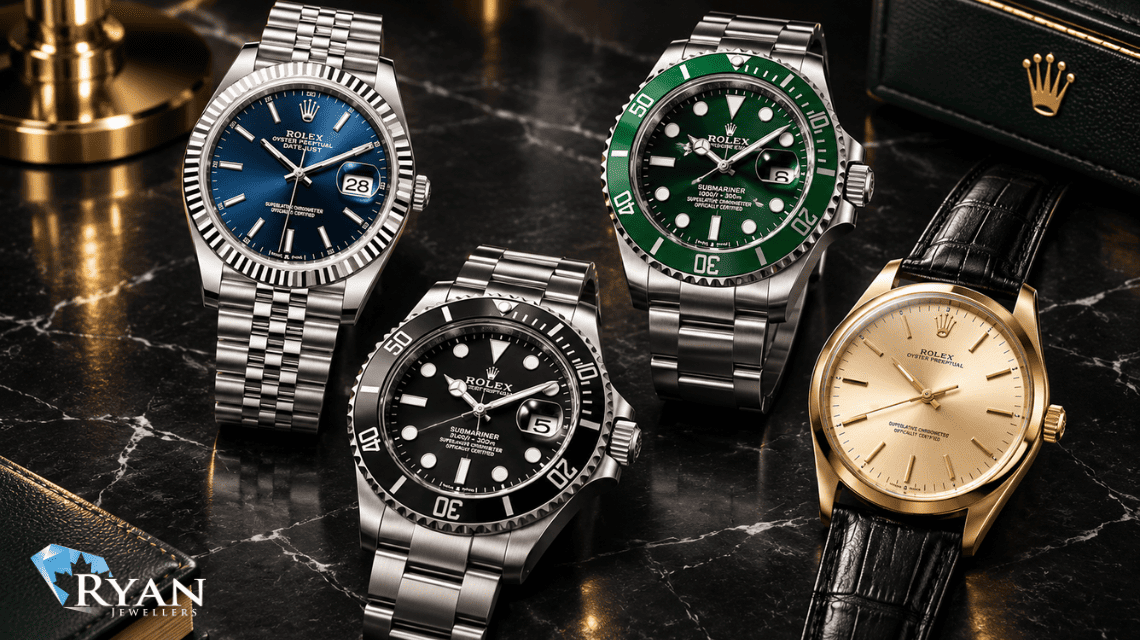
Its current Canadian collection includes:
- Oyster Perpetual
- Datejust
- Day-Date
- Submariner
- GMT-Master II
- Explorer
- Explorer II
- Sea-Dweller
- Deepsea
- Cosmograph Daytona
- Yacht-Master
- Sky-Dweller
- 1908
Current Canadian pricing demonstrates how widely configurations can vary. An Oyster Perpetual 36 in Oystersteel is listed at CAD $8,500, while a platinum Cosmograph Daytona is listed at CAD $107,100.
The brand’s Canadian network also includes authorized retailers, Certified Pre-Owned locations, and service centres.
Explore the Rolex Watches collection at Ryan Jewellers and discover iconic timepieces for your collection.
OMEGA
OMEGA is particularly recognized for collections such as:
- Speedmaster
- Seamaster
- Constellation
- De Ville
The Speedmaster is strongly associated with chronograph watchmaking and space exploration, while Seamaster models cover a broad range of diving and water-oriented designs.
Explore the OMEGA Watches collection at Ryan Jewellers and discover iconic timepieces designed for every style and occasion.
TUDOR
TUDOR is known for combining contemporary mechanical watchmaking with designs influenced by its historical collections.
Major collections include:
- Black Bay
- Pelagos
- Ranger
- 1926
- Royal
TUDOR maintains an official Canadian retailer network, including retailers, boutiques, and service centres.
Explore the TUDOR Watches collection at Ryan Jewellers and discover heritage-inspired timepieces for your collection.
Breitling
Breitling has a particularly strong association with aviation and chronographs.
Its major collections include:
- Navitimer
- Chronomat
- Superocean
- Avenger
- Premier
For buyers interested in a chronograph with a strong historical identity, Breitling can offer a very different proposition from a traditional dress-watch manufacturer.
Explore the Breitling Watches collection at Ryan Jewellers and discover precision timepieces built around distinctive design and performance.
Cartier
Cartier takes a more design-oriented approach to watchmaking.
Its iconic collections include:
- Tank
- Santos
- Ballon Bleu
- Panthère
The distinctive case shapes make Cartier particularly useful to consider when design is a primary purchasing factor.
Comparing Brands by Intended Use
| Intended Use | Collections to Consider |
|---|---|
| Everyday luxury | Rolex Datejust, OMEGA Aqua Terra, TUDOR Black Bay |
| Diving | Rolex Submariner, OMEGA Seamaster, TUDOR Pelagos |
| Travel | Rolex GMT-Master II, other GMT models |
| Chronograph | OMEGA Speedmaster, Breitling Navitimer, TAG Heuer Carrera |
| Formal wear | Cartier Tank, OMEGA De Ville, Rolex 1908 |
| Heritage-inspired style | TUDOR Black Bay, OMEGA Speedmaster |
The specific model matters more than the brand category alone.
How Do Watch Prices, Quality, and Overall Value Compare?
Price is one of the easiest factors to compare, but quality and value require more context.
Retail Price
Manufacturers establish retail prices based on factors such as:
- Materials
- Movement development
- Manufacturing
- Finishing
- Complications
- Distribution
- Brand positioning
A higher price does not necessarily mean that one watch is technically superior in every category.
Quality
Quality can be evaluated through several dimensions:
Movement quality
- Construction
- Regulation
- Finishing
- Reliability
- Serviceability
Case quality
- Machining
- Brushing
- Polishing
- Edge definition
Bracelet quality
- Link construction
- Clasp
- Finishing
- Adjustment system
Dial quality
- Printing
- Applied markers
- Hand finishing
- Alignment
Value
Value is more subjective.
One buyer may value:
- Brand recognition
Another may prioritize:
- Mechanical complexity
A collector may care about:
- Historical significance
A frequent traveller may prioritize:
- GMT functionality
Someone buying a daily watch may care most about:
- Durability
- Comfort
- Service support
New vs. Pre-Owned
A pre-owned watch can sometimes offer a lower entry price, but condition, service history, documentation, originality, and market demand all affect its value.
A used watch that requires an immediate overhaul may not actually represent better value than a more expensive example with documented recent servicing.
Consider Long-Term Ownership
A complete watch comparison should include future ownership.
Ask:
- How often will it require servicing?
- Where can it be serviced in Canada?
- Are replacement parts available?
- What does the warranty cover?
- Is the bracelet easy to adjust?
- Can the watch handle your lifestyle?
These factors can matter more over a decade of ownership than a modest difference in initial purchase price.
A Practical Watch Comparison Checklist
Before choosing between two watches, compare them using the same criteria:
| Category | Watch A | Watch B |
|---|---|---|
| Brand | — | — |
| Collection | — | — |
| Reference | — | — |
| Case size | — | — |
| Case material | — | — |
| Movement | — | — |
| Power reserve | — | — |
| Complications | — | — |
| Water resistance | — | — |
| Crystal | — | — |
| Bracelet/strap | — | — |
| Warranty | — | — |
| Retail price | — | — |
| Canadian taxes | — | — |
| Service availability | — | — |
| Intended use | — | — |
| Overall value | — | — |
This approach makes it easier to identify which differences actually matter to you.
Explore the Watch Comparison Guide at Ryan Jewellers to compare luxury watch brands, models, features, and prices before choosing your next timepiece.
FAQ About Comparing Watches
What should I compare when choosing between two watches?
Start with the movement, case size, materials, functions, water resistance, bracelet or strap, warranty, price, and service support. Then consider how each watch fits your intended lifestyle.
Is an automatic watch better than a quartz watch?
Neither is universally better. Automatic movements appeal to buyers who value mechanical craftsmanship, while quartz watches generally offer high accuracy and lower routine maintenance requirements.
Does a larger watch mean better quality?
No. Case size has little to do with overall quality. The appropriate size depends on the watch’s design, proportions, your wrist, and how you intend to wear it.
Which luxury watch brands are popular in Canada?
Canadian buyers can find established brands such as Rolex, OMEGA, TUDOR, Breitling, Cartier, and TAG Heuer through authorized retailers and established jewellers. Availability varies by brand, retailer, and specific model. Rolex and TUDOR both maintain official Canadian retailer networks.
Are expensive luxury watches always better value?
Not necessarily. Price reflects many factors beyond technical performance, including materials, craftsmanship, brand positioning, availability, and demand. The best value depends on what the buyer actually needs and appreciates.
Should I compare watches based on price alone?
No. A meaningful comparison should include the movement, materials, dimensions, functions, warranty, service support, condition, and expected ownership costs. Canadian taxes should also be included when calculating the final purchase price.
Final Thoughts
A thorough watch comparison should help you understand not only which watch costs more, but why.
Movement type, case material, dimensions, complications, finishing, water resistance, bracelet construction, brand heritage, warranty, and service support can all contribute to the ownership experience. Two watches with similar prices can therefore be very different products.
For Canadian buyers, local availability and total purchase cost deserve additional attention. Sales taxes differ between provinces, while established brands such as Rolex and TUDOR maintain official Canadian retail and service networks.
The best watch is ultimately the one that balances design, functionality, comfort, craftsmanship, budget, and long-term ownership. Instead of asking which watch is objectively better, ask which one better matches the way you plan to wear and enjoy it.
Explore the watch collection at Ryan Jeweller to compare established luxury brands, collections, and styles before choosing your next timepiece.