
Summarize the article with:


Understanding luxury watch prices in Canada requires looking beyond the number displayed on a price tag. Brand reputation, movement, materials, complications, craftsmanship, production volume, availability, and market demand can all influence the final price of a luxury timepiece.
The Canadian market includes everything from accessible Swiss and Japanese luxury watches to highly complicated and precious-metal models that can cost well into six figures. Current Rolex Canada listings, for example, range from around CAD $7,800 for some Oyster Perpetual configurations to more than CAD $100,000 for selected platinum and diamond-set models. TUDOR’s Canadian collection also spans several thousand dollars, with current models such as the Royal starting around CAD $3,425 and Black Bay models reaching above CAD $7,000 depending on configuration.
For Canadian buyers, the advertised price is also not necessarily the final amount paid. Applicable GST/HST and, depending on the province, other taxes can affect the total purchase cost.
If you’re comparing luxury watch prices in Canada, Ryan Jeweller offers an opportunity to explore different styles and brands while considering the factors that influence long-term ownership value.
How Much Do Luxury Watches Cost in Canada?
There is no single price range that defines a luxury watch in Canada.
The market covers a broad spectrum, depending on brand positioning, materials, movement complexity, and model availability.
Entry-Level Luxury Watches
Some established luxury brands offer watches starting in the low-thousands of Canadian dollars.
TUDOR provides a useful current example. Its Canadian collection includes Royal models from approximately CAD $3,425 and other models such as the Black Bay 54 from approximately CAD $4,475–$4,725 depending on strap or bracelet configuration.
At this level, buyers can find mechanical watches with quality cases, bracelets, and movements without entering the highest price tiers.
Mid-Range Luxury Watches
As prices increase, buyers may gain access to:
- More sophisticated mechanical movements
- Chronograph functions
- GMT complications
- Higher-end case materials
- More elaborate finishing
- Greater brand prestige
- Precious-metal components
Prices can move from several thousand dollars into the five-figure range.
High-End Luxury Watches
At the upper end, precious metals, diamonds, complicated movements, limited production, and exceptional finishing can significantly increase the price.
Current Rolex Canada listings demonstrate this range. Examples include:
- Oyster Perpetual 36 in Oystersteel — approximately CAD $8,500
- Explorer 40 in Oystersteel — approximately CAD $10,600
- Datejust 41 — approximately CAD $14,750
- GMT-Master II in Oystersteel — approximately CAD $14,900
- Day-Date 40 in platinum — approximately CAD $87,100
- Cosmograph Daytona in platinum — approximately CAD $107,100
These are current manufacturer-listed Canadian prices for specific configurations, not universal prices for an entire collection.
Why Prices Vary Within the Same Collection
Two watches from the same collection can have dramatically different prices.
A Rolex Datejust, for example, can vary based on:
- Case diameter
- Gold content
- Bezel
- Dial
- Diamond setting
- Bracelet
- Configuration
The current Rolex Canada collection illustrates this clearly, with Datejust models appearing from around CAD $10,300 for certain Oystersteel configurations to well above CAD $30,000 for selected gold, diamond, and mixed-material versions.
What Factors Influence Luxury Watch Prices?
Luxury watch prices in Canada are determined by several overlapping factors.
Brand Positioning
Brand recognition and reputation have a major influence on pricing.
A watch with a similar movement specification may cost more if it comes from a brand with a stronger heritage, greater recognition, or higher perceived exclusivity.
However, price should not be interpreted as a direct measurement of technical quality.
Movement
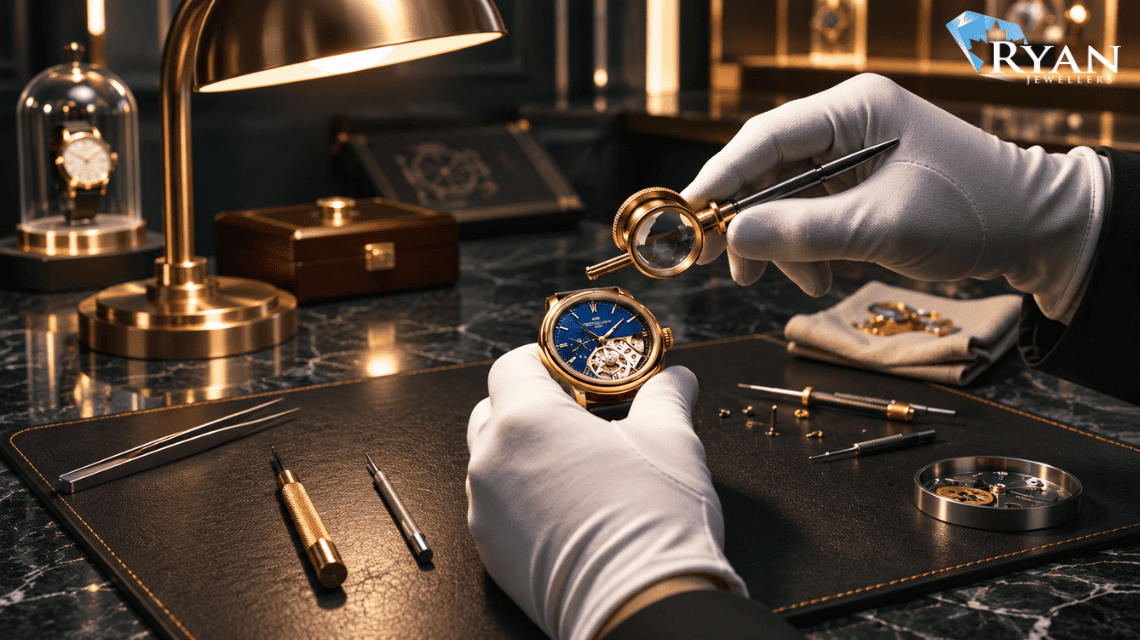
The movement is one of the most important components of a mechanical watch.
A relatively simple three-hand automatic movement generally requires less engineering and assembly than a complicated chronograph, perpetual calendar, or tourbillon.
Factors affecting movement-related cost include:
- Number of components
- Manufacturing complexity
- Finishing
- Precision requirements
- Research and development
- Production volume
- Complications
Materials
Case material can have a major impact on price.
Common options include:
- Stainless steel
- Titanium
- Ceramic
- Gold
- Platinum
Precious metals generally increase material cost and can significantly change the retail price.
Rolex’s current Canadian collection illustrates the difference. Oystersteel models such as the Explorer 40 are listed around CAD $10,600, while platinum and gold models can reach tens of thousands of dollars more.
Diamonds and Gemstones
Diamond-set watches generally cost more because of the additional materials and specialized setting work involved.
The difference can be substantial.
For example, current Rolex Canada listings include diamond-set models above CAD $100,000, while comparable non-gem-set configurations can be considerably less expensive.
The value of a gem-set watch therefore reflects more than the intrinsic value of the stones alone.
Complications
Additional functions can increase both manufacturing complexity and servicing requirements.
Common complications include:
- Chronograph
- GMT
- Annual calendar
- Perpetual calendar
- Moon phase
- Power reserve
- World time
A complicated movement may require more components, specialized assembly, and more extensive testing.
Craftsmanship and Finishing
Finishing refers to the treatment and decoration of components.
Examples include:
- Polishing
- Brushing
- Anglage
- Perlage
- Côtes de Genève
- Hand decoration
Highly finished movements can require substantial manual labour and specialized expertise.
Production Volume
Production volume can also affect pricing.
A watch produced in relatively large quantities may have different economics from a highly limited model requiring specialized manufacturing.
Limited production does not automatically mean a watch is technically superior, but scarcity can influence market demand.
Availability and Demand
Retail availability can affect what buyers actually pay.
Rolex notes that demand can at times exceed production capacity and that availability of certain models may therefore be limited.
This distinction is important:
Retail price ≠ secondary-market price.
A watch can have an official retail price while trading at a different price in the pre-owned market because of supply and demand.
How Do Brand, Materials, and Movement Affect Watch Pricing?
Looking at these factors individually makes it easier to understand why two watches with similar dimensions can have very different prices.
Brand and Heritage
Established luxury watch brands often have decades or centuries of history behind their products.
Heritage can influence:
- Brand recognition
- Design language
- Collector interest
- Perceived exclusivity
- Resale demand
However, buyers should still evaluate the actual watch rather than purchasing solely for the name on the dial.
Stainless Steel vs Precious Metals
Stainless steel is widely used for sports and everyday luxury watches.
Gold and platinum introduce substantially different material characteristics and typically increase the price.
Rolex’s current Canadian catalogue provides clear examples. A stainless-steel Oyster Perpetual 36 is listed around CAD $8,500, while a 39 mm 18 ct yellow-gold 1908 is listed around CAD $51,800. A platinum Day-Date 40 is listed around CAD $87,100.
Automatic vs Manual-Winding Movements
Both automatic and manual-winding movements are mechanical.
An automatic movement uses a rotor to wind the mainspring as the watch is worn, while a manual-winding movement requires regular winding by the wearer.
Neither category is automatically more luxurious.
Price depends on the movement’s design, finishing, complexity, production, and the brand using it.
Quartz Movements
Luxury watchmaking is not limited to mechanical movements. Quartz watches can also occupy the luxury segment, particularly when they use sophisticated technology, premium materials, and high-quality finishing.
Known for their accuracy and relatively low maintenance requirements, advanced quartz movements are used in some high-end timepieces. Therefore, movement type alone should not determine whether a watch is considered luxurious.
Therefore, movement type alone should not be used to determine whether a watch is “luxury.”
Complicated Mechanical Movements
Chronographs, GMT watches, calendars, and other complications can increase mechanical complexity.
However, complications should be chosen because they provide useful functionality or appeal to your collecting interests, not simply because they increase the price.
How Do New and Pre-Owned Luxury Watch Prices Compare?
When researching luxury watch prices in Canada, it is important to distinguish manufacturer retail pricing from pre-owned market pricing.
New Luxury Watches
New watches purchased through an authorized retailer generally come with the manufacturer’s applicable warranty or guarantee.
Rolex states that new and genuine Rolex watches are sold exclusively through Official Rolex Retailers, which warrant authenticity and provide a five-year international guarantee on qualifying new purchases.
The price is generally determined by the manufacturer’s current retail pricing and the exact configuration.
Pre-Owned Luxury Watches
Pre-owned prices depend on additional factors.
These may include:
- Age
- Condition
- Reference number
- Service history
- Original components
- Box and papers
- Remaining warranty
- Scarcity
- Market demand
A pre-owned watch can therefore be less expensive than its current retail equivalent, but this is not guaranteed.
Discontinued Models
Discontinued models can behave differently from current-production watches.
If demand remains strong and supply becomes limited, a discontinued reference may retain or increase its market value.
Conversely, a model with limited demand may depreciate after leaving the current collection.
Condition Matters
Two examples of the same reference can have very different values.
A watch with:
- Excellent condition
- Original components
- Recent professional service
- Complete documentation
- Original bracelet
may command a premium over an example with heavy wear and an unknown service history.
Certified Pre-Owned Watches
Manufacturer-backed certified pre-owned programmes can also have different pricing structures.
Certification may add value because the watch has undergone authentication, inspection, or servicing and may include a dedicated warranty.
For example, Rolex’s Certified Pre-Owned programme provides authenticated qualifying watches through participating Official Rolex Retailers, with a new two-year international guarantee.
What Additional Costs Should You Consider When Buying a Luxury Watch?
The advertised price is only one part of the total cost of ownership.
GST, HST, and Provincial Taxes
Canadian sales taxes vary by province.
According to the Canada Revenue Agency, applicable rates currently include:
- Alberta — 5% GST
- British Columbia — 5% GST + 7% PST
- Ontario — 13% HST
- Quebec — 5% GST + 9.975% QST
- Nova Scotia — 14% HST
- New Brunswick — 15% HST
Other provinces and territories have their own applicable combinations.
Therefore, a watch advertised at CAD $10,000 does not necessarily cost CAD $10,000 at checkout.
For example, a CAD $10,000 taxable purchase delivered in Ontario would have 13% HST, bringing the purchase price to CAD $11,300 before any other charges.
Insurance
A luxury watch can represent a substantial financial asset.
Depending on your insurance policy, you may need:
- An appraisal
- Purchase documentation
- Photographs
- Serial/reference information
- Separate scheduled coverage
Insurance requirements vary by provider, so confirm the terms before assuming your existing policy provides sufficient coverage.
Servicing
Mechanical watches require professional servicing over their ownership life.
Service costs vary based on:
- Brand
- Movement
- Complications
- Parts
- Labour
- Service centre
- Required repairs
A complicated chronograph generally requires more specialized work than a simple three-hand movement.
Bracelet and Strap Adjustments
A new watch may need bracelet sizing or strap adjustment.
Although this is generally a small expense compared with the watch itself, it should still be considered when comparing retailers.
Shipping and Insurance
Online purchases may involve shipping charges and additional insurance.
For an expensive watch, confirm who is responsible for the package while it is in transit and whether the shipment requires a signature.
Potential Repairs
A luxury watch should be viewed as a long-term mechanical product rather than a completely maintenance-free purchase.
Potential future costs can include:
- Crystal replacement
- Crown repair
- Bracelet repair
- Battery replacement for quartz watches
- Gasket replacement
- Movement servicing
- Water-resistance testing
Planning for these expenses can make the purchase more financially realistic.
How Can You Determine Whether a Luxury Watch Is Worth the Price?
A high price does not automatically mean a watch is the right purchase.
Instead, consider what you are actually receiving for the money.
Compare Equivalent Specifications
When comparing two watches, look beyond the brand.
Compare:
- Case material
- Movement
- Power reserve
- Water resistance
- Complications
- Crystal
- Bracelet
- Finishing
- Warranty
- Service support
This creates a more meaningful comparison than looking at price alone.
Consider Long-Term Ownership
A watch that costs slightly more but has strong service support and readily available parts may be more practical over decades of ownership.
For a high-value purchase, ask how easy it will be to maintain the watch five, ten, or twenty years from now.
Separate Price From Value
Price is what you pay.
Value is the combination of what the watch provides and how much you personally appreciate it.
A collector may place significant value on historical importance, while another buyer may prioritize accuracy, durability, or design.
There is no single definition of value that applies to every buyer.
Explore our complete guide to Luxury Watches in Canada for more information on brands, prices, and buying tips.
FAQ About Luxury Watch Prices in Canada
How much do luxury watches cost in Canada?
Prices vary significantly by brand and model. Current Canadian examples include TUDOR models starting around CAD $3,425 and Rolex models starting around the high-thousands, while precious-metal and diamond-set Rolex watches can exceed CAD $100,000.
Why are some luxury watches much more expensive than others?
Brand positioning, movement complexity, materials, complications, craftsmanship, diamonds or gemstones, production volume, and market demand can all influence the price.
Are luxury watches cheaper in Canada?
Not necessarily. Prices depend on the brand, model, retailer, exchange rates, taxes, and whether the watch is new or pre-owned. Canadian buyers should compare the final after-tax price rather than only the advertised price.
Do gold and platinum watches cost more than stainless-steel models?
Generally, yes. Precious metals add material cost and can also involve more complex manufacturing. Current Rolex Canada listings demonstrate substantial price differences between stainless-steel, gold, and platinum configurations.
Are pre-owned luxury watches cheaper than new ones?
They can be, but there is no universal rule. Condition, rarity, demand, service history, documentation, and model availability can cause some pre-owned watches to trade below, near, or above current retail pricing.
What additional costs should I budget for when buying a luxury watch in Canada?
Consider applicable provincial taxes, insurance, servicing, bracelet adjustments, shipping, and future repairs. GST/HST rates vary by province, so the final cost can differ considerably depending on where the watch is purchased or delivered.
Final Thoughts
Understanding luxury watch prices in Canada is easier when the purchase is viewed as a combination of brand, engineering, materials, craftsmanship, availability, and long-term ownership costs.
Current Canadian retail listings demonstrate just how broad the market can be. TUDOR offers models in the several-thousand-dollar range, while Rolex pricing extends from the high-thousands for certain Oystersteel watches to more than CAD $100,000 for selected platinum and diamond-set configurations.
However, the most expensive watch is not automatically the best value. Buyers should compare equivalent specifications and consider the movement, materials, complications, service support, warranty, condition, and intended use.
Canadian taxes should also be included when calculating the true purchase price. Depending on the province, the applicable GST/HST and other sales taxes can add a meaningful amount to the final bill.
Ultimately, the right luxury watch is one that fits both your budget and your lifestyle. Understanding what drives the price allows you to make a more informed decision instead of paying simply for a recognizable name.
Explore the luxury watch selection at Ryan Jeweller to compare different styles, brands, materials, and price points before choosing your next timepiece.