
Summarize the article with:


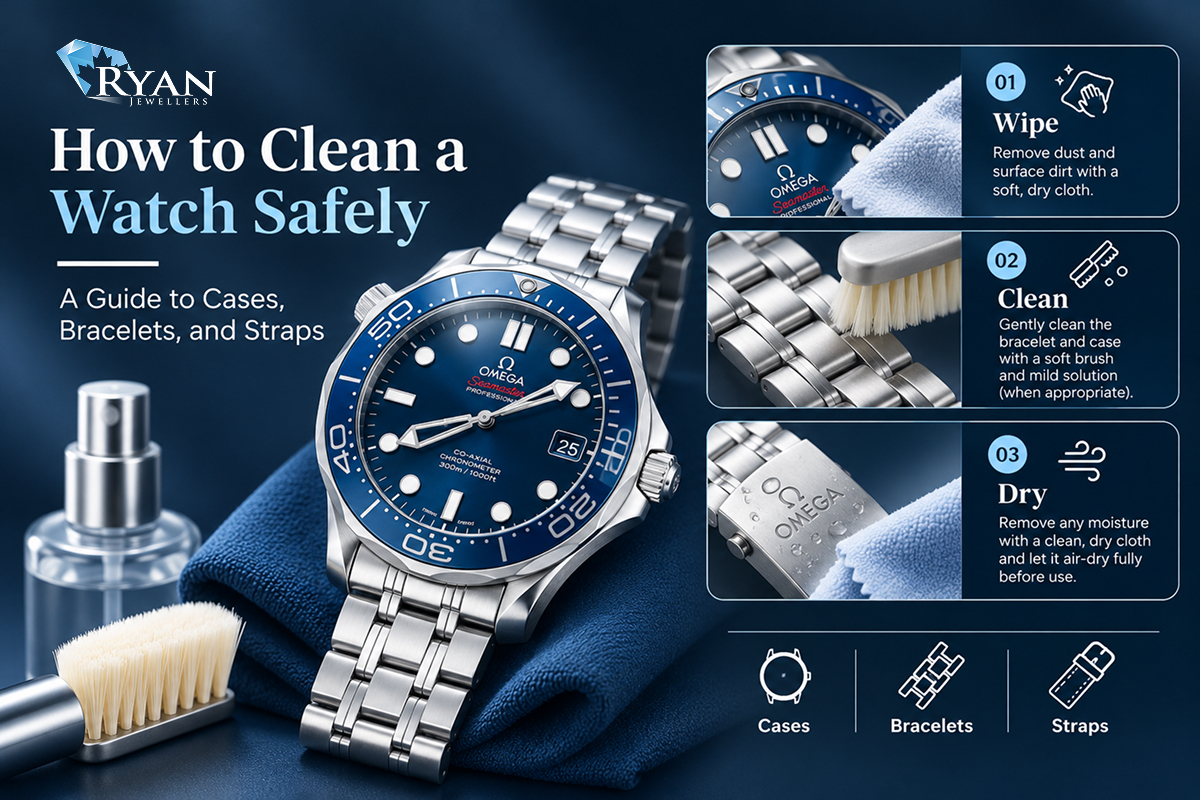
A luxury watch is exposed to more than you might realize. Skin oils, sweat, dust, moisture, cosmetics, and everyday contact can gradually affect its appearance. Learning how to clean a watch properly can help preserve the case, crystal, bracelet, and strap without creating unnecessary risks.
The good news is that most watches do not require complicated daily cleaning. Rolex recommends occasional cleaning with a microfiber cloth, while TUDOR advises gentle cleaning with a microfiber cloth or soft brush and soapy water for appropriate watches.
For Canadian watch owners, regular cleaning can be particularly useful after exposure to rain, snow, sweat, or salt water during travel and outdoor activities. However, the correct method depends on the watch’s construction, materials, water resistance, and manufacturer’s instructions.
If you’re looking for a luxury timepiece designed for long-term ownership, explore the collection at Ryan Jeweller and find a watch that suits your style and lifestyle.
What Should You Know Before Cleaning a Watch?
Before cleaning a watch, the most important step is to understand what the watch can safely tolerate.
Check the Water Resistance
Never assume that every watch can be washed with water.
A watch’s water resistance depends on its construction and condition. Seals can age, and an impact can affect components involved in maintaining water resistance.
OMEGA recommends having water resistance tested regularly by an authorized service centre because aging gaskets or accidental shocks can affect the watch.
If you are uncertain about the watch’s water resistance, a dry microfiber cloth is the safer choice until the watch has been professionally assessed.
Secure the Crown
A screw-down crown should be properly secured before cleaning a water-resistant watch.
TUDOR specifically instructs owners to make sure the winding crown is screwed down properly before cleaning. Rolex gives the same recommendation before washing the case and bracelet.
Never manipulate the crown or other controls while the watch is in water unless the manufacturer specifically states that the function is designed for underwater use.
Identify the Materials
Different materials require different cleaning methods.
Before you begin, determine whether the watch has:
- Stainless steel
- Titanium
- Gold
- Ceramic
- Leather
- Rubber
- Fabric
- A coated or specially finished surface
For example, TUDOR recommends protecting leather straps from water and moisture, while its care guidance allows appropriate metal, rubber, and fabric bracelets to be cleaned with soapy water and a soft brush.
Gather the Right Supplies
For basic cleaning, you generally need:
- A clean microfiber cloth
- A soft brush
- Mild soapy water, when appropriate
- Clean fresh water for rinsing, when permitted
- A dry, soft cloth
Avoid using household cleaning products simply because they are designed for metal, glass, or jewelry. A watch contains materials and seals that may react differently to chemicals.
How Do You Clean a Stainless Steel Watch Bracelet?
Stainless steel bracelets are among the easier watch components to clean, but they still require a gentle approach.
Sweat, skin oils, dust, and debris can accumulate between bracelet links and around the clasp.
Step 1: Secure the Crown
Before using water, make sure the crown is properly secured according to the manufacturer’s instructions.
This is particularly important for watches with screw-down crowns.
Step 2: Remove Surface Dust
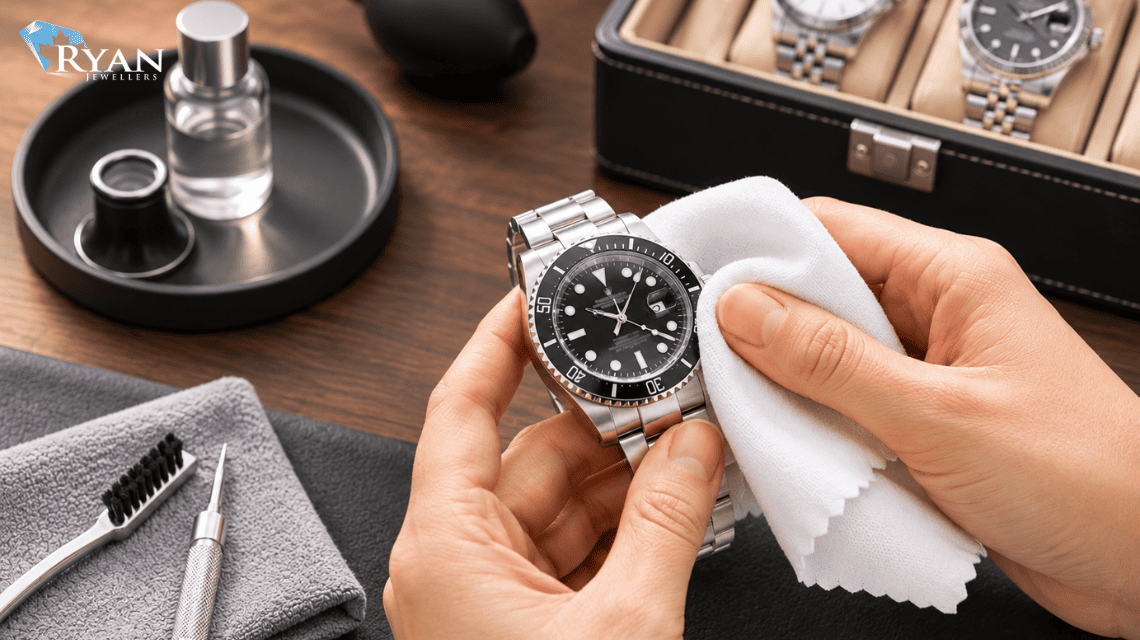
Start with a clean microfiber cloth.
Gently wipe the:
- Case
- Bracelet
- Clasp
- Bezel
- Caseback
This removes loose dust and surface oils before you introduce any moisture.
Step 3: Use Mild Soapy Water When Appropriate
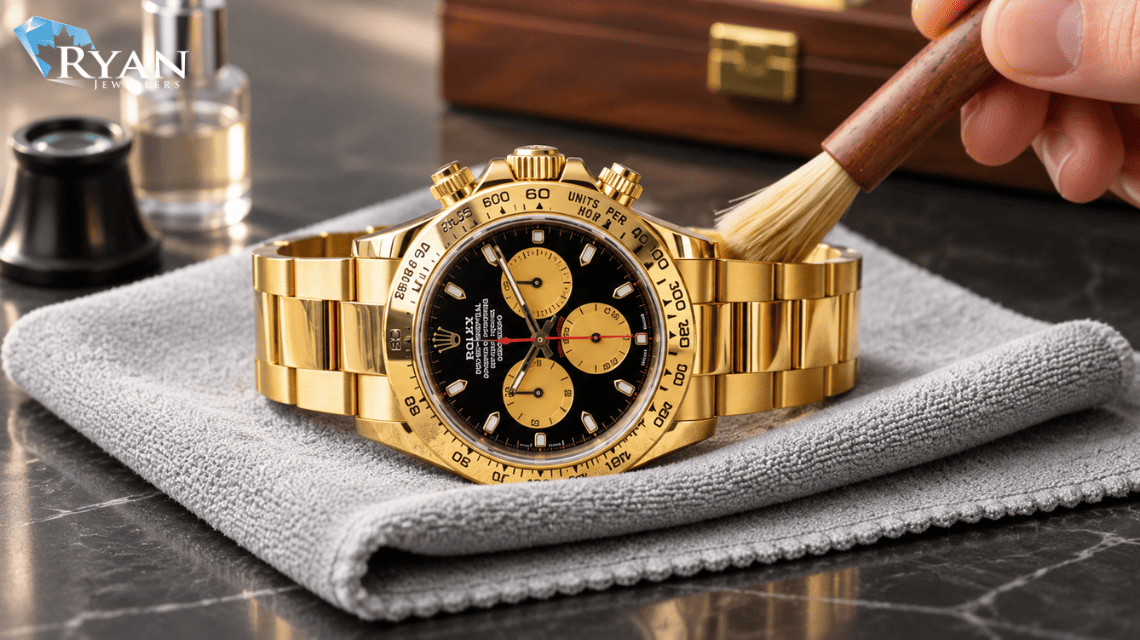
For suitable water-resistant watches, a soft brush and mild soapy water can be used to clean the case and metal bracelet.
Rolex specifically recommends soapy water and a soft brush for cleaning its case and bracelet, while TUDOR provides similar guidance.
Use gentle pressure rather than aggressive scrubbing.
Pay particular attention to areas where dirt tends to collect, including:
- Between bracelet links
- Around the clasp
- Near the lugs
- Around the caseback
- Around the crown guards
Step 4: Rinse With Fresh Water
If the watch is suitable for this cleaning method, rinse it with clean fresh water.
This is especially important after exposure to seawater.
Rolex recommends rinsing the watch with fresh water after exposure to the sea to remove salt and sand deposits. TUDOR provides the same recommendation.
Step 5: Dry Thoroughly
Use a clean, soft cloth to remove remaining moisture.
Allow the watch to dry completely before placing it in a box or case.
What About Gold and Titanium?
Gold and titanium should also be cleaned according to the manufacturer’s recommendations, but avoid assuming that every finish can be treated identically.
Brushed, polished, coated, and specially finished surfaces can respond differently to abrasion.
A soft microfiber cloth is a good starting point for routine surface cleaning.
How Should You Clean Leather, Rubber, and Fabric Watch Straps?
Straps require more material-specific care than metal bracelets.
Leather Watch Straps
Leather should generally be kept away from excessive water and moisture.
TUDOR specifically recommends protecting leather straps from water and moisture.
Instead of washing a leather strap under running water:
- Wipe it gently with a suitable soft cloth.
- Remove surface moisture promptly.
- Allow it to dry naturally if it becomes damp.
- Avoid prolonged exposure to sweat and water.
- Follow the manufacturer’s specific care instructions.
Do not use the same cleaning method for a leather strap that you would use for a stainless steel bracelet.
Leather can also develop natural changes in colour and texture with age, so some signs of use are normal.
Rubber Watch Straps
Rubber straps are generally more resistant to moisture than leather.
OMEGA’s care guidance recommends soapy water and a toothbrush for cleaning suitable rubber straps and waterproof cases, followed by drying with a soft cloth.
Even so, avoid unnecessary exposure to:
- Solvents
- Perfume
- Detergents
- Cosmetics
- Strong cleaning chemicals
These substances can affect certain materials over time.
Fabric Watch Straps
Fabric straps can also be cleaned, but the manufacturer’s instructions should take priority.
TUDOR’s care guidance states that metal bracelets, rubber straps, and fabric bracelets can be cleaned periodically with a soft brush and soapy water.
After cleaning, allow the fabric to dry completely before wearing or storing the watch.
If the fabric has decorative coatings, leather sections, or other mixed materials, use the most conservative cleaning method recommended by the manufacturer.
NATO and Removable Fabric Straps
A removable fabric strap has one advantage: you can often clean the strap separately from the watch.
If the strap is designed to be removed, detach it before washing when the manufacturer’s instructions permit.
This prevents unnecessary exposure of the watch case to water.
Learn more about protecting your collection with our Watch Storage Guide.
Which Cleaning Products and Methods Should You Avoid?
Knowing what not to use is just as important as knowing how to clean a watch.
Avoid Household Chemicals
Do not assume that household glass cleaner, disinfectant, jewelry cleaner, or metal polish is safe for a watch.
OMEGA specifically advises avoiding direct contact with solvents, detergents, perfumes, cosmetics, and mosquito repellents because these substances may damage the bracelet, case, or gaskets.
Avoid Abrasive Materials
Do not use:
- Rough towels
- Abrasive pads
- Steel wool
- Hard brushes
- Household polishing compounds
- Aggressive scrubbing tools
These can create scratches or alter the finish.
A polished surface can lose its original appearance, while a brushed surface can develop uneven marks.
Do Not Polish Scratches at Home
A scratch is not necessarily a reason to polish a luxury watch.
Professional refinishing removes a small amount of material from the case or bracelet and can affect the original geometry if performed incorrectly.
Rolex states that professional polishing of its cases and bracelets should be performed through an Official Rolex Service Centre.
For collectible or vintage watches, preserving the original case profile can be particularly important.
Avoid Ultrasonic Cleaners Unless Specifically Approved
Ultrasonic cleaning can be appropriate for certain detached components during professional servicing, but that does not mean you should place an assembled luxury watch into a household ultrasonic cleaner.
A watch contains a movement, seals, crystal, crown, and other components that require model-specific handling.
When in doubt, leave ultrasonic cleaning to a professional.
Never Clean a Watch With the Crown Open
If the crown is unscrewed or pulled out, exposing the watch to water can create an unnecessary risk.
Secure the crown before any water-based cleaning.
Do Not Use Hot Water
Hot water can create unnecessary thermal stress and is not required for routine watch cleaning.
Mild water at a suitable temperature is sufficient when the manufacturer permits water-based cleaning.
When Should You Choose Professional Watch Cleaning?
Routine surface cleaning can usually be handled at home when the manufacturer permits it. More complex cleaning and refinishing should be left to professionals.
When the Watch Is Very Dirty
If dirt has accumulated deeply around:
- The bracelet
- Caseback
- Crown
- Bezel
- Pushers
- Bracelet links
professional cleaning may be safer than aggressive home scrubbing.
When Water Resistance Is Uncertain
If you do not know whether the watch is still water resistant, avoid water-based cleaning until it has been tested.
OMEGA recommends regular water-resistance testing through an authorized service centre.
This is particularly relevant for older watches or watches that have recently experienced an impact.
After a Significant Impact
A hard impact can affect the case, crown, crystal, seals, or movement.
If the watch has been dropped or struck heavily, professional inspection is advisable before using water to clean it.
When You Notice Condensation
Condensation beneath the crystal should never be treated as a simple cleaning issue.
It can indicate moisture inside the case.
Stop wearing the watch and seek professional assistance rather than attempting to open the case yourself.
When the Watch Needs Refinishing
Professional cleaning and refinishing are different tasks.
A service centre may be able to clean, polish, or satin-finish the case and bracelet according to the manufacturer’s specifications.
TUDOR explains that its full service can include optional refinishing of the case and bracelet, with polishing, satin-finishing, and ultrasonic cleaning performed according to its standards.
During a Complete Service
Professional cleaning can form part of a broader mechanical service.
For example, TUDOR’s servicing process involves dismantling and ultrasonically cleaning movement components, inspecting worn parts, replacing components where necessary, lubricating and reassembling the movement, and testing accuracy and waterproofness.
Rolex similarly states that a complete service involves dismantling and cleaning the movement, examining components, replacing parts that no longer meet specifications, and testing the finished watch for waterproofness, power reserve, and precision.
A Simple Watch Cleaning Routine
If you want a practical routine for everyday ownership, keep it simple.
Regular Surface Cleaning
- Use a clean microfiber cloth.
- Gently wipe away fingerprints and surface oils.
- Avoid abrasive materials.
- Keep chemicals away from the watch.
- Check the manufacturer’s instructions before using water.
Metal Bracelets
- Secure the crown.
- Use mild soapy water only when permitted.
- Clean gently with a soft brush.
- Rinse with fresh water when appropriate.
- Dry thoroughly.
Leather Straps
- Avoid soaking.
- Keep away from excessive moisture.
- Wipe gently when necessary.
- Allow damp leather to dry naturally.
- Follow the manufacturer’s strap-care instructions.
After Seawater Exposure
A suitable water-resistant watch should be rinsed with fresh water after exposure to seawater to remove salt and sand deposits. Rolex and TUDOR both specifically recommend this step.
Learn more about proper watch maintenance with our Watch Care Guide and discover practical tips to keep your timepiece in excellent condition.
FAQ About Cleaning a Watch
How often should I clean my watch?
There is no universal cleaning schedule. A microfiber cloth can be used regularly to remove fingerprints and surface oils, while deeper cleaning can be performed when dirt or residue accumulates, provided the manufacturer’s instructions allow it.
Can I clean my watch with soap and water?
Some water-resistant watches can be cleaned with mild soapy water and a soft brush. Rolex and TUDOR both recommend this method for appropriate cases and metal bracelets. Always secure the crown first and check the manufacturer’s instructions.
Can I wash a leather watch strap?
Leather should generally be protected from water and moisture. TUDOR specifically recommends keeping leather straps away from water, so they should not be cleaned using the same method as a metal bracelet.
Can I use jewelry cleaner on my watch?
It is better to avoid general jewelry cleaners unless the watch manufacturer specifically approves the product. Some cleaners contain chemicals that can affect the case, bracelet, coating, strap, or gaskets.
Can I use an ultrasonic cleaner on my watch?
An assembled luxury watch should not automatically be placed in an ultrasonic cleaner. Professional watchmakers may use ultrasonic cleaning for appropriate components during servicing, but the correct process depends on the watch and its construction.
When should I have my watch professionally cleaned?
Professional cleaning is appropriate when dirt is difficult to remove safely, water resistance is uncertain, the watch has suffered an impact, condensation appears under the crystal, or the case and bracelet require professional refinishing.
Final Thoughts
Learning how to clean a watch safely is mainly about using the right method for the right materials.
A microfiber cloth is usually enough for everyday surface care. Suitable water-resistant watches may tolerate gentle cleaning with mild soapy water and a soft brush, while leather straps require much more protection from moisture.
The most important rule is to follow the manufacturer’s instructions for your specific model. Water resistance, materials, coatings, straps, and case construction can vary significantly between watches.
Avoid harsh chemicals, abrasive tools, aggressive polishing, and unnecessary exposure to water. When the watch needs deeper cleaning, refinishing, or inspection of its seals and movement, professional service is the safer choice.
With simple and consistent care, your watch can retain its appearance and remain a reliable part of your collection for many years.
Ready to add another timepiece to your collection? Explore the luxury watches at Ryan Jeweller and discover a watch worth caring for and enjoying for years to come.