

Summarize the article with:


Proper storage is an important part of long-term watch ownership. Whether you have one everyday timepiece or a collection of luxury watches, knowing how to store watches can help reduce unnecessary exposure to dust, moisture, scratches, temperature changes, and magnetic fields.
A good storage routine is particularly useful for Canadian watch owners. Seasonal changes can mean significant differences between cold outdoor temperatures and heated indoor environments. While a quality watch is designed to handle normal use, manufacturers still recommend avoiding extreme temperatures, sudden temperature variations, moisture, chemicals, and strong magnetic fields.
Storage also depends on the type of watch. An automatic watch that is worn regularly has different practical considerations from a quartz watch or a mechanical watch that spends most of its time in a collection.
If you’re building or expanding a luxury watch collection, explore the selection at Ryan Jeweller and find a timepiece worth protecting for years to come.
What Is the Best Way to Store a Watch?
The best storage environment is clean, dry, stable, and protected from unnecessary impact.
A watch should ideally be kept somewhere away from direct sunlight, excessive humidity, extreme temperatures, and strong magnetic sources.
Keep Watches Separate
If you own multiple watches, avoid allowing their cases or bracelets to rub directly against one another.
Separate compartments or individual watch cushions can help prevent:
- Scratches
- Bracelet marks
- Case-to-case contact
- Accidental impacts
- Dust accumulation
This is especially important when storing watches with polished surfaces, precious metals, or delicate finishes.
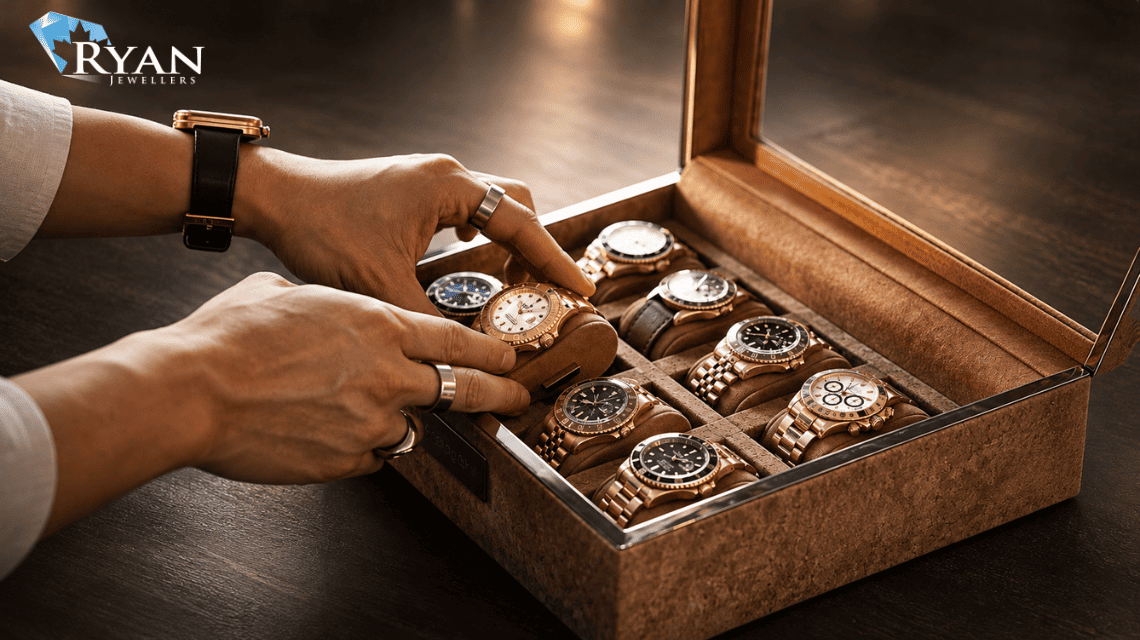
Use a Padded Watch Box or Case
A quality watch box can provide protection while also keeping your collection organized.
Look for:
- Soft watch cushions
- Individual compartments
- Secure closures
- Dust protection
- Enough space for the bracelet or strap
- A stable interior environment
For travel, a dedicated watch roll or hard-sided travel case can provide additional protection against movement and impact.
Keep the Watch Clean Before Storage
Before putting a watch away for an extended period, remove fingerprints, sweat, and surface moisture with a clean microfiber cloth.
For suitable water-resistant watches with metal bracelets, manufacturers such as Rolex recommend occasional cleaning with soapy water and a soft brush, provided the crown is properly secured.
Leather straps should be treated differently and should not be routinely soaked in water.
Keep Documentation With the Collection
For valuable watches, keep the following in a safe, organized location:
- Warranty documentation
- Service records
- Original purchase information
- Manuals
- Extra bracelet links
- Original accessories
These records can be useful for future servicing, insurance, authentication, or resale.
How Do Temperature, Humidity, and Sunlight Affect Watches?
Environmental conditions are an important part of understanding how to store watches correctly.
Temperature
Extreme temperatures can affect watches in different ways.
OMEGA recommends avoiding temperatures above 60°C (140°F) or below 0°C (32°F), as well as extreme variations in temperature.
For Canadian owners, this means avoiding prolonged storage in places such as:
- Unheated garages during winter
- Vehicles
- Directly beside radiators
- Near heating vents
- Areas exposed to extreme summer heat
Normal seasonal temperature changes are not necessarily a problem. The greater concern is prolonged exposure to extremes or rapid temperature changes.
Humidity and Moisture
Excessive humidity can be problematic, particularly if moisture finds its way inside a watch.
Potential warning signs include:
- Condensation beneath the crystal
- Fogging
- Corrosion
- Unusual movement behaviour
A watch box should therefore be kept in a dry indoor environment rather than somewhere exposed to persistent humidity.
If moisture appears inside the watch, do not simply place it in storage and hope that it disappears. Professional inspection is recommended.
Sunlight
Direct sunlight can gradually affect certain watch materials.
Depending on the model, prolonged exposure may contribute to changes in:
- Dial colour
- Strap materials
- Finishes
- Packaging
- Certain decorative components
For this reason, a watch collection is better stored away from direct windows or other sources of intense sunlight.
A display case can still be used, but it should provide appropriate protection from excessive UV exposure.
Sudden Temperature Changes
Rapid transitions between environments can also be undesirable.
For example, taking a watch directly from a very cold outdoor environment into a warm, humid room can create condensation under certain circumstances.
OMEGA specifically recommends avoiding extreme variations in temperature.
Should You Store Watches in a Box, Case, or Watch Winder?
The right storage method depends on the type of watch and how frequently you wear it.
Watch Box
A watch box is generally the most practical option for a collection.
It allows multiple watches to be stored separately while protecting them from dust and accidental contact.
A quality box is particularly useful if you rotate between several watches throughout the week.
Watch Roll
A watch roll is useful for:
- Travel
- Short-term storage
- Carrying multiple watches
- Keeping watches separated
Choose one with soft interiors and enough space to prevent the watches from rubbing against each other.
Travel Case
For expensive watches, a rigid travel case can offer additional impact protection.
This can be useful when transporting a collection in luggage or during longer trips.
Watch Winder
A watch winder rotates an automatic watch while it is not being worn.
Its main purpose is convenience: keeping the watch running so that the wearer does not need to reset the time and date after the power reserve has expired.
However, an automatic watch does not generally require a watch winder simply because it is mechanical.
If a watch is left unworn, it can normally be allowed to stop and then wound and reset when needed, following the manufacturer’s instructions.
For example, Rolex explains that a daily-worn watch does not need manual winding, while a watch that has stopped after being set aside can be manually wound before being worn again.
Should Every Automatic Watch Be Kept Running?
No.
Whether you prefer to keep an automatic watch running is largely a matter of convenience and the particular functions of the watch.
A simple three-hand watch may be easy to reset.
A complicated watch with multiple calendar indications can take considerably longer to set correctly, making a compatible winder more convenient for some owners.
If you use a watch winder, select one appropriate for the specific movement rather than assuming that every automatic watch requires the same rotation settings.
How Should You Store Automatic and Quartz Watches Differently?
Automatic and quartz watches have different movement technologies, so their storage considerations are not identical.
Storing an Automatic Watch
An automatic watch stores energy in its mainspring and is wound through the movement of the rotor when worn.
If it is not worn for long enough, the power reserve will eventually run down and the watch will stop.
This is normal.
When storing an automatic watch:
- Clean and dry it before storage.
- Place it securely on a soft cushion.
- Keep it away from strong magnetic sources.
- Store it in a stable environment.
- Allow it to stop naturally if you do not need it running.
- Follow the manufacturer’s instructions when restarting it.
If the watch has a screw-down crown, ensure the crown is properly secured after winding or setting it.
Storing a Manual-Winding Watch
A manual-winding watch does not use an automatic rotor to wind its mainspring.
When stored for an extended period, it can simply remain stopped.
There is generally no need to wind a manual watch continuously while it is sitting in storage.
When you decide to wear it again, follow the manufacturer’s winding instructions.
Storing a Quartz Watch
Quartz watches typically require less mechanical maintenance during storage, but they still need appropriate environmental protection.
Keep a quartz watch:
- Dry
- Away from extreme temperatures
- Away from strong magnetic sources where applicable
- Protected from scratches
- Stored according to the manufacturer’s instructions
What About the Battery?
For quartz watches, battery condition matters during long-term storage.
If a quartz watch is going to remain unused for an extended period, check the manufacturer’s recommendations regarding battery storage.
A depleted battery should not simply be ignored indefinitely. If you notice that a quartz watch has stopped because of a battery issue, have it addressed appropriately.
For high-value quartz watches, professional battery replacement can also provide an opportunity to inspect seals and restore water resistance where necessary.
How Can You Protect Watches From Dust, Scratches, and Moisture?
The primary goal of watch storage is to reduce unnecessary exposure to damaging conditions.
Protect Against Dust
Dust can accumulate around:
- Bracelet links
- Clasps
- Case edges
- Crown areas
- Watch boxes
A closed watch box can provide better protection than leaving watches exposed on an open shelf.
Before long-term storage, gently wipe the watch with a microfiber cloth.
Prevent Scratches
Never store watches loose in a drawer with:
- Keys
- Coins
- Jewelry
- Metal accessories
- Other watches
Even watches with scratch-resistant sapphire crystals can have other components that are easier to mark.
Use separate compartments or soft watch cushions.
Protect Leather Straps
Leather requires particular attention.
Avoid storing a damp leather strap inside a closed box. Allow it to dry naturally first.
Leather should also be kept away from prolonged exposure to:
- Water
- Sweat
- High humidity
- Direct sunlight
- Harsh chemicals
Protect Against Magnetic Fields
Magnetic fields can interfere with certain mechanical watches.
OMEGA advises owners not to place watches near strong magnetic sources such as magnets, speakers, refrigerators, laptops, and certain tablet cases.
For this reason, avoid storing your mechanical watch directly beside speakers, magnetic closures, or other strong magnetic sources.
Some modern watches are specifically engineered with increased magnetic resistance, but protection varies by model.
Protect Against Chemicals
Storage areas should be free from chemical exposure.
OMEGA specifically warns against direct contact with solvents, detergents, perfumes, cosmetics, and mosquito repellents because these substances can damage the case, bracelet, or gaskets.
This is another reason not to store a watch alongside open bottles of perfume, cleaning products, or other chemicals.
Check Water Resistance Before Long-Term Storage
Water resistance is not permanent.
Gaskets can age, and an accidental impact can affect components involved in sealing the watch.
OMEGA recommends having water resistance tested annually by an authorized service centre, while also noting that the appropriate maintenance depends on the model and conditions of use.
For watches that are regularly exposed to water, this is particularly important.
How Should You Prepare a Watch for Long-Term Storage?
If you plan to store a watch for several months, a little preparation can reduce unnecessary problems.
Step 1: Clean the Watch
Remove fingerprints, sweat, dust, and other surface residue.
Use only cleaning methods appropriate for the watch’s materials.
Step 2: Make Sure It Is Completely Dry
Never place a damp watch or leather strap into a closed box for long-term storage.
Step 3: Check the Crown
If the watch has a screw-down crown, make sure it is properly secured according to the manufacturer’s instructions.
Rolex emphasizes that the crown should be screwed down correctly to maintain waterproofness.
Step 4: Store It Separately
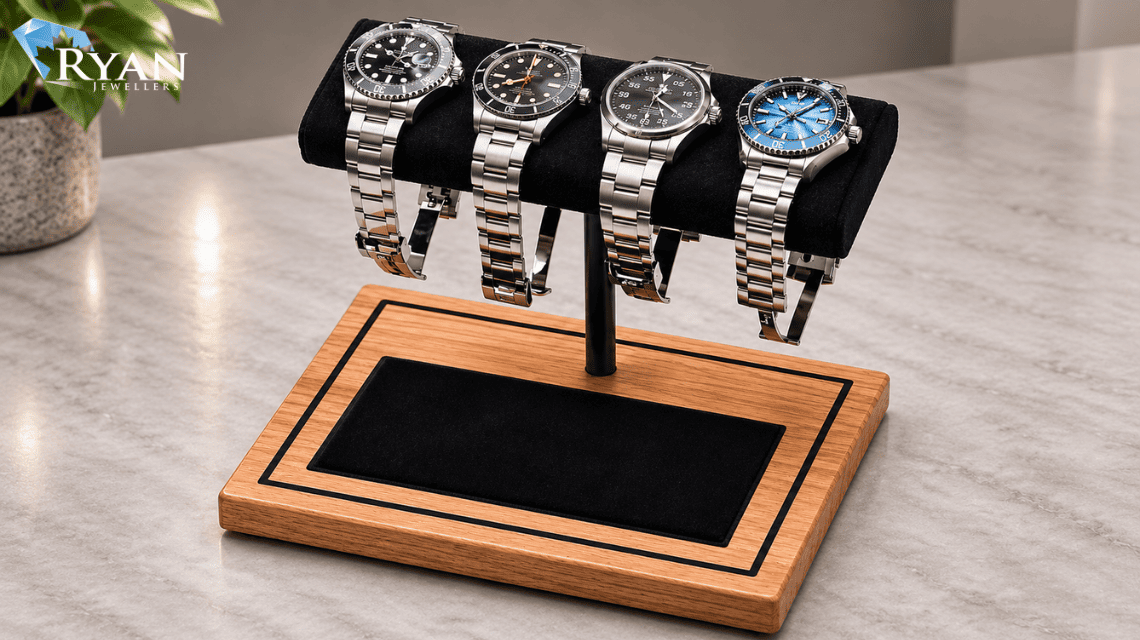
Use an individual cushion or compartment.
Avoid direct contact with other watches or metal objects.
Step 5: Choose the Right Environment
Keep the collection in a stable indoor location away from:
- Direct sunlight
- Extreme temperatures
- Excessive humidity
- Strong magnetic fields
- Chemicals
- Heavy vibration
Step 6: Keep Records Organized
Store service records, warranty information, manuals, and other documentation in a separate, secure location.
For high-value collections, photographing each watch and recording its reference information can also make insurance and future servicing easier.
How Often Should Stored Watches Be Checked?
Long-term storage does not mean forgetting about the collection completely.
Periodically check for:
- Moisture
- Condensation
- Strap deterioration
- Battery issues
- Unusual odours
- Dust accumulation
- Damage to the box or cushion
Automatic watches generally do not need to remain continuously wound while they are in storage.
Quartz watches require attention to battery condition according to the manufacturer’s recommendations.
Valuable mechanical watches should still be serviced according to the manufacturer’s recommended schedule, even when they spend most of their time stored.
Rolex currently recommends periodic professional servicing approximately every 10 years depending on the model and real-life usage, while OMEGA gives a general guideline of 5–8 years depending on the model, climate, and care.
Learn more about proper watch maintenance with our Watch Care Guide and discover practical tips to keep your timepiece in excellent condition.
FAQ About Watch Storage
What is the best way to store watches?
Store watches individually in a clean, dry, stable environment away from direct sunlight, extreme temperatures, moisture, strong magnetic fields, and potential impacts. A padded watch box or dedicated watch case is usually a practical solution.
Should I keep my automatic watch running while it is stored?
Not necessarily. An automatic watch can generally be allowed to stop when it is not being worn. A watch winder is mainly a convenience for owners who prefer to keep the movement running and avoid resetting the watch.
Is it better to store a watch in its original box?
Yes, the original box can provide useful protection, provided the interior is clean and dry. For long-term storage, however, the most important factors are the storage environment and protection from moisture, scratches, temperature extremes, and magnetic fields.
Can I store watches in a safe?
A safe can provide protection against theft, but it is important to consider its internal environment. Avoid prolonged exposure to excessive humidity or extreme temperature fluctuations. If a safe is used for valuable watches, appropriate humidity control may be beneficial.
Should I wind an automatic watch before storing it?
You do not generally need to keep an automatic watch fully wound during storage. It can be allowed to stop naturally. When you decide to wear it again, follow the manufacturer’s instructions for manually winding and setting the watch.
How should I store a watch with a leather strap?
Keep the leather strap dry and away from excessive humidity, direct sunlight, and chemicals. Do not store it while damp. Allow moisture to evaporate naturally before placing the watch inside a closed box or case.
Final Thoughts
Understanding how to store watches properly is one of the simplest ways to protect a luxury collection.
The ideal approach is straightforward: keep watches clean and dry, store them separately, avoid extreme temperatures and strong magnetic fields, protect leather and other sensitive materials, and use an appropriate box or case.
For automatic watches, a watch winder can be useful but is not a requirement. Quartz watches have different storage considerations, particularly around battery condition. Regardless of movement type, the storage environment remains important.
Canadian owners should pay particular attention to seasonal temperature changes and indoor heating during winter. A stable indoor environment away from direct sunlight, moisture, and extreme temperature changes is generally a better choice than a garage, vehicle, or area beside a heating source.
Finally, storage should not replace professional maintenance. Water resistance, seals, movement condition, and battery requirements should still be addressed according to the manufacturer’s recommendations.
A well-maintained watch can remain part of a collection for decades. With the right storage habits, you can help protect its appearance, functionality, and long-term value.
Ready to add another timepiece to your collection? Explore the luxury watch selection at Ryan Jeweller and find a watch worth protecting for years to come.