
Summarize the article with:


An automatic watch is designed to run through the natural movement of the wearer, but that does not mean it is maintenance-free. Proper automatic watch maintenance helps protect the movement, case, bracelet, water resistance, and overall performance of a mechanical timepiece.
Unlike a quartz watch, an automatic watch contains a complex mechanical movement with numerous components working together. Regular wear, moisture, temperature changes, impacts, and the gradual aging of lubricants can all influence how the watch performs over time.
For Canadian owners, seasonal conditions are worth considering as well. Moving between cold outdoor temperatures and heated indoor environments, exposure to snow or rain, and changes in humidity can all affect how a watch is worn and stored.
If you’re considering a mechanical timepiece for long-term ownership, explore the luxury watch selection at Ryan Jeweller and find a model suited to your style and lifestyle.
How Does an Automatic Watch Work?
An automatic watch is a type of mechanical watch that winds its mainspring through the movement of the wearer’s wrist.
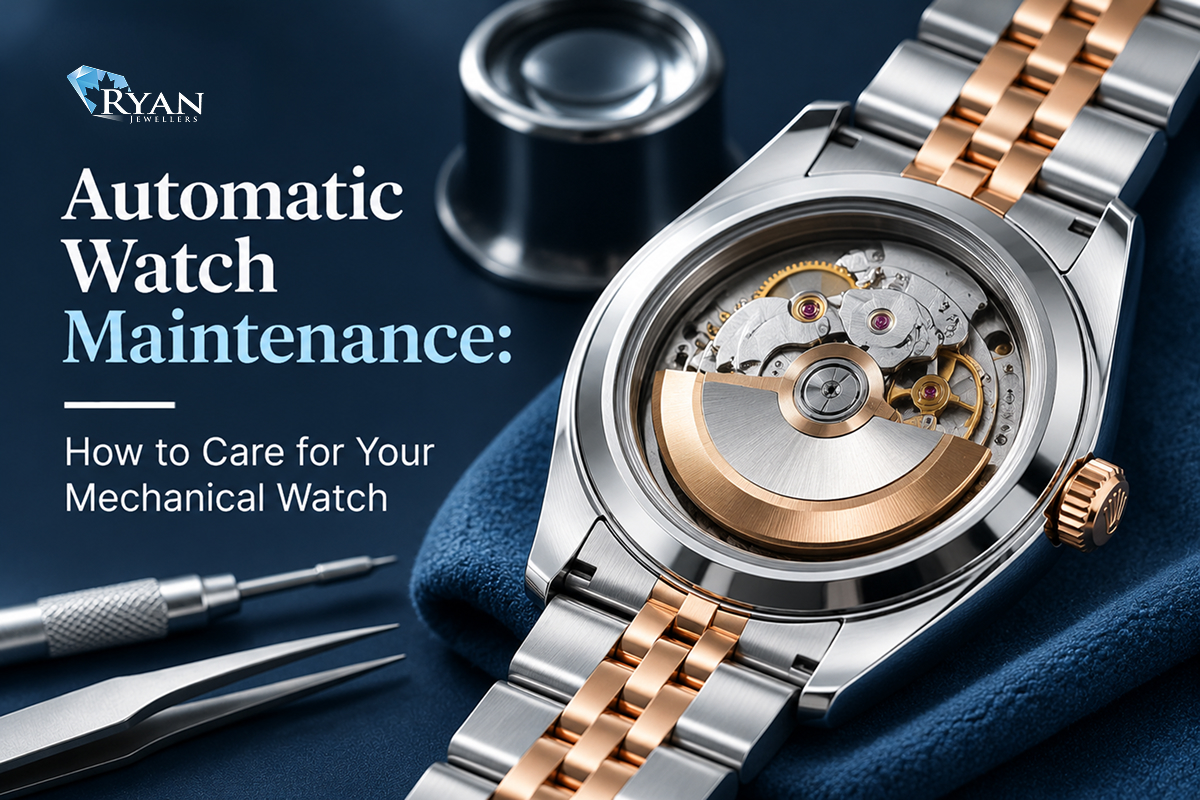
Inside the movement is an oscillating weight, commonly called a rotor. As the wrist moves, the rotor turns and transfers energy to the winding mechanism. That energy is stored in the mainspring and gradually released to power the movement.
Rolex describes this process through its Perpetual rotor: movement of the wrist causes the rotor to rotate, winding the mainspring and providing energy for the mechanical movement.
Automatic vs Manual-Winding Watches
Both automatic and manual-winding watches use mechanical movements, but their winding systems differ.
A manual-winding watch requires the wearer to turn the crown periodically to wind the mainspring.
An automatic watch can wind itself through wrist movement, although the crown can generally also be used for manual winding when the watch has stopped or needs additional energy.
What Happens When an Automatic Watch Is Not Worn?
An automatic watch does not generate energy indefinitely.
Once the stored energy in the mainspring is depleted, the watch will stop. The amount of time it can continue running is called its power reserve, and it varies by movement.
For example, Rolex states that some of its watches can retain their charge for two days or more depending on the model.
A stopped automatic watch is not necessarily experiencing a problem. It may simply need to be wound and reset before being worn again.
How Should You Wear and Wind an Automatic Watch?
Proper winding is an important part of automatic watch maintenance, particularly when a watch has stopped.
Wearing the Watch Regularly
If an automatic watch is worn regularly, normal wrist movement can provide energy to the movement.
However, wearing a watch every day does not eliminate the need for professional servicing. The movement still contains lubricated mechanical components that gradually age with use and time.
What If the Watch Has Stopped?
If the watch has stopped after being left unworn, manual winding may be necessary.
The exact procedure varies by manufacturer and movement, so always follow the model-specific instructions.
For example, Rolex explains that if a watch has stopped, the wearer can manually wind it before setting the time. Rolex’s current guidance for some models specifies turning the crown clockwise around 20 times after bringing it to the winding position.
Do not assume that every automatic movement uses exactly the same winding procedure.
Avoid Excessive Force
A crown should never be forced.
If winding suddenly feels unusually stiff, rough, or inconsistent, stop and have the watch inspected.
Mechanical winding systems are designed to operate smoothly. Unusual resistance can indicate an issue with the crown, winding mechanism, or movement.
Screw-Down Crowns
If your watch has a screw-down crown, make sure it is properly secured after winding or setting the watch.
This is particularly important for water resistance.
Rolex states that its crown should be screwed down properly against the case to maintain waterproofness.
OMEGA similarly instructs owners to return the crown to its proper position after use and warns against manipulating the crown while the watch is in water.
Does an Automatic Watch Need a Watch Winder?
Not necessarily.
A watch winder is a device that rotates an automatic watch when it is not being worn. The purpose is to keep the movement running and, depending on the watch, keep functions such as the date or other indications active.
However, an automatic watch does not require a winder simply because it is mechanical.
When a Watch Winder Can Be Convenient
A winder can be useful if you:
- Own several automatic watches
- Rotate between multiple watches
- Want a watch to remain running while stored
- Prefer not to reset the time and date after the power reserve expires
- Own a complicated calendar or other function that is inconvenient to reset
For some owners, the convenience is the main benefit.
When You May Not Need One
If you wear your watch regularly, natural wrist movement already provides the winding energy.
If you wear the watch only occasionally, allowing it to stop and manually winding it when needed is also a perfectly practical approach, provided the manufacturer allows manual winding.
There is no general requirement that an automatic watch remain continuously wound.
Is Leaving an Automatic Watch Stopped Harmful?
A properly functioning automatic watch can generally be left unworn until its power reserve runs down.
Letting the watch stop does not mean that the movement is damaged.
The more important consideration is proper storage and following the manufacturer’s recommendations for winding, setting, and servicing.
Avoid Choosing a Winder Based Only on Rotation
If you decide to use a watch winder, compatibility matters.
Different automatic movements can have different winding requirements and recommended rotation patterns.
A winder should therefore be selected based on the specific movement rather than simply choosing the fastest or most expensive device.
How Should You Clean and Store an Automatic Watch?
Good daily care is one of the simplest ways to support long-term automatic watch maintenance.
Clean the Watch Regularly
A microfiber cloth is useful for removing fingerprints, dust, and surface oils.
For suitable water-resistant watches, some manufacturers also allow gentle cleaning with mild soapy water and a soft brush.
Rolex recommends occasionally cleaning the case and bracelet with a microfiber cloth and washing suitable cases and metal bracelets with soapy water and a soft brush.
OMEGA similarly recommends soapy water and a toothbrush for appropriate metal bracelets, rubber straps, and waterproof cases, followed by drying with a soft cloth.
Be Careful With Leather
Leather straps should not be treated like metal bracelets.
Avoid soaking leather in water or exposing it unnecessarily to sweat and moisture.
If your automatic watch has a leather strap, follow the manufacturer’s specific care instructions.
Keep Chemicals Away
Perfume, cosmetics, detergents, solvents, and other chemicals can damage certain case, bracelet, strap, and gasket materials.
OMEGA specifically advises avoiding direct contact with solvents, detergents, perfumes, cosmetics, and mosquito repellents because they may damage the case, bracelet, or gaskets.
A simple habit is to apply perfume or cosmetics before putting on your watch and allow them to dry first.
Protect the Watch From Magnetic Fields
Magnetic fields can affect some mechanical movements.
OMEGA advises owners to avoid placing watches near strong magnetic sources such as speakers, refrigerators, laptops, and certain electronic accessories.
Some modern movements are specifically designed with increased magnetic resistance, but the level of protection varies by model.
Store the Watch Safely
When an automatic watch is not being worn, keep it somewhere:
- Dry
- Clean
- Stable in temperature
- Away from strong magnetic sources
- Protected from accidental impacts
A padded watch box or watch roll can help prevent scratches and contact with other watches or jewelry.
Consider Canadian Seasonal Conditions
Canadian winters can create substantial differences between outdoor and indoor temperatures.
OMEGA recommends avoiding extreme temperatures above 60°C or below 0°C, as well as extreme temperature variations.
You do not need to treat normal winter wear as dangerous. Instead, avoid leaving the watch for prolonged periods in extreme environments or directly beside heaters and other strong heat sources.
When Should an Automatic Watch Be Professionally Serviced?
Professional servicing is one of the most important aspects of long-term automatic watch ownership.
There is no single service interval that applies to every mechanical watch.
Follow the Manufacturer’s Recommendation
Different brands provide different guidelines.
For example:
- Rolex: approximately every 10 years, depending on the model and real-life usage.
- OMEGA: generally every 5–8 years, depending on the model, climate, and care.
These are guidelines rather than universal rules for every automatic watch.
The correct interval depends on the specific movement and how the watch is used.
Signs That an Automatic Watch May Need Service
Do not wait for the scheduled interval if the watch develops unusual symptoms.
Potential warning signs include:
- Sudden changes in accuracy
- Significantly reduced power reserve
- Unusual sounds
- Difficulty winding
- Problems with the crown
- Condensation under the crystal
- Chronograph or other function problems
- Damage after a significant impact
A sudden change in performance can indicate that the watch needs professional assessment.
Water Resistance Should Also Be Checked
Water resistance depends partly on seals and gaskets, which can age over time.
OMEGA recommends having water resistance tested annually by an authorized service centre because aging gaskets or accidental shocks to the crown can affect the watch’s water resistance.
This is particularly relevant if you regularly swim, dive, or expose your watch to water.
What Happens During a Complete Service?
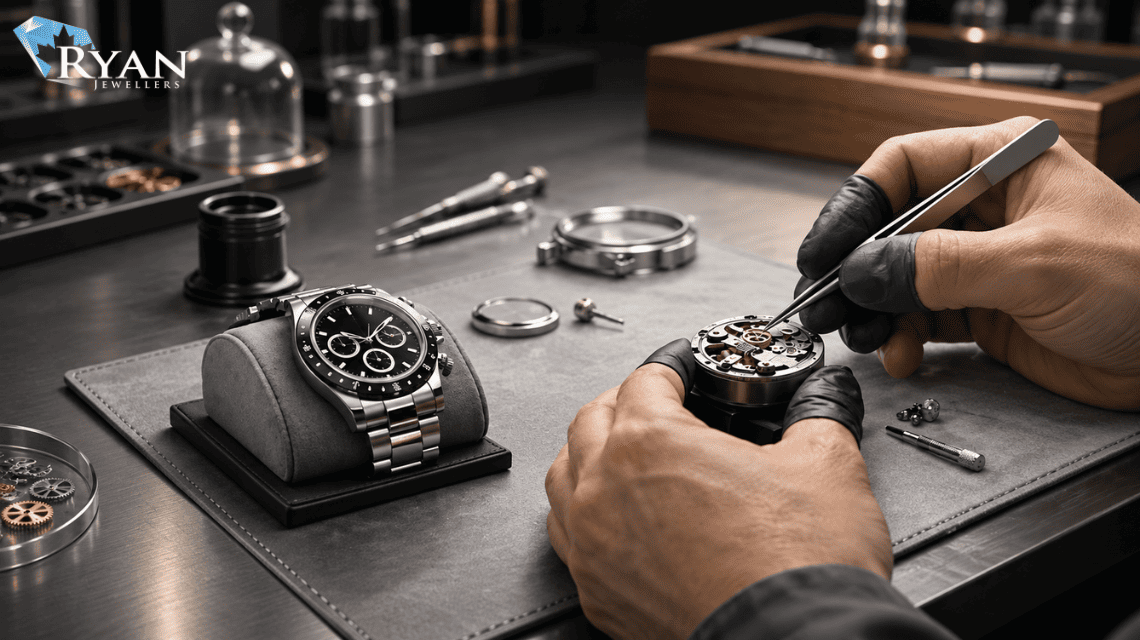
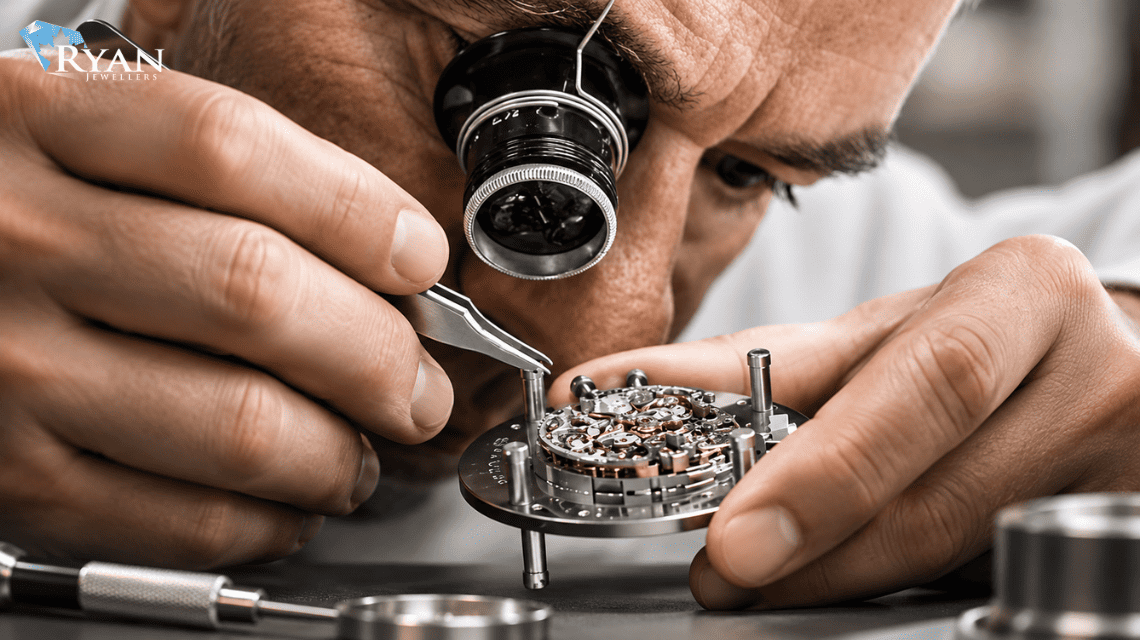
A professional mechanical-watch service can involve:
- Initial assessment
- Movement removal
- Complete movement disassembly
- Cleaning of components
- Inspection for wear
- Replacement of necessary parts
- Lubrication
- Reassembly
- Accuracy testing
- Water-resistance testing
- Final quality control
Rolex states that its complete service involves fully dismantling the movement, cleaning components, examining individual parts, replacing components that no longer meet specifications, lubricating the movement, testing accuracy, and conducting waterproofness, power-reserve, and precision checks.
How Much Can Servicing Cost in Canada?
The price depends on the brand, model, movement, age, and required repairs.
As one current Canadian reference point, Rolex lists complete service starting at:
- CAD $840 for many modern six-digit references
- CAD $980 for selected professional models
- CAD $1,190 for models including the Cosmograph Daytona and Sky-Dweller
Additional repairs or parts may cost extra.
This demonstrates why servicing should be considered part of the long-term ownership cost of a luxury automatic watch.
Use an Appropriate Service Provider
For an expensive mechanical watch, an authorized manufacturer service centre or appropriately qualified watchmaker is generally the safest choice.
OMEGA recommends contacting an authorized OMEGA service centre or boutique because they have the appropriate tools, equipment, and testing procedures.
Rolex similarly operates an official service network with trained watchmakers.
Automatic Watch Maintenance Checklist
A simple routine can help keep your mechanical watch in good condition.
Every Day or When Worn
- Wipe the watch with a soft microfiber cloth.
- Avoid unnecessary exposure to chemicals.
- Make sure the crown is properly secured.
- Avoid significant impacts.
- Keep the watch away from strong magnetic sources.
After Water or Seawater Exposure
- Confirm the watch is designed for the activity.
- Rinse appropriate water-resistant watches with fresh water after seawater exposure.
- Dry the watch thoroughly.
- Check for condensation.
When the Watch Has Stopped
- Follow the manufacturer’s winding instructions.
- Wind gently rather than forcing the crown.
- Set the time and other functions according to the model’s instructions.
- Secure the crown afterward.
Periodically
- Monitor accuracy.
- Pay attention to changes in power reserve.
- Check the condition of the bracelet or strap.
- Have water resistance tested when appropriate.
- Follow the manufacturer’s recommended service interval.
- Keep service documentation.
Learn more about proper watch maintenance with our Watch Care Guide and discover practical tips to keep your timepiece in excellent condition.
FAQ About Automatic Watch Maintenance
How often should an automatic watch be serviced?
There is no universal interval. Rolex currently recommends servicing approximately every 10 years depending on the model and real-life usage, while OMEGA gives a general guideline of 5–8 years depending on conditions.
Do automatic watches need to be wound manually?
Not when they are being worn regularly and the automatic winding system is functioning normally. If the watch has stopped after being unworn, manual winding may be necessary. Follow the specific manufacturer’s instructions for the movement.
Is a watch winder necessary for an automatic watch?
No. A watch winder is primarily a convenience for owners who want to keep an automatic watch running while it is not being worn. An automatic watch can generally be allowed to stop and manually wound when needed.
Can I wear an automatic watch every day?
Yes, provided the watch is designed for your intended activities and is cared for according to the manufacturer’s instructions. Daily wear is actually how an automatic movement receives energy through wrist movement.
How do I know if my automatic watch needs servicing?
Watch for sudden changes in accuracy, reduced power reserve, unusual sounds, winding problems, crown issues, condensation, or other changes in normal operation. A significant impact or uncertainty about water resistance can also justify professional inspection.
How should I store an automatic watch when I am not wearing it?
Keep it in a clean, dry, stable environment away from strong magnetic fields, extreme temperatures, and unnecessary impacts. A padded watch box or watch roll can provide additional protection.
Final Thoughts
Good automatic watch maintenance is not about constantly adjusting or servicing your watch. It is about understanding how the movement works and developing a few consistent habits.
Wear the watch appropriately, wind it according to the manufacturer’s instructions when necessary, keep the case and bracelet clean, protect it from chemicals and strong magnetic fields, and store it properly when it is not being worn.
Most importantly, pay attention to changes in performance. A sudden change in accuracy, power reserve, winding, water resistance, or overall operation can be more meaningful than the number of years since the last service.
For Canadian owners, seasonal temperature changes and exposure to rain, snow, seawater, and indoor heating are additional reasons to take storage and water resistance seriously.
With sensible daily care and professional servicing at the appropriate interval, a quality automatic watch can remain a reliable and enjoyable part of your collection for many years.
Ready to find an automatic watch worth maintaining for the long term? Explore the luxury watch collection at Ryan Jeweller and discover a timepiece that fits your style and collection.