
Summarize the article with:


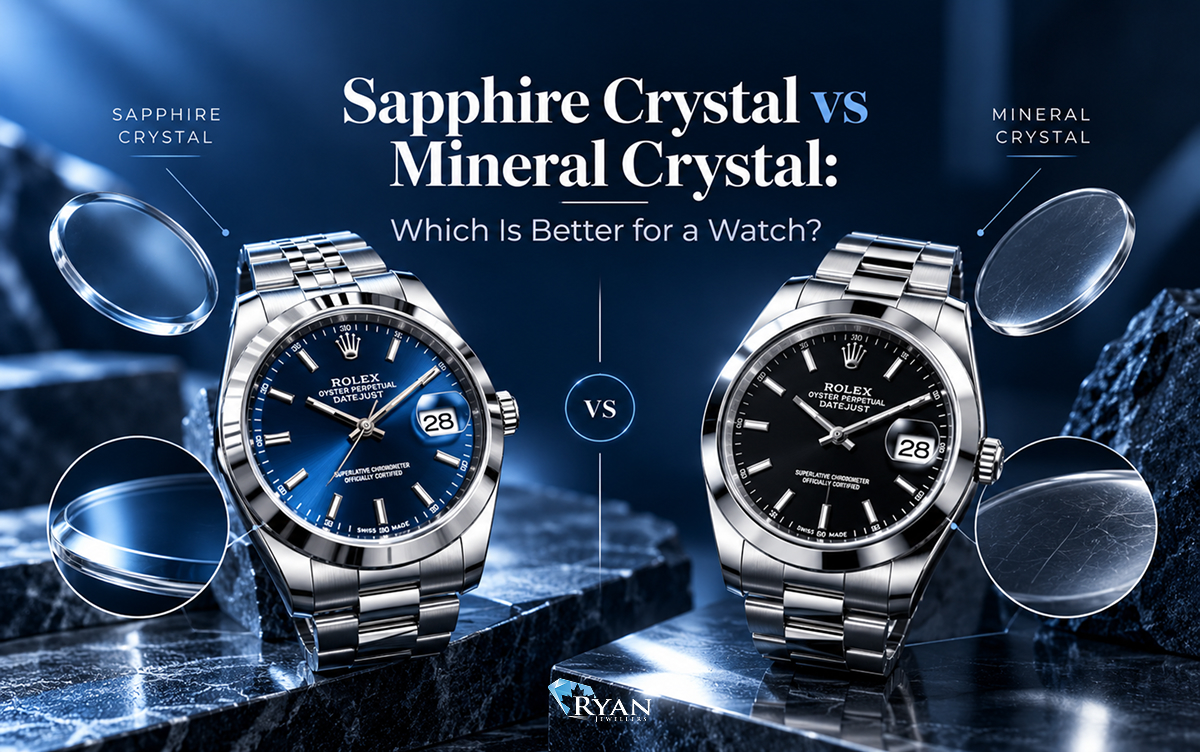
When comparing sapphire crystal vs mineral crystal, the biggest differences come down to scratch resistance, impact behaviour, clarity, price, and replacement considerations. Both materials are widely used in watches, but they suit different priorities.
Sapphire crystal is generally associated with higher-end watches because of its excellent scratch resistance and optical clarity. Mineral crystal is typically more affordable and can provide a practical balance between durability and cost.
For Canadian buyers, understanding these differences can help you choose a watch based on how and where you plan to wear it rather than relying on price or marketing alone.
If you’re exploring watches and fine jewelry for different lifestyles and budgets, visit Ryan Jeweller to discover available timepieces and find a style that suits you.
What Is Sapphire Crystal in a Watch?
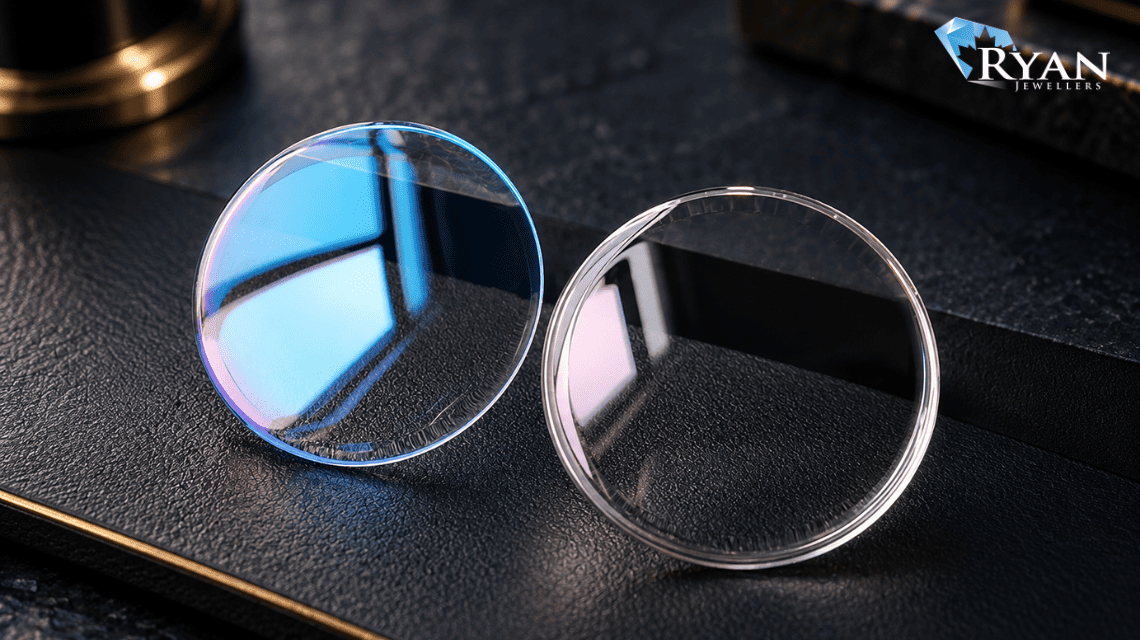
Sapphire crystal is a synthetic material made from crystalline aluminium oxide. It is not the same material as the naturally occurring blue gemstone sapphire, although both are forms of corundum.
For watchmaking, synthetic sapphire is manufactured into a transparent crystal and precisely shaped to protect the dial.
Why Is Sapphire Used in Watches?
The main reason manufacturers use sapphire crystal is its exceptional hardness.
On the Mohs hardness scale, sapphire is rated at approximately 9, making it one of the hardest transparent materials commonly used in watches.
Only diamond is harder on the standard Mohs scale.
This gives sapphire several important advantages:
- Excellent scratch resistance
- High optical clarity
- Long-lasting appearance
- Resistance to everyday surface wear
Is Sapphire Crystal Actually Glass?
Not technically.
Although watchmakers and consumers commonly call it a “crystal,” synthetic sapphire is crystalline aluminium oxide rather than conventional glass.
The terminology can therefore be slightly confusing.
In watch specifications, “sapphire crystal” refers to the transparent synthetic sapphire component protecting the dial.
Sapphire Crystal and Anti-Reflective Coatings
Many sapphire watch crystals use anti-reflective coatings to reduce reflections and improve dial visibility.
Depending on the watch, the coating may be applied to:
- The underside
- The top surface
- Both surfaces
Anti-reflective treatment can improve legibility, particularly under bright lighting.
However, the coating itself may have different scratch characteristics from the sapphire underneath.
Sapphire Is Not Indestructible
One common misconception is that sapphire crystal cannot break.
Its high hardness makes it highly resistant to scratching, but hardness and impact resistance are different properties.
A sufficiently strong impact can cause sapphire to chip, crack, or fracture.
Therefore, sapphire should be considered highly scratch-resistant, not unbreakable.
What Is Mineral Crystal and How Is It Made?
Mineral crystal is a type of glass used to protect watch dials.
It is generally produced from glass that has been processed or treated to improve its resistance to scratching and everyday wear compared with ordinary glass.
Why Do Watches Use Mineral Crystal?
Mineral crystal offers a practical balance between:
- Cost
- Clarity
- Scratch resistance
- Impact performance
It is commonly found in watches positioned below the premium and luxury segments, although material choice varies significantly between manufacturers.
Mineral Crystal Is Not the Same as Ordinary Glass
Watch-grade mineral crystal is designed specifically for use in timepieces.
Manufacturers can use different glass compositions and treatments to improve performance.
Some mineral crystals may also receive additional coatings or treatments.
Advantages of Mineral Crystal
Mineral crystal can be attractive for buyers who want:
- Lower purchase costs
- Good everyday clarity
- Reasonable scratch resistance
- Practical durability
- Easier replacement costs
Limitations of Mineral Crystal
Compared with sapphire, mineral crystal is generally more susceptible to scratches.
Small marks can accumulate over time, particularly if the watch is worn regularly in environments where the crystal may contact hard surfaces.
However, mineral crystal can offer a useful balance between scratch resistance and impact behaviour.
How Do Sapphire and Mineral Crystals Compare in Scratch Resistance?
This is where sapphire has its clearest advantage.
Sapphire Crystal
Sapphire has a Mohs hardness of approximately 9.
This means it is highly resistant to scratches from many materials encountered during everyday use.
For someone who wears the same watch regularly, this can help the crystal maintain its appearance for a longer period.
Mineral Crystal
Mineral glass is softer than sapphire.
It can therefore develop scratches more easily through normal use.
This does not mean mineral crystal is fragile. It simply means that its surface is more susceptible to scratching.
What Does Scratch Resistance Mean in Real Life?
Consider everyday situations such as:
- Brushing against a desk
- Contact with metal objects
- Carrying keys
- Outdoor activities
- Contact with rough surfaces
Sapphire is generally better at resisting superficial scratches from these types of contact.
However, neither material should intentionally be exposed to abrasive surfaces.
Hardness Does Not Equal Overall Durability
This distinction is important.
Hardness refers largely to resistance to scratching and indentation.
Toughness relates more closely to resistance against cracking or breaking under impact.
Sapphire is harder than mineral crystal, but that does not mean it is automatically more resistant to every type of damage.
This is why sapphire can remain nearly scratch-free for years while still being capable of cracking after a sufficiently severe impact.
Which Is Better for Long-Term Appearance?
If your priority is maintaining a clean, scratch-free crystal, sapphire generally has the advantage.
This is one of the main reasons sapphire is common in higher-priced watches.
Which Watch Crystal Is More Resistant to Impact?
The answer is more nuanced than simply choosing one material.
Mineral Crystal and Impact
Mineral crystal is generally less hard than sapphire.
However, its material characteristics can make it a practical option for everyday watches where impact resistance is important.
A mineral crystal may be less likely to behave like a brittle hard material under certain impacts, although actual performance depends on thickness, shape, mounting, and the specific glass used.
Sapphire Crystal and Impact
Sapphire is extremely hard and highly scratch-resistant.
However, its hardness does not make it immune to impact damage.
A sufficiently strong blow can cause:
- Chipping
- Cracking
- Fracturing
The design of the crystal and case also affects impact resistance.
Crystal Thickness Matters
A thicker crystal may behave differently from a thin one.
The shape and mounting system also influence how forces are distributed.
Therefore, simply knowing that a watch uses sapphire or mineral crystal does not provide a complete picture of impact resistance.
Case Construction Matters Too
The case protects the crystal and determines how the crystal is mounted.
Important factors include:
- Bezel design
- Crystal shape
- Crystal thickness
- Case construction
- Mounting system
A well-designed watch can provide good protection regardless of whether it uses sapphire or mineral crystal.
What About Sports and Outdoor Watches?
If the watch will be exposed to frequent impacts, consider the complete construction rather than focusing solely on the crystal.
Look at:
- Case durability
- Shock resistance
- Crystal material
- Crystal thickness
- Bezel protection
- Water resistance
- Manufacturer specifications
A purpose-built sports watch may be a better choice than simply selecting a sapphire crystal.
How Do Price, Clarity, and Replacement Costs Compare?
Price is one of the main reasons manufacturers continue to use both materials.
Sapphire Crystal Cost
Sapphire generally costs more to manufacture and process than standard mineral glass.
The manufacturing process involves producing synthetic sapphire and machining it into the required shape.
Additional treatments, such as anti-reflective coatings, can also contribute to the cost.
This is one reason sapphire crystal is more commonly associated with higher-priced watches.
Mineral Crystal Cost
Mineral crystal is generally less expensive to produce and replace.
This makes it attractive for watches where keeping the overall price accessible is important.
Optical Clarity
Both materials can provide good visibility.
Sapphire can offer excellent optical clarity, particularly when combined with a quality anti-reflective coating.
Mineral crystal can also provide clear viewing of the dial, although the exact optical performance depends on the material, thickness, treatment, and construction.
Anti-Reflective Coatings
A high-quality anti-reflective coating can significantly improve legibility.
This is particularly noticeable under:
- Direct sunlight
- Strong indoor lighting
- Photography
- Angled viewing conditions
However, coatings can have their own durability considerations.
Replacement Costs
Replacement costs depend on much more than the crystal material.
Factors can include:
- Watch brand
- Model
- Crystal shape
- Crystal thickness
- Coating
- Case design
- Labour
- Availability of replacement parts
A simple round mineral crystal can be relatively straightforward to replace.
A specialized sapphire crystal with complex curvature or integrated design can be considerably more expensive.
Is Sapphire Worth Paying More For?
For many buyers, yes—particularly if scratch resistance and long-term appearance are priorities.
Sapphire can be particularly appealing for:
- Everyday watches
- Luxury watches
- Watches worn for many years
- Buyers who want minimal visible scratching
Mineral crystal can still make sense if affordability and practical durability are more important.
Sapphire Crystal vs Mineral Crystal: Which Is Better for Everyday Wear?
The answer depends on your lifestyle.
Choose Sapphire If You Prioritize:
- Scratch resistance
- Long-term appearance
- Premium specifications
- High-end construction
- Frequent everyday wear
A sapphire crystal can be particularly useful if you plan to wear one watch most days.
Choose Mineral Crystal If You Prioritize:
- Lower purchase price
- Lower replacement cost
- Practical everyday performance
- A balance between durability and affordability
Mineral crystal can be perfectly appropriate for casual and everyday watches.
For Luxury Watches
Sapphire is generally the more common choice because luxury buyers often expect strong scratch resistance and long-lasting clarity.
For Dress Watches
Either can work.
If the watch is worn mainly for formal occasions, crystal durability may be less important than the overall design, case proportions, dial, and finishing.
For Sports Watches
Sapphire can be attractive because of its scratch resistance, but impact resistance and overall case construction should also be considered.
For Vintage Watches
Vintage watches may use acrylic or other historical crystal materials rather than sapphire or modern mineral crystal.
Replacing the original crystal with a modern material can change the appearance and character of a vintage watch, so collectors may prefer to preserve the original specification.
How Should You Care for Sapphire and Mineral Crystal?
Regardless of material, proper care can extend the appearance and lifespan of your watch.
Sapphire Crystal Care
Although sapphire is highly scratch-resistant:
- Avoid unnecessary contact with hard surfaces.
- Clean it with a soft cloth.
- Do not use abrasive cleaners.
- Be careful around hard impacts.
- Follow the manufacturer’s cleaning recommendations.
If the watch has an anti-reflective coating, avoid aggressive polishing.
Mineral Crystal Care
Mineral crystal requires slightly more attention to scratches.
Use:
- A soft microfiber cloth
- Gentle cleaning products approved for watches
- Proper storage
Avoid placing the watch face-down on rough surfaces.
Storage
When storing a watch:
- Keep it away from jewelry that could scratch the crystal.
- Use a soft-lined watch box.
- Avoid unnecessary exposure to extreme temperatures.
- Keep the watch away from harsh chemicals.
Proper storage is particularly important when you own several watches and rotate between them.
If you want a more detailed overview before making a purchase, read our Watch Buying Guide for practical advice on movements, sizing, materials, features, and budget.
FAQ About Sapphire vs Mineral Crystal
Is sapphire crystal better than mineral crystal?
For most buyers, sapphire is better if scratch resistance and long-term clarity are priorities. Mineral crystal can be a practical alternative when lower cost and balanced everyday performance are more important.
Is sapphire crystal scratch-proof?
No. Sapphire is highly scratch-resistant but not completely scratch-proof. It can still be damaged by sufficiently hard materials or severe impact.
Is mineral crystal more impact-resistant than sapphire?
Mineral crystal can offer different impact characteristics because it is less hard and generally less brittle than sapphire, but actual performance depends on thickness, shape, mounting, and case construction.
Which watch crystal is more expensive?
Sapphire crystal generally costs more to manufacture and replace than standard mineral crystal, although the actual replacement cost depends heavily on the watch model and crystal design.
Does sapphire crystal make a watch better?
It can improve one important aspect of the watch: resistance to everyday scratching. However, the overall quality of a watch depends on many other factors, including movement, case, finishing, materials, construction, and design.
Should I choose sapphire or mineral crystal for an everyday watch?
Sapphire is generally the better choice if you wear the watch frequently and want to minimize scratches. Mineral crystal can be suitable if you want a more affordable watch and are comfortable with greater susceptibility to surface marks.
Final Thoughts
When comparing sapphire crystal vs mineral crystal, neither material is universally better for every watch or every buyer.
Sapphire crystal offers exceptional hardness and excellent resistance to everyday scratching, making it particularly attractive for luxury and frequently worn watches. Mineral crystal is generally more affordable and can provide a practical combination of clarity, durability, and cost.
The key distinction is that hardness and impact resistance are not the same thing. Sapphire is harder and more scratch-resistant, but it can still chip or fracture under a sufficiently strong impact. Mineral crystal is softer and more prone to scratches, while its characteristics can make it a practical choice for watches where affordability and everyday durability are priorities.
For Canadian buyers, the best choice ultimately depends on how you plan to wear the watch, your budget, and how important long-term crystal appearance is to you.
If you’re ready to compare watches with different materials, movements, and designs, visit Ryan Jeweller to explore the collection and find a timepiece that fits your lifestyle.