
Summarize the article with:


Custom jewelry allows you to create a piece around your own preferences rather than choosing from a fixed collection. From selecting the metal and gemstone to deciding the setting, proportions, and final details, a custom design can reflect a personal story, milestone, or individual style.
For Canadian buyers, the process can also involve practical considerations such as metal purity, gemstone certification, CAD pricing, deposits, production timelines, and taxes. Understanding these details before starting can make the experience more predictable and help you make informed decisions.
Whether you are designing an engagement ring, wedding band, necklace, bracelet, or personalized gift, custom jewelry offers flexibility that ready-made pieces cannot always provide. If you are considering a one-of-a-kind design, explore Ryan Jeweller for inspiration and use this guide to understand what goes into creating a custom piece.
What Is Custom Jewelry?
Custom jewelry is a piece designed or modified specifically according to a customer’s preferences. Rather than selecting a finished item exactly as it appears in a display case, you can work with a jeweller to determine elements such as the metal, gemstone, setting, dimensions, and overall design.
Custom jewelry can range from a completely original creation to a modification of an existing design.
Fully Custom Jewelry
A fully custom piece is created from the ground up.
You may decide:
- The overall shape
- Metal type and colour
- Gold karat
- Gemstone type
- Diamond shape and size
- Setting style
- Band width
- Surface finish
- Engraving
- Decorative details
This approach provides the greatest level of personalization.
Modified Jewelry
Not every custom project needs to start from nothing.
A jeweller may be able to modify an existing design by changing:
- The gemstone
- Metal colour
- Ring size
- Band details
- Engraving
- Setting
- Proportions
This can be a practical option if you already have a style you like but want to personalize specific elements.
Custom Jewelry vs Bespoke Jewelry
The terms are sometimes used interchangeably, although “bespoke” generally suggests a highly individualized design created specifically for one customer.
The exact terminology varies between jewelry businesses, so it is more useful to ask what customization is actually included rather than relying on the label alone.
Why Choose Custom Jewelry Over Ready-Made Pieces?
Custom jewelry is not automatically better than ready-made jewelry. The right option depends on your priorities, budget, timeline, and desired level of personalization.
Create a More Personal Design
A custom piece can incorporate details that have personal meaning.
For example, you might include:
- A birthstone
- A specific diamond shape
- An engraving
- A meaningful motif
- A combination of metals
- A gemstone from an existing piece
This makes customization particularly appealing for engagement rings, anniversary jewelry, and family pieces.
Choose the Exact Gemstone
With a ready-made piece, the gemstone is already selected.
Custom jewelry allows you to choose characteristics such as:
- Diamond shape
- Carat weight
- Colour
- Clarity
- Cut quality
- Natural or lab-grown origin
- Certification, when available
For diamonds, understanding the 4Cs — cut, colour, clarity, and carat weight — can help you prioritize the characteristics that matter most to you.
Select Your Preferred Metal
You can typically choose among options such as:
- Yellow gold
- White gold
- Rose gold
- Platinum
Gold jewelry may also be available in different karats, such as 10K, 14K, or 18K.
The choice affects colour, durability, gold content, appearance, and price.
Create a Better Fit
Customization can be particularly useful for rings.
Instead of choosing a standard design and hoping it fits comfortably, the design can take factors such as finger size, band width, setting height, and lifestyle into consideration.
Make Better Use of Your Budget
A custom design does not necessarily mean spending more.
You can decide where to allocate your budget.
For example, you might prioritize:
- A larger centre diamond
- Higher cut quality
- A particular metal
- A more intricate setting
- Additional accent stones
This gives you greater control over the final balance between design and cost.
Preserve or Repurpose Existing Jewelry
Custom work can sometimes incorporate gemstones or materials from an existing piece.
However, not every old gemstone or jewelry component is suitable for reuse. A jeweller should assess the condition and compatibility before incorporating an existing piece into a new design.
Popular Types of Custom Jewelry
Custom jewelry can be created for almost any occasion, but some categories are particularly popular.
Custom Engagement Rings
Engagement rings are one of the most common custom jewelry projects.
Customization may involve selecting:
- Diamond shape
- Centre-stone size
- Setting style
- Metal
- Band design
- Accent diamonds
- Hidden details
A custom engagement ring can be designed around both personal style and practical considerations such as everyday wear.
Custom Wedding Bands
Wedding bands can be created to complement an engagement ring or designed as standalone pieces.
Options may include:
- Plain gold bands
- Diamond bands
- Eternity-style designs
- Curved bands
- Engraved bands
- Mixed-metal designs
Custom Necklaces
Custom necklaces can range from simple pendants to more elaborate designs.
Popular options include personalized initials, names, birthstones, symbolic shapes, and gemstone pendants.
Custom Bracelets
Bracelets can be customized through:
- Metal
- Chain style
- Gemstones
- Engraving
- Link design
- Width
A custom bracelet can be designed specifically for everyday wear or a formal occasion.
Custom Earrings
Custom earrings can be created in a variety of styles, including:
- Studs
- Hoops
- Drop earrings
- Huggies
- Diamond earrings
Customization can be particularly useful when matching earrings to an engagement ring or other jewelry.
Personalized Family Jewelry
Custom designs can also incorporate multiple birthstones, initials, dates, or other symbolic elements.
These designs are often chosen for anniversaries, birthdays, family milestones, and meaningful gifts.
How the Custom Jewelry Design Process Works
Although the exact process varies between Canadian jewellers, custom projects generally follow several stages.
1. Initial Consultation
The process usually begins with a discussion about your idea.
You may discuss:
- Desired style
- Jewelry type
- Metal
- Gemstones
- Budget
- Timeline
- Intended use
Bring reference photos if you have them. They can help communicate the overall aesthetic you want.
2. Design Development
The jeweller develops the concept based on your requirements.
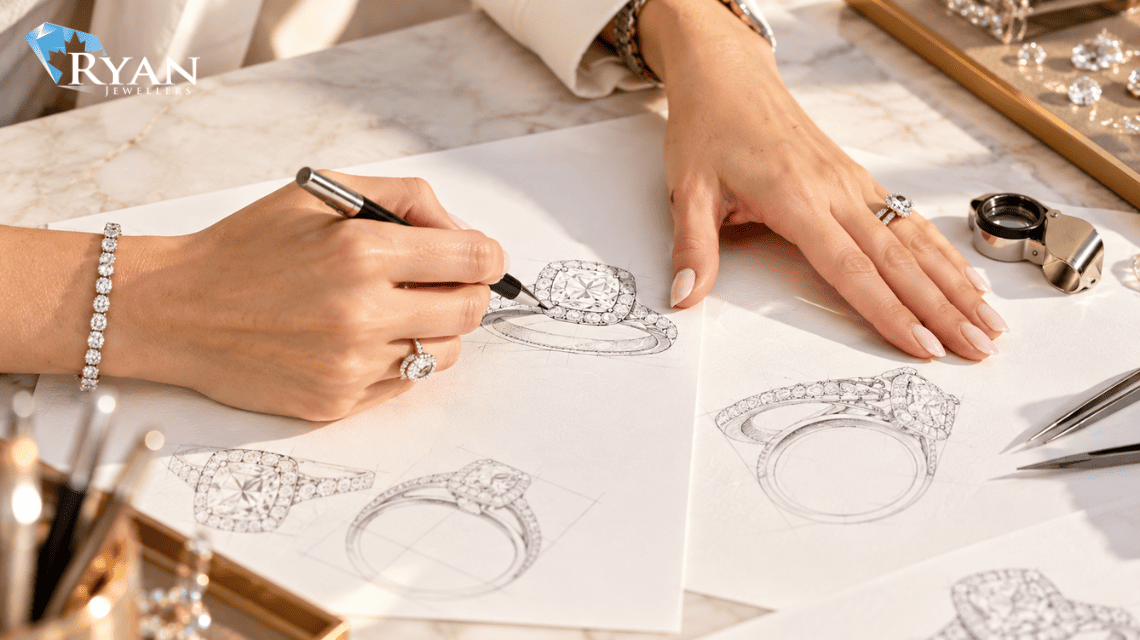
Depending on the project, this may involve sketches, technical drawings, or computer-aided design (CAD).
CAD can help visualize proportions and design details before production begins.
3. Selecting the Gemstones
If the design includes diamonds or other gemstones, you can select the stones based on the project’s priorities.
For diamonds, consider the 4Cs alongside factors such as:
- Shape
- Fluorescence
- Certification
- Measurements
- Overall appearance
A certificate can provide important information about a diamond’s characteristics, but the document should be considered alongside the actual stone and the design in which it will be set.
4. Confirming the Metal
The next step is selecting the metal and purity.
For gold, the karat indicates the proportion of pure gold in the alloy.
For example:
| Gold Type | Approximate Gold Content |
|---|---|
| 10K | 41.7% |
| 14K | 58.5% |
| 18K | 75% |
| 24K | 99.9% |
Higher-karat gold contains more pure gold, while lower-karat alloys generally contain a greater proportion of other metals.
5. Reviewing the Final Design
Before production begins, confirm the important details.
Check:
- Dimensions
- Ring size
- Metal
- Gemstone specifications
- Setting
- Engraving
- Finish
- Estimated price
- Production timeline
This is an important stage because changes can become more difficult or expensive once production has started.
6. Production
Once the design is approved, the jeweller creates the piece.
Depending on the design, production can involve casting, metalwork, stone setting, polishing, engraving, and finishing.
Complex designs may require more production time than simple pieces.
7. Quality Inspection
Before accepting the finished jewelry, inspect it carefully.
Look at:
- Overall finish
- Stone security
- Symmetry
- Engraving
- Clasp function
- Ring size
- Surface condition
For diamond jewelry, confirm that the centre stone and accent stones match the agreed specifications.
8. Final Fitting and Collection
For rings, make sure the fit is comfortable without being excessively loose or tight.
For necklaces and bracelets, check the length and clasp.
If adjustments are needed, discuss them with the jeweller before considering the project complete.
How Much Does Custom Jewelry Cost?
There is no standard price for custom jewelry in Canada because the final cost depends on the materials, design, craftsmanship, and complexity of the project.
Main Factors That Affect Price
Metal
The type and amount of metal affect the overall cost.
Platinum generally costs more than many gold options, while the karat and weight of gold also influence the price.
Gemstones
Gemstones can represent a significant portion of the total price.
For diamonds, cost can vary considerably based on:
- Carat weight
- Cut
- Colour
- Clarity
- Shape
- Natural or lab-grown origin
- Certification
Two diamonds with the same carat weight can therefore have very different prices.
Design Complexity
A simple custom band generally requires less work than an intricate design with multiple gemstones and detailed metalwork.
More complex designs can require additional labour, CAD work, setting, finishing, and production time.
Craftsmanship
The labour involved in creating a custom piece contributes to the final price.
Hand-finishing, intricate settings, engraving, and specialized techniques may increase the cost.
Existing Jewelry
If you want to reuse an existing diamond or gemstone, the project may have a different cost structure.
However, the jeweller should first evaluate whether the stone is suitable for removal and resetting.
Is Custom Jewelry More Expensive?
Not always.
Custom jewelry can cost more when the design requires significant development or specialized craftsmanship. However, a relatively simple custom piece may be comparable to a ready-made piece with similar materials and quality.
The best way to compare prices is to evaluate the complete specification, rather than comparing only the final dollar amount.
Ask for a Detailed Quote
Before approving a custom project, ask what is included in the quoted price.
A useful quote should clarify, where applicable:
- Metal
- Gemstones
- Labour
- Design or CAD work
- Engraving
- Setting
- Finishing
- Taxes
- Deposit requirements
- Potential additional charges
Canadian purchases are generally subject to applicable sales taxes, with the exact amount depending on the province or territory and the transaction.
What to Consider Before Ordering Custom Jewelry in Canada
A custom design is a significant purchase, so it is worth considering more than appearance.
Set a Realistic Budget
Determine your overall spending limit before selecting gemstones or finalizing the design.
Then decide which characteristics are most important.
Think About Lifestyle
A beautiful design still needs to work for everyday life.
If the piece will be worn daily, consider:
- Setting height
- Band thickness
- Prong design
- Gemstone durability
- Comfort
- Maintenance requirements
Consider Future Maintenance
Some custom designs require more maintenance than simple jewelry.
Intricate pavé settings, delicate chains, and white gold pieces may require additional attention over time.
Understand the Warranty and After-Sales Service
Before ordering, ask about:
- Warranty coverage
- Resizing
- Repairs
- Cleaning
- Inspection
- Rhodium replating for white gold
- Returns or cancellations
Custom orders can have different policies from ready-made jewelry, so clarify these terms before paying a deposit.
FAQ About Custom Jewelry
What is custom jewelry?
Custom jewelry is a piece designed or modified according to a customer’s specific preferences, including elements such as metal, gemstones, dimensions, setting, and decorative details.
Is custom jewelry more expensive than ready-made jewelry?
Not necessarily. Cost depends on the materials, gemstone specifications, design complexity, craftsmanship, and production requirements.
Can I design my own engagement ring?
Yes. Many custom engagement-ring projects allow you to select the diamond or gemstone, metal, setting, band design, and other details.
Can I use my own diamond in custom jewelry?
In many cases, an existing diamond can potentially be reused. However, the jeweller should inspect the stone first to determine whether it is suitable for removal and resetting.
Can lab-grown diamonds be used in custom jewelry?
Yes. Lab-grown diamonds can be incorporated into custom jewelry designs. They have essentially the same chemical composition and crystal structure as natural diamonds, while their origin and production method differ.
How long does custom jewelry take to make?
The timeline depends on the design, materials, gemstone availability, CAD approval, production process, and jeweller. Simple projects may be completed faster than highly detailed designs, so confirm the estimated timeline before placing an order.
Do I need a CAD design?
Not every custom jewelry project requires CAD. However, CAD can be useful for visualizing proportions and complex designs before production.
Can custom jewelry be resized?
Many rings can be resized, but the amount of adjustment depends on the design, metal, setting, and construction. Some intricate or full-eternity designs may have limited resizing options.
Can custom jewelry include engraving?
Yes. Engraving can add names, dates, initials, symbols, or short messages. The available space and design determine what can be engraved.
Is custom jewelry worth it?
Custom jewelry can be worthwhile if personalization, specific materials, unique design, or sentimental value are important to you. If you prefer convenience, immediate availability, or a lower-complexity purchase, ready-made jewelry may be more suitable.
What should I ask a jeweller before ordering custom jewelry?
Ask about the total price, materials, gemstone specifications, production timeline, deposit, revision process, warranty, resizing, repairs, and policies for custom orders.
Can custom jewelry be returned?
Return policies vary by jeweller and by the nature of the customization. Because personalized pieces may be made specifically for one customer, confirm the return and cancellation policy before placing a deposit.
Final Thoughts
Custom jewelry gives you greater control over the details that make a piece unique. From the metal and gemstone to the setting, proportions, engraving, and finish, each decision can contribute to a design that feels personal and intentional.
For Canadian buyers, the most important step is to understand exactly what you are purchasing before production begins. Compare the complete specifications, clarify the quote, confirm the gemstone details, understand the timeline, and review warranty and after-sales policies.
A well-designed custom piece should not only look beautiful. It should also suit your lifestyle, fit comfortably, use appropriate materials, and remain practical to maintain over time.
If you’re ready to explore ideas for your own one-of-a-kind piece, visit Ryan Jeweller to discover jewelry styles and find inspiration for your next custom design.
I love the idea of creating custom jewelry because it makes a piece feel so much more personal and meaningful. This guide is a great starting point for anyone who wants something unique rather than choosing a ready-made design. For a first custom jewelry project, would you recommend starting with a simple design and adding personal details over time?
This was an interesting read, especially for someone considering a custom engagement ring. I think being able to choose the metal, gemstone, and overall design makes the process much more meaningful, although I imagine it can be difficult to know where to start. What should buyers prioritize first when planning a custom piece: the budget, the gemstone, or the design?
I really appreciate the focus on personalization, since jewelry can hold special memories and mark important milestones. A custom piece also seems like a thoughtful gift for anniversaries, birthdays, or other meaningful occasions. For anyone ordering custom jewelry in Canada, how far in advance would you suggest starting the design process to allow enough time for adjustments?