
Summarize the article with:


Wedding jewelry plays an important role in bringing a bridal look together. From diamond earrings and necklaces to wedding bands and bracelets, the right pieces can complement the dress, hairstyle, neckline, and overall style of the celebration.
For couples planning a wedding in Canada, jewelry shopping also involves practical considerations such as metal quality, diamond specifications, sizing, budget, taxes, and after-purchase care. Natural and lab-grown diamonds provide additional choices, while gold and platinum offer different characteristics for wedding jewelry.
The goal is not necessarily to choose the largest or most expensive pieces. Instead, the best approach is to understand how different materials, designs, and proportions work together and then select jewelry that fits both the occasion and your personal style.
If you are beginning your search, explore the wedding jewelry selection at Ryan Jeweller and use this Wedding Jewelry Canada Guide to understand the key factors before purchasing.
Popular Wedding Jewelry Styles for Canadian Brides
Wedding jewelry encompasses much more than the engagement ring and wedding band. Earrings, necklaces, bracelets, and other pieces can be selected individually or coordinated as a complete set.
Diamond Earrings
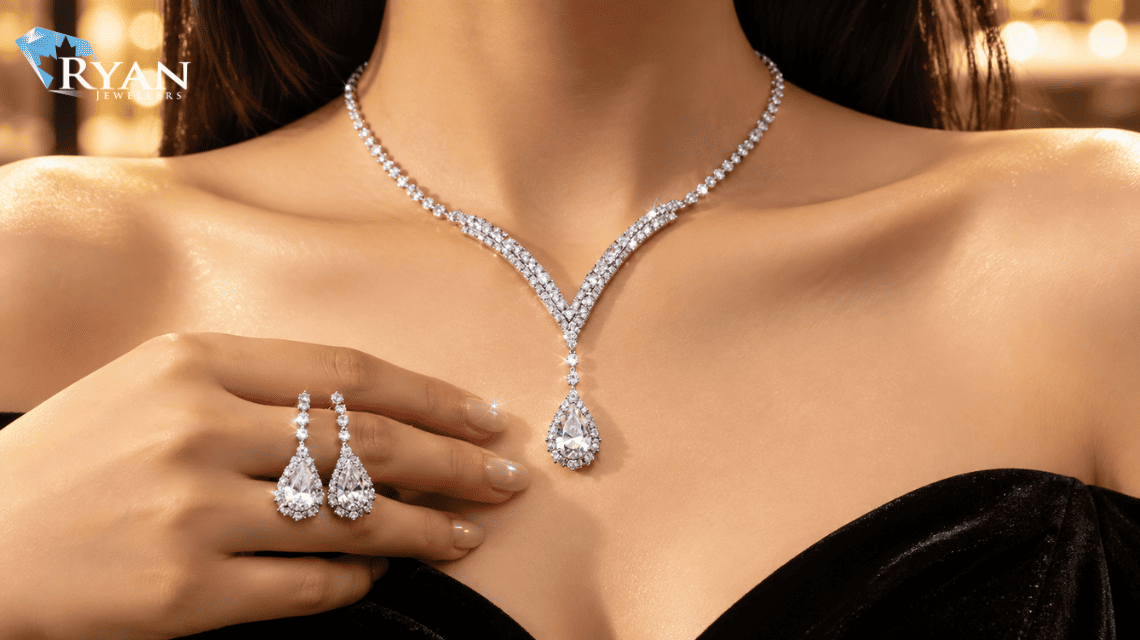
Diamond earrings are a popular choice because they can add sparkle around the face without competing heavily with the wedding dress.
Common styles include:
- Diamond studs
- Halo earrings
- Drop earrings
- Cluster earrings
- Hoop-style diamond earrings
Studs tend to provide a clean and understated appearance, while drop earrings can create more movement and visual length.
The hairstyle should also influence the choice. Updos and pulled-back hairstyles leave more of the ear visible, making longer or more detailed earrings easier to see.
Bridal Necklaces
A necklace can help balance the neckline of a wedding dress.
Common options include:
- Diamond solitaire pendants
- Delicate diamond necklaces
- Tennis-style necklaces
- Pearl necklaces
- Statement necklaces
The necklace should generally complement rather than compete with the neckline.
For example, a strapless or sweetheart neckline can leave more room for a necklace, while a high neckline may work better with earrings as the primary jewelry focus.
Wedding Bracelets
A bracelet can add detail to the wrist without changing the overall character of the bridal look.
Popular choices include:
- Diamond tennis bracelets
- Delicate chain bracelets
- Diamond bangles
- Gold bracelets
- Minimalist bracelets
When wearing a bracelet with a detailed wedding dress, a simpler design can maintain visual balance.
Wedding Bands
The wedding band is both symbolic and practical because it is normally intended for long-term wear.
Popular styles include:
- Plain metal bands
- Diamond bands
- Eternity bands
- Half-eternity bands
- Pavé bands
- Contoured bands
When choosing a wedding band, consider how it sits next to the engagement ring. The two rings should be comfortable together and compatible in terms of shape, height, and metal.
Coordinated Jewelry Sets
Some couples prefer a coordinated jewelry look, while others mix different pieces.
A coordinated set may use:
- The same metal colour
- Similar diamond shapes
- Consistent design details
- Similar levels of visual weight
However, every piece does not need to match perfectly. Mixing textures or designs can create a more personal appearance.
If you’re looking for guidance on creating a complete bridal jewelry look, explore our How to Choose Bridal Jewelry Guide for tips on selecting pieces that complement your wedding dress, style, and special day.
How to Choose Jewelry That Matches Your Wedding Dress
The dress should be one of the main references when selecting wedding jewelry.
Consider the Neckline
Different necklines create different amounts of space for jewelry.
| Dress Neckline | Jewelry Considerations |
|---|---|
| Strapless | Pendant or statement necklace can work well |
| Sweetheart | Delicate pendant or structured necklace |
| V-neck | Pendant following the neckline |
| Halter | Earrings may work better than a necklace |
| High neckline | Focus on earrings and bracelet |
| Off-the-shoulder | Necklace and drop earrings can complement the open neckline |
| One-shoulder | Minimal necklace or earrings can preserve the asymmetry |
These are styling guidelines rather than strict rules. The fabric, embellishment, hairstyle, and overall design also matter.
Match Jewelry to Dress Embellishment
A heavily embellished dress may already contain significant visual detail.
In this situation, simpler jewelry can create balance.
Conversely, a minimalist dress can provide more freedom to introduce:
- Larger diamond earrings
- A statement necklace
- A detailed bracelet
- More noticeable gemstones
The objective is to create visual harmony rather than simply adding as much jewelry as possible.
Consider the Dress Colour
The colour of the dress can also influence the appearance of the metal.
White gold and platinum can create a crisp, cool appearance, while yellow gold creates warmer contrast.
Rose gold can introduce a softer pink-toned element.
There is no requirement to match the dress colour perfectly. The decision should also reflect the wearer’s existing jewelry and personal preferences.
Coordinate With the Engagement Ring
The engagement ring is often the most important jewelry piece to consider when building the rest of the wedding look.
If the engagement ring features a prominent centre diamond, smaller earrings and a delicate necklace can allow the ring to remain a focal point.
Alternatively, simpler engagement-ring designs can be paired with more noticeable earrings or other pieces.
Think About the Hairstyle
Hairstyle changes how visible earrings and necklaces will be.
An updo can make earrings more prominent, while loose hair can partially conceal smaller designs.
Consider your planned hairstyle before choosing the final earring size.
Diamond, Gold, and Platinum Wedding Jewelry Options
Materials influence the appearance, durability, maintenance, and cost of wedding jewelry.
Natural Diamonds
Natural diamonds form through geological processes and are recovered from the Earth.
When selecting a natural diamond, buyers should understand the 4Cs:
- Cut
- Colour
- Clarity
- Carat weight
The Gemological Institute of America describes the 4Cs as the standard framework for evaluating diamond quality. Cut, for example, affects a diamond’s interaction with light and therefore contributes to brilliance and visual performance.
Lab-Grown Diamonds
Lab-grown diamonds are produced using technological processes rather than geological formation.
GIA notes that laboratory-grown diamonds have essentially the same visual and physical characteristics as natural diamonds, while specialized testing can distinguish their origin.
For wedding jewelry, lab-grown diamonds can provide another option for buyers who want to compare different combinations of:
- Diamond size
- Cut
- Colour
- Clarity
- Setting
- Overall budget
The origin should be clearly disclosed when purchasing.
Gold
Gold remains one of the most common precious metals used in wedding jewelry.
Common karat levels include:
- 10K
- 14K
- 18K
- 22K
The karat indicates the proportion of gold in the alloy.
Canadian regulations recognize specific gold quality designations. For example, the Competition Bureau identifies .416 for 10K, .583 for 14K, .750 for 18K, and .916 for 22K.
When a precious-metal quality mark is used in Canada, it must accurately represent the quality of the metal and comply with applicable requirements.
White Gold
White gold provides a neutral-toned appearance that works particularly well with diamonds.
Depending on the construction and finish, white-gold jewelry may require maintenance over time. Ask the jeweller about the specific care requirements for the piece you are considering.
Rose Gold
Rose gold has a warmer pinkish tone created by the alloying metals used with gold.
It can work particularly well for couples who want a softer alternative to traditional yellow or white metals.
Platinum
Platinum is a naturally white precious metal and is used in fine jewelry because of its density and durability.
Under Canadian precious-metal marking requirements, a platinum item carrying a platinum quality mark must meet the applicable purity requirements; the Competition Bureau identifies at least 95% platinum for such a mark.
How Should You Choose?
There is no universally correct wedding jewelry metal.
Consider:
- Personal style
- Existing jewelry
- Dress colour
- Desired maintenance
- Durability
- Budget
- Engagement-ring compatibility
Choosing the same metal across the engagement ring, wedding band, earrings, and necklace can create a cohesive appearance, but mixed-metal styling can also be intentional and elegant.
For brides who prefer a refined and understated look, explore our Wedding Minimalist Jewelry Collection for elegant designs that complement modern wedding styles while maintaining timeless simplicity.
How Much Does Wedding Jewelry Cost in Canada?
There is no single standard price for wedding jewelry in Canada. The final cost depends on the specific materials, gemstones, design, craftsmanship, and retailer.
What Determines the Price?
For diamond jewelry, major factors can include:
- Diamond carat weight
- Cut
- Colour
- Clarity
- Diamond origin
- Diamond shape
- Number of diamonds
- Metal type
- Metal weight
- Setting design
- Craftsmanship
Two pieces that appear similar can therefore have significantly different prices.
Diamond Quality and Cost
Carat weight measures diamond weight rather than directly measuring visible size.
A larger carat weight can increase the price, but the other characteristics also influence the overall cost.
For example, two one-carat diamonds may have different prices because their cut, colour, clarity, shape, and other characteristics differ.
GIA explains that diamond grading evaluates these characteristics systematically through the 4Cs.
Natural vs Lab-Grown Pricing
Natural and lab-grown diamonds have different origins and supply structures. Consequently, their market pricing should not be assumed to be identical.
When comparing the two, consider the complete product rather than only the price per carat.
Compare:
- Diamond specifications
- Measurements
- Grading documentation
- Setting
- Metal
- Design
- Total jewelry price
Wedding Jewelry Budget Categories
Instead of applying a fixed percentage of the wedding budget to jewelry, couples can prioritize pieces based on their actual needs.
For example:
Primary pieces:
Engagement ring and wedding bands.
Secondary pieces:
Earrings, necklace, and bracelet.
Optional pieces:
Additional rings, fashion jewelry, or heirloom pieces.
This approach allows couples to decide where they want to allocate more of their budget.
Remember Canadian Sales Taxes
The final amount paid for jewelry can depend on the province or territory and the applicable tax rules.
The Canada Revenue Agency currently lists different GST/HST rates across Canada. For example, Ontario has a 13% HST rate, British Columbia has 5% GST plus 7% PST, and Alberta has 5% GST with no provincial sales tax.
Therefore, when comparing jewelry prices, consider the final amount including applicable taxes, rather than comparing advertised prices alone.
For couples preparing for their special day, explore our Wedding Jewelry Collection to discover elegant pieces designed to complement your wedding style, from timeless diamond designs to modern bridal jewelry options.
Where to Buy Wedding Jewelry in Canada
Choosing the right retailer is an important part of purchasing wedding jewelry.
Look for Transparent Product Information
A reputable retailer should provide clear information about the jewelry.
Depending on the product, this can include:
- Metal type
- Metal purity
- Diamond origin
- Carat weight
- Colour
- Clarity
- Cut
- Measurements
- Product dimensions
- Grading documentation
Clear information makes it easier to compare different pieces.
Ask About Diamond Documentation
For a significant diamond purchase, ask whether the stone has an independent grading report.
GIA grading reports provide information about diamond characteristics and can be checked using the report number through GIA’s verification system.
However, remember that a grading report is not the same as an appraisal. A grading report describes characteristics, while an appraisal addresses value for a particular purpose.
Check Metal Quality Information
Canadian shoppers can also review precious-metal quality information.
The Competition Bureau states that applying a quality mark to a precious-metal article is not mandatory in every situation. However, if a quality mark is used, it must be truthful and meet the applicable legal requirements.
Review Return and Resizing Policies
Wedding jewelry is often purchased months before the wedding, so policies matter.
Before buying, check:
- Return period
- Exchange conditions
- Ring resizing
- Warranty
- Repairs
- Cleaning services
- Delivery timeline
- Custom-order conditions
This is particularly important for engagement rings and wedding bands because sizing requirements can change or need adjustment.
Consider After-Sale Service
Fine jewelry may require maintenance over its lifetime.
Depending on the retailer, after-sale services can include:
- Cleaning
- Inspection
- Resizing
- Repairs
- Stone-setting checks
- Warranty support
A retailer that clearly explains these services can make long-term jewelry ownership easier.
Shop With a Clear Comparison Process
Before purchasing, create a simple comparison:
| Factor | Option A | Option B |
|---|---|---|
| Diamond origin | Natural/Lab-grown | Natural/Lab-grown |
| Carat weight | — | — |
| Cut | — | — |
| Colour | — | — |
| Clarity | — | — |
| Shape | — | — |
| Metal | — | — |
| Ring size | — | — |
| Grading report | — | — |
| Warranty | — | — |
| Final price | — | — |
This makes it easier to distinguish actual differences between products.
If you’re considering a classic and elegant option for your wedding day, explore our Gold Wedding Jewelry Collection for timeless designs crafted to complement bridal styles and meaningful celebrations.
How to Build a Balanced Wedding Jewelry Look
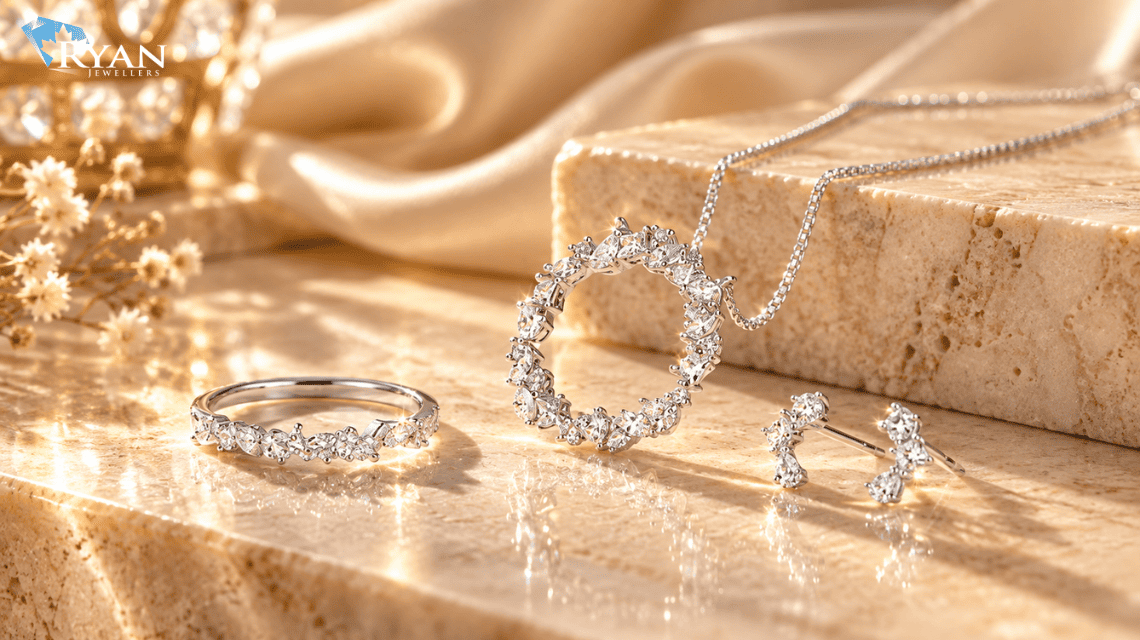
A coordinated bridal jewelry look does not require every piece to be identical.
Choose a Focal Point
Decide which piece should attract the most attention.
For many brides, this might be:
- Engagement ring
- Earrings
- Necklace
- Wedding dress
Once the focal point is established, the remaining jewelry can support rather than compete with it.
Balance Visual Weight
If your earrings are large and detailed, a delicate necklace may create better balance than another statement piece.
Similarly, a substantial necklace can work with simpler earrings.
This approach prevents the overall look from becoming visually crowded.
Consider the Wedding Setting
The wedding venue and overall aesthetic can also influence jewelry choices.
A formal ballroom wedding may lend itself to diamond drops and more elaborate pieces, while a minimalist ceremony may suit delicate jewelry.
Outdoor weddings can also influence practical considerations such as secure earring backs and comfortable pieces that can be worn for several hours.
If you’re looking to create a coordinated bridal look, explore our Wedding Jewelry Sets Collection for elegant matching pieces designed to complement your wedding style and special occasion.
FAQ About Wedding Jewelry in Canada
What jewelry should a bride wear on her wedding day?
There is no fixed combination. Common choices include earrings, a necklace, bracelet, engagement ring, and wedding band. The final selection should complement the dress, hairstyle, personal style, and desired level of detail.
Should wedding jewelry match the engagement ring?
It does not have to match exactly. Using the same metal or similar design elements can create a coordinated appearance, while mixed-metal combinations can create intentional contrast.
What metal is best for wedding jewelry?
The choice depends on personal preferences, durability requirements, design, maintenance, and budget. Gold and platinum are both widely used precious metals with different characteristics.
Is platinum better than gold for wedding jewelry?
There is no universally better option. Platinum and gold differ in density, composition, colour, maintenance, and price. The appropriate choice depends on the individual piece and the wearer’s priorities.
Are lab-grown diamonds suitable for wedding jewelry?
Lab-grown diamonds can be used in engagement rings, wedding bands, earrings, necklaces, and other jewelry. They have essentially the same visual and physical characteristics as natural diamonds, while their laboratory-grown origin can be identified through specialized testing.
What should I look for when buying diamond wedding jewelry?
Consider the diamond’s origin, 4Cs, shape, measurements, grading documentation, setting, metal, craftsmanship, and total price.
How much should I spend on wedding jewelry in Canada?
There is no universal budget. Start with your overall wedding finances and determine which jewelry pieces are most important to you. Then compare materials, diamond characteristics, designs, and retailer policies within that budget.
Are wedding jewelry prices affected by Canadian taxes?
Yes. Applicable sales taxes depend on the transaction and the relevant province or territory. CRA’s current GST/HST information shows different rates across Canada.
How can I verify the quality of a diamond?
Review the diamond’s grading documentation when available and verify the report through the issuing laboratory’s official system. GIA, for example, provides report verification using its report number. GIA 4Cs
Should my necklace match my wedding dress neckline?
The necklace can be selected to complement the neckline rather than match it exactly. Open necklines generally provide more space for necklaces, while high or heavily embellished necklines may work better with earrings as the main jewelry feature.
How do I choose wedding earrings?
Consider the dress neckline, hairstyle, face proportions, desired level of sparkle, and comfort. Studs provide understated elegance, while drop earrings create more movement and visual impact.
Can I wear different metals for my wedding jewelry?
Yes. Mixed-metal jewelry can create contrast and allow you to incorporate existing pieces. If you prefer a more traditional coordinated appearance, using the same metal across the main pieces can create greater visual consistency.
Final Thoughts
Choosing wedding jewelry in Canada is ultimately about finding the right balance between style, quality, comfort, materials, and budget. Rather than following a fixed formula, consider how each piece works with the wedding dress, engagement ring, hairstyle, and overall aesthetic.
For diamond jewelry, understanding the 4Cs and the distinction between natural and lab-grown diamonds can make comparisons easier. For precious metals, Canadian regulations provide requirements for truthful quality marking when such marks are used.
It is also important to look beyond the initial price. Sizing, craftsmanship, warranty, resizing, maintenance, documentation, and after-sale service can all contribute to the overall buying experience.
If you’re ready to explore wedding jewelry for your celebration, visit Ryan Jeweller to discover diamond jewelry, wedding bands, earrings, necklaces, and other fine jewelry options for your special day.
This is a helpful guide for anyone planning their wedding jewellery in Canada. I particularly liked the advice to consider the wedding dress, personal style, metal choice, and overall budget together when selecting pieces.
I found the suggestions on coordinating different pieces of wedding jewellery particularly useful. Thinking about how the engagement ring, wedding bands, earrings, and necklace work together can make the overall look feel much more cohesive.
The Canada-focused information makes this a useful reference when shopping for wedding jewellery locally. I appreciate the practical approach to balancing design preferences, quality, and budget when choosing pieces for such an important occasion.
На этом сайте есть шанс обнаружить полезную информацию.
https://ivecodom.ru/home/istoriya-sozdaniya-onlayn-kazino-sweet-ot-idei-do-globalnogo-brenda-163/